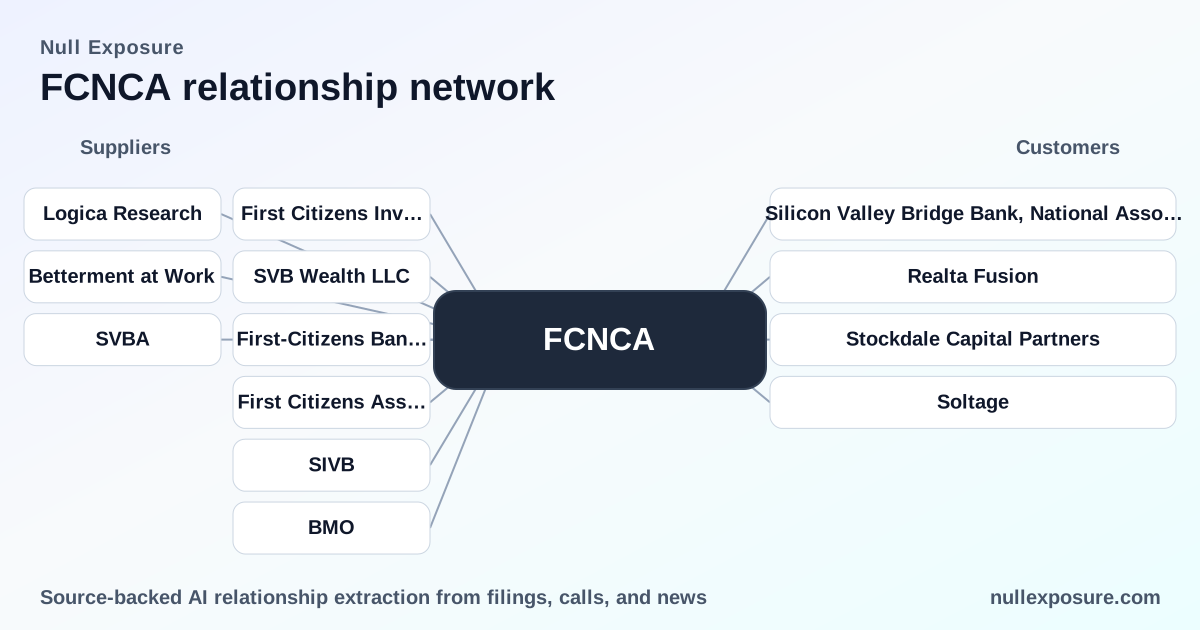
First Citizens BancShares (FCNCA): customer relationships that fund growth and widen franchise reach
First Citizens BancShares operates a diversified regional bank that monetizes through deposit-funded lending, leasing and fee businesses; the company funds roughly 81% of its balance sheet with deposits, prices credit and capital markets products to middle-market and retail clients, and captures margins across commercial banking, specialty finance and wealth management. For investors, the important signal is that First Citizens acts both as a core deposit gatherer and an active lender/agent across industry verticals, enabling steady net interest income and recurring fee streams. Learn more about coverage and relationship analytics at https://nullexposure.com/.
Why these customer ties matter to the bank's economics
First Citizens’ operating model is built around deposit-driven funding, diversified commercial lending, and long-duration leasing exposures. The company’s financials show a profitable franchise (profit margin ~24.7%, ROE ~10.2%), and its contracting posture includes long-term leasing and multi-year credit facilities that produce durable cash flows. The bank serves a mixed counterparty base — individuals, small businesses and middle-market companies — concentrated in North America through a 500+ branch footprint, which underpins deposit stability but also concentrates credit exposure regionally. The firm acts both as a lender/agent (service provider) and as a seller of derivative products to customers, which diversifies fee income but also creates counterparty operational obligations.
Second CTA (mid-article): for a consolidated view of First Citizens’ customer relationships and detailed sourcing, visit https://nullexposure.com/.
What the customer list shows — deal-by-deal takeaways
Silicon Valley Bridge Bank, N.A. (SVB) — deposit and asset assumption that reweighted deposits into First Citizens
First Citizens assumed all deposits and many loans of Silicon Valley Bridge Bank under the FDIC purchase and assumption, which materially expanded First Citizens’ commercial deposit footprint in innovation banking; deposit balances in the SVB Commercial segment included significant large accounts (>$50 million) totaling roughly $5.01 billion as of December 31, 2024. Source: ProShare article on the SVB deposit assumption (FY2023) and company disclosures on SVB Commercial balances (Dec 31, 2024).
FSLY (Fastly) — amendment agent on secured facilities
First Citizens acted as creditor/agent in amendments to Fastly’s senior secured credit facilities, illustrating the bank’s role as a middle-market credit provider and administrative lender for technology companies. Source: Quartz coverage noting Fastly’s 10-Q and amendments with First-Citizens (FY2024).
Realta Fusion — growth capital facility through the SVB division
A division of First Citizens (Silicon Valley Bank) provided a $9.5 million growth capital facility to fusion energy startup Realta Fusion, demonstrating First Citizens’ continuation of venture-stage and growth lending through its SVB channel. Source: Quantisnow reporting on the Realta facility (FY2025–FY2026).
FitLife Brands / FTLF — financing for an acquisition using committed term loan and an upsized revolver
First Citizens provided a committed term loan and an upsized $10 million revolving credit facility to support FitLife Brands’ acquisition of Irwin Naturals assets, showing the bank’s participation in sponsor-backed M&A financing. Source: QuiverQuant transaction notice (FY2025).
Stockdale Capital Partners — first-mortgage debt for healthcare campus acquisition
First Citizens’ Healthcare Finance group supplied $38 million of first-mortgage debt to Stockdale Capital Partners to finance acquisition of a large outpatient medical campus, underscoring targeted sector lending in healthcare real estate. Source: Sahm Capital press release (FY2025).
Quipt Home Medical (QIPT) — administrative agent on guaranty and amendment to credit
First Citizens served as administrative agent on an amendment that added incremental revolving capacity and included guaranty support from a going-private parent, indicating the bank’s role in sponsor financings and syndicated administrative functions. Source: TradingView summary of the QIPT amendment (Mar 13, 2026 / FY2026).
Soltage — syndicated development revolver for solar + storage projects
First Citizens continued a relationship providing development financing for Soltage, participating in an $80 million syndicated development revolver designed to accelerate solar-storage deployment — signifying energy-sector lending and project finance capabilities. Source: Sahm Capital and Quantisnow coverage of the Soltage revolver (FY2025).
Globus Maritime (GLBS) — amendment to CIT loan facility for tranche alignment
Globus Maritime amended its CIT loan facility with First Citizens to extend termination dates on specific tranches, a routine but material exercise that highlights the bank’s maritime and asset-backed lending footprint. Source: Manila Times summary of Globus Maritime’s Q3/9-month filing (FY2025).
ALKT (Alkami Technology) — administrative agent role on credit agreement amendment
Silicon Valley Bank, a division of First Citizens, acted as Administrative Agent on a second amendment to Alkami Technology’s Amended and Restated Credit Agreement, reinforcing the bank’s role in technology sector syndicated credit administration. Source: StockTitan summary of Alkami’s 10-K/credit amendment (FY2026).
Company-level signals from constraints: what operators and investors should derive
- Contracting posture is oriented to longer-term exposures: the bank’s rail and equipment leasing language and full-service leases indicate long-lived contract structures that generate recurring cash flows rather than one-off lending spreads.
- Counterparty mix skews retail through mid-market but includes large-ticket relationships: filings cite individuals, small businesses and middle-market companies as core clients, while the SVB Commercial segment contained substantial large deposits (>$50m buckets).
- Geographic concentration is North America-first: branch and leasing footprints are heavily U.S.-centric, delivering strong local deposit capture but regional macro sensitivity.
- Materiality of deposits to funding is critical: deposits funded ~81% of total funding as of Dec 31, 2024 — a structural funding advantage that also creates sensitivity to deposit flows and large-account behavior.
- Relationship roles are dual: seller and service provider: First Citizens both sells derivative contracts to hedge customers and acts as a service provider/agent on syndicated facilities, expanding fee pools but increasing operational complexity.
- Stage and maturity are active: the bank continues to execute active originations, amendments and agency roles across industries, signaling an active commercial origination engine rather than a run-off model.
Investment implications — a concise read for allocators and operators
First Citizens combines stable deposit economics with targeted middle-market lending and specialist finance capabilities (energy, healthcare, maritime, tech). The franchise benefits from high deposit funding, diversified fee activities, and long-duration leasing cash flows, but investors must monitor large-depositor concentration within the SVB channel and execution risk in sector-specific project financings. For operators, the bank’s dual role as lender and administrative agent requires robust syndication and servicing infrastructure to manage cross-sector exposures.
Key takeaways:
- Deposit-driven model underpins margin stability but creates concentration risk (SVB large accounts).
- Active lending and agency roles extend revenue sources beyond NII into fees and credit syndication.
- Long-term leasing and project finance provide durable cashflows but require ongoing asset and credit management.
For a deeper relationship map and source-level detail, visit https://nullexposure.com/.