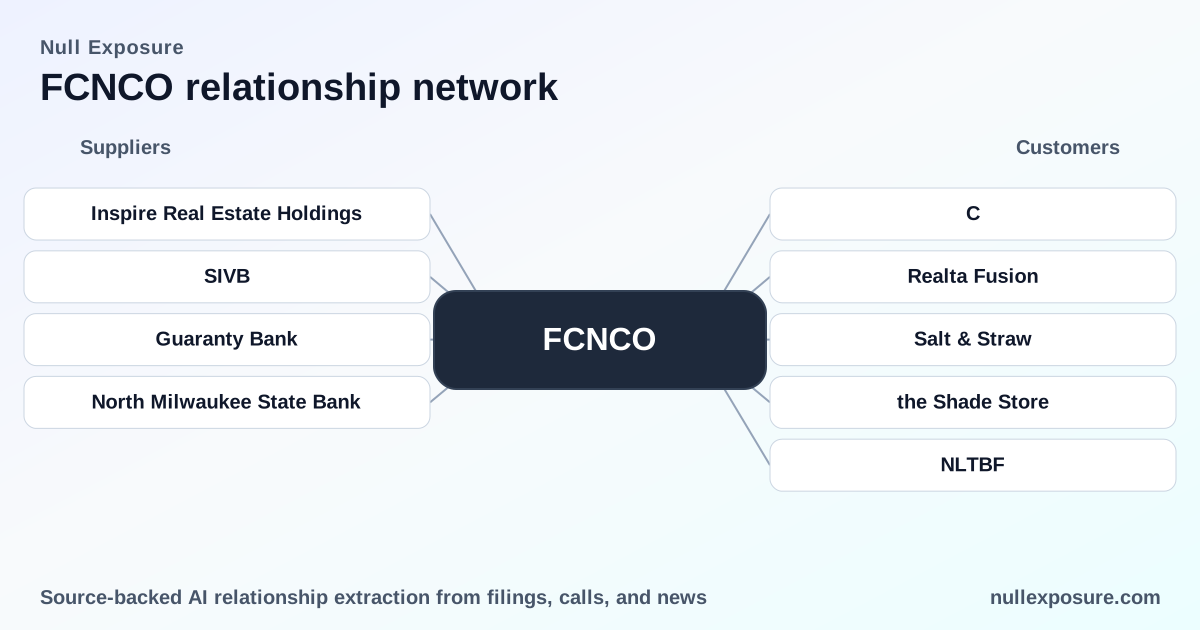
FCNCO — First Citizens BancShares: customer relationships that shape credit and fee revenue
First Citizens BancShares operates as a diversified regional bank and financial services platform, monetizing through interest income (commercial and consumer lending), fee-based services (wealth management, deposits, capital markets) and equipment/rail leasing. The observed customer relationships range from retail tenants and specialty retailers to middle-market borrowers, reinforcing a business model that combines broad consumer distribution with targeted commercial lending and leasing. For deeper coverage of relationship mapping and risk signals, visit https://nullexposure.com/.
Quick investor thesis: diversified franchise with real estate and lending touchpoints
First Citizens generates predictable deposit and fee cashflows from a large branch footprint and digital channels while pursuing higher-yield opportunities through commercial lending and specialized leasing (including rail and equipment). Key monetization drivers are net interest margin on loans, recurring fees from deposit/wealth products, and contract-based leasing revenues—all supported by a broad geographic footprint across North America. Given long-term lease liabilities on the balance sheet and an active commercial underwriting posture, credit and real estate exposures are first-order drivers of valuation and tail risk.
Counterparty roll call — who shows up with First Citizens
Below are every counterparty observed in the relationship results and what each relationship indicates in plain English.
- Citibank — The Real Deal reported that First Citizens bought 250 University Avenue in Palo Alto, whose ground-floor retail roster includes a Citibank branch, indicating a real estate ownership role with established bank tenancy in a high-demand market. Source: The Real Deal (Aug 13, 2025) reporting on the 250 University Avenue purchase.
- Realta Fusion — A Finviz news item noted that Realta Fusion secured a $9.5 million growth capital facility from Silicon Valley Bank, a division of First Citizens Bank, demonstrating First Citizens’ role as direct lender to growth-stage companies through its SVB platform. Source: Finviz news summary (FY2026).
- Salt & Straw — The Real Deal article lists Salt & Straw as a ground-floor tenant at the Palo Alto property acquired by First Citizens, representing retail tenancy that contributes to property-level cashflows where First Citizens is the landlord. Source: The Real Deal (Aug 13, 2025).
- The Shade Store — Also named as a ground-floor tenant in the same Palo Alto acquisition article, The Shade Store is a retail lessee anchoring street-level revenue for the property owned by First Citizens. Source: The Real Deal (Aug 13, 2025).
- NLTBF — The Real Deal coverage includes NLTBF among ground-floor tenants at 250 University Avenue, documenting a retail occupancy relationship tied to First Citizens’ real estate investment. Source: The Real Deal (Aug 13, 2025).
- Nola — Listed alongside other retailers as a ground-floor tenant at the Palo Alto purchase, Nola represents local retail exposure within a property that First Citizens acquired for investment and branch-network strategy. Source: The Real Deal (Aug 13, 2025).
Each of these relationships has been observed in public reporting and indicates either a lending/finance relationship (Realta Fusion via SVB) or a landlord-tenant relationship tied to First Citizens’ direct real estate ownership (multiple retail tenants and Citibank branch).
What these relationships reveal about operating model and contract posture
The relationship set and supporting disclosures point to several company-level operating characteristics:
- Contract maturity skewed toward long-dated obligations. First Citizens’ disclosures note real estate leases with remaining terms up to 33 years and renewal options up to 25 years, implying long-term cashflow commitments and sensitivity to property-level vacancy and rent trends. This is a company-level signal tied to the bank’s property ownership and branch strategy.
- Counterparty breadth across the spectrum. Public excerpts show engagement with individuals (retail customers), small and mid-market businesses (commercial lending and factoring), and large enterprises (rail customers and institutional counterparties). The client base is intentionally broad, which supports diversification of deposit and fee income but requires differentiated underwriting frameworks.
- Service-provider and seller roles embedded in operations. First Citizens acts as lender, lessor, lease guarantor and counterparty seller of derivatives for client hedging—an operational posture that combines credit intermediation with contract-based service delivery.
- North American commercial footprint. Multiple statements reference over 500 branches concentrated across the U.S., and the rail and leasing segments operate throughout North America. Geographic concentration is continental rather than global, focusing operational risk on U.S./Canadian markets.
- Sector exposure includes infrastructure and manufacturing. The bank’s rail leasing and equipment financing expose it to infrastructure cashflows, while factoring and receivables purchase activities connect it to manufacturing and consumer goods sectors.
Concentration, criticality and maturity — implications for investors
These signals translate into concrete portfolio considerations:
- Concentration risk is moderate but multi-dimensional. Branch-based deposit funding reduces wholesale volatility, but long-term lease liabilities and concentrated real-estate investments (e.g., the Palo Alto property) create localized real-estate exposure that can be material to property cashflows if vacancy rises.
- Counterparty criticality varies by segment. Retail tenants and branch locations are low individual criticality but high collective importance for deposit flows; mid-market and specialized borrowers (rail, equipment) are individually more material to credit loss and asset-liability management.
- Contract maturity implies slower cyclical adjustment. Long lease durations and multi-year lending facilities make rapid de-risking difficult without transactional sale or write-down, increasing sensitivity to prolonged economic stress in core geographies.
Risks to monitor and what drives upside
- Credit performance across commercial portfolios (middle-market, rail and equipment leases) is the primary near-term risk vector. Watch loss rates and charge-offs reported in quarterly filings.
- Real-estate valuation and vacancy around investment-grade locations (e.g., Palo Alto) will influence property-level returns and the bank’s lease-liability dynamics.
- Deposit stability and NIM compression remain ongoing drivers of earnings volatility; centralized branch strength is a structural advantage if deposit retention holds.
Bottom line and next steps
First Citizens combines a broad retail distribution platform with targeted commercial lending and leasing businesses; the observed customer relationships underscore a hybrid model where property ownership and lending both contribute to revenue and risk. For investors and operators evaluating counterparty exposure, the mix of long-term leases, multi-segment lending and North American geographic focus creates both diversification and concentrated idiosyncratic risks that warrant active monitoring.
If you want the full relationship map and constraint analysis for FCNCO and peer instruments, explore the platform at https://nullexposure.com/ for detailed signals and curated citations.