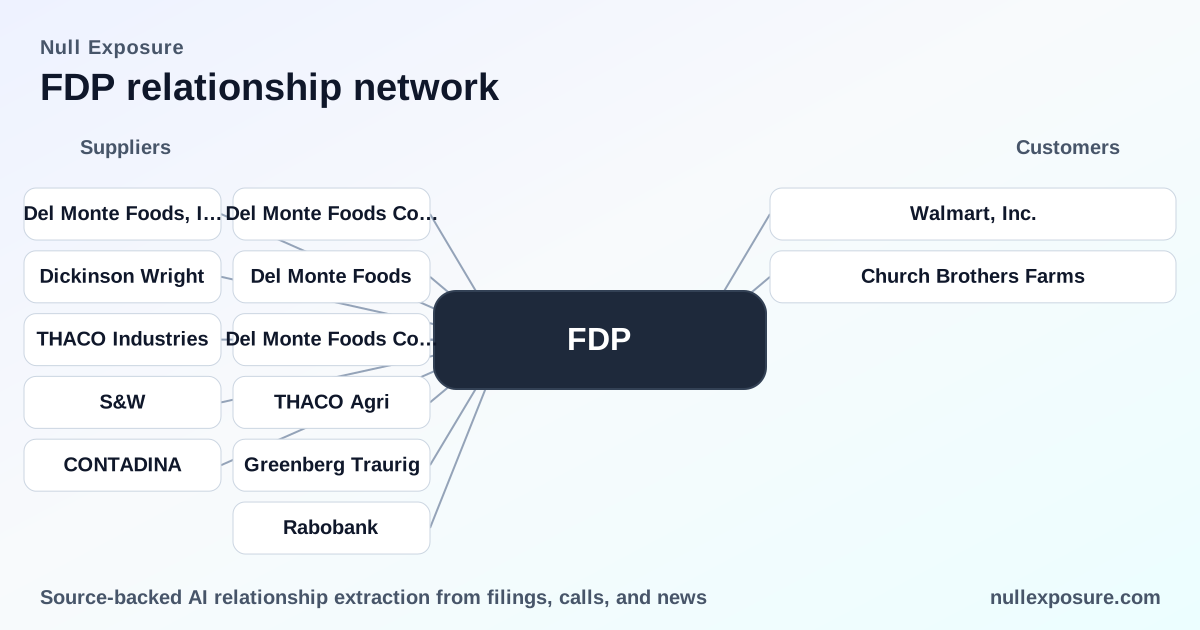
Fresh Del Monte Produce (FDP): customer relationships that drive revenue and risk
Fresh Del Monte Produce runs a vertically integrated fresh-produce business that produces, markets and distributes fresh and value-added fruits and vegetables worldwide and monetizes primarily through wholesale and retail net sales to large retailers, club and convenience chains, distributors and foodservice operators. The company’s global scale—reflected in roughly $4.3 billion in trailing revenue—and its mix of fresh, value‑added and banana segments create stable volume-driven cash flows, while concentration in large customers and North America introduces measurable counterparty and pricing exposure for investors and operators. For a concise upstream view of company signals and relationship detail, see Null Exposure’s coverage at https://nullexposure.com/.
What the customer mix tells investors: concentration, geography and contracting posture
Fresh Del Monte is a seller-first company: it operates as a vertically integrated supplier that contracts with downstream retail and foodservice customers for volume supply and branded/value‑added products. Several company-level constraints are notable and directly inform underwriting and operational strategy:
- Customer concentration is material. The top 10 customers represented approximately 32% of net sales in 2024, implying meaningful revenue dependence on a relatively small set of buyers and placing pricing leverage and promotion risk squarely on counterparty relationships.
- Large-enterprise counterparties dominate the go-to market. The company explicitly targets large retail, club and foodservice customers as preferred suppliers, supporting a contracting posture focused on long-term supply agreements and volume commitments rather than spot sales.
- North America is the core market. North America accounted for roughly 59% of net sales in 2024, with meaningful operations and distribution focus there; FDP also maintains revenues across EMEA and APAC, supporting global diversification but with regional concentration toward NA.
- Top-customer spend profile suggests large account economics. Given total net sales and top-10 concentration, several customers comfortably sit in a >$100 million annual spend band, increasing the bilateral criticality of these relationships.
- Maturity and role mix. FDP is principally a seller of core products (fresh and value‑added produce) with long-established routes-to-market; it also buys and sells assets and business lines when strategically appropriate.
These company-level signals drive how investors should think about counterparty credit, promotional support obligations, and the operational flexibility required to reallocate volumes if a major buyer changes buying patterns.
Relationship-by-relationship review: the customers and counterparties you need to know
Walmart, Inc.
Walmart accounted for approximately 9% of FDP’s total net sales in 2024, making it a clearly material retail counterparty in terms of revenue concentration and negotiating importance. According to Fresh Del Monte’s FY2024 10‑K, this level of exposure highlights Walmart as a strategically important large-enterprise customer for FDP.
Church Brothers Farms
Church Brothers Farms is the buyer of specific machinery, equipment and the customer list tied to a divested business, in a transaction valued at $19 million plus inventory at closing, reflecting FDP’s selective asset divestiture and commercial repositioning. This detail emerged during FDP’s Q3 2025 earnings call where management disclosed the terms of the sale.
Church Brothers, LLC
Church Brothers, LLC entered into an agreement for the sale and transfer of Mann Packing assets from Fresh Del Monte, a transaction reported in market commentary in May 2026; the transfer signals FDP’s strategic reshaping of its vegetable division and the monetization of certain value‑added assets. A Simply Wall St note covering FDP’s corporate actions documented the transaction in May 2026.
Newman’s Own
Fresh Del Monte’s Mann Packing launched its first‑ever Newman’s Own salad kits, a branded product collaboration that ties FDP’s vegetable business to a philanthropic consumer brand and expands its co‑branding product set. This product launch was covered in the market press in May 2026 and reflects FDP’s use of licensed or co‑branded offerings to capture incremental shelf space and margin in value‑added categories.
Why these relationships matter operationally and financially
These four relationships together illustrate two parallel dynamics in FDP’s commercial model:
- Large retailers drive volume and pricing. Walmart’s ~9% share of net sales is a direct signal that retail giants shape FDP’s revenue volatility, promotional cadence and logistics scale. Large-retailer exposure increases negotiating leverage for counterparties and requires FDP to maintain disciplined supply chain and category management.
- Selective divestitures and partnerships shift the value mix. Sales of Mann Packing assets and related equipment and customer lists to Church Brothers entities show FDP is actively reshaping its value‑added footprint; at the same time, co‑branding with Newman’s Own shows the company is pursuing margin-enhancing product partnerships rather than a pure commodity play.
Taken together, these dynamics create a balanced but concentrated commercial profile: stable base volumes from big-box accounts, active portfolio management via asset sales, and upside in branded/value‑added products.
For investors tracking counterparty exposure or operators planning contingency, Null Exposure maintains a focused lens on how those large-enterprise relationships and divestiture flows change FDP’s revenue mix; see more at https://nullexposure.com/.
Practical implications and risk checklist for investors and operators
- Revenue concentration risk: With the top 10 customers at roughly 32% of sales, investor downside is asymmetric if multiple large buyers reduce purchases simultaneously; modeling scenarios should stress NA volumes and key retailer churn.
- Contracting posture: FDP’s emphasis on being a preferred supplier to large retailers implies long-term contractual commitments, promotional allowances and logistical obligations; operational resilience in cold‑chain and distribution matters more than in single-store foodservice.
- Reallocation capacity: Asset sales such as the Mann Packing divestiture reduce FDP’s exposure to certain value‑added product lines even as co‑branding deals (Newman’s Own) seek to preserve margin; assess how quickly volumes can be rechanneled across customers.
- Geographic concentration: North America’s ~59% share means macro or retail‑specific shocks in NA flow directly to FDP’s top-line volatility; EMEA and APAC diversification provides a buffer but does not eliminate NA-driven cyclicality.
- Counterparty credit and strategic leverage: Large-enterprise buyers bring both scale and negotiating leverage; monitoring payment terms, promotion funding and slotting requirements is essential for cash conversion and margin stability.
Bottom line: a concentrated, asset-savvy supplier with predictable volume risk
Fresh Del Monte is a large-scale, vertically integrated supplier whose revenue profile is driven by a handful of large, enterprise retail and foodservice customers and is actively rebalancing its value‑added portfolio through asset sales and co‑branded product launches. Walmart’s ~9% share, the Mann Packing divestiture to Church Brothers, and the Newman’s Own product collaboration are immediate signals of how FDP is managing concentration and pursuing higher-margin channels. Investors should underwrite both the operational strengths of scale and the clear counterparty concentration that makes FDP sensitive to major retail account dynamics.
For additional company-level relationship analytics and historical tracking, visit Null Exposure’s platform at https://nullexposure.com/.