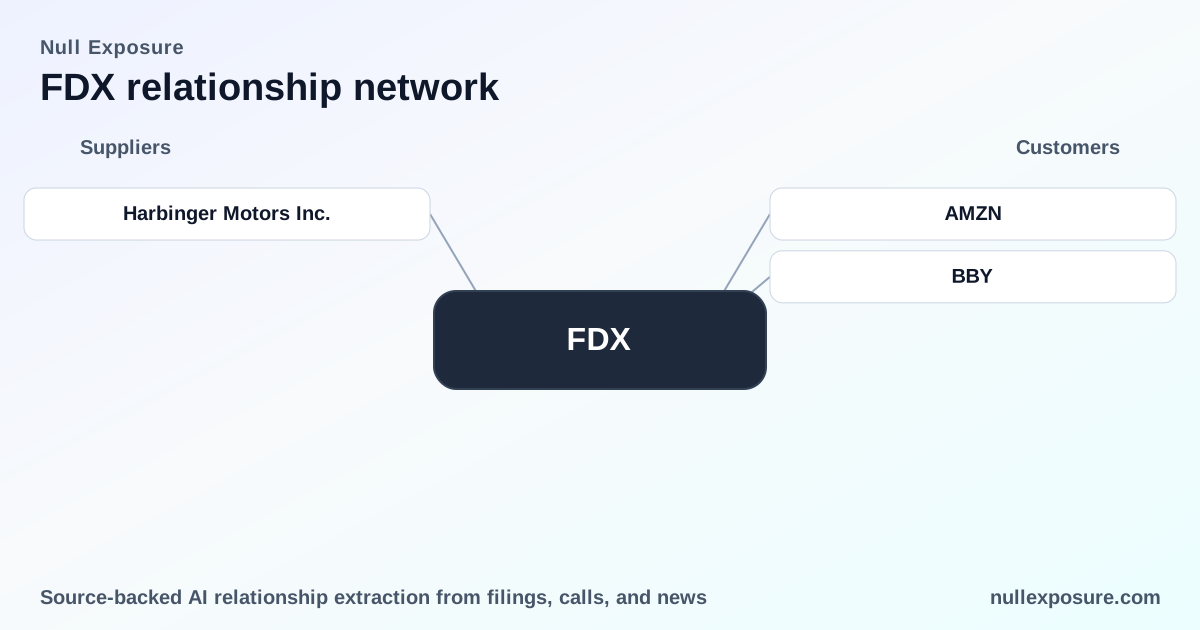
FedEx (FDX) — Customer Footprint, Commercial Signals, and What It Means for Investors
FedEx monetizes a global logistics franchise by charging time- and day-definite transportation, freight and value-added services to a broad set of business customers and consumers; its revenue mix reflects recurring service fees, fuel and surcharge components, and enterprise contracts that scale with shipping volumes. With trailing revenue near $91.9 billion and an established integrated air‑ground network, FedEx’s economics are driven by network density, contract pricing with large shippers, and the ability to manage unit cost through fleet and yield optimization. For deeper customer relationship mappings, visit NullExposure: https://nullexposure.com/.
What the public record shows — a compact customer roll call
Below I catalogue every customer relationship surfaced in public disclosures and press, with a short plain‑English takeaway and the source.
ACV-A (ACV Auctions)
ACV-A discloses that it relies on FedEx to ship and deliver vehicle titles for marketplace sales and warns that service disruption from a natural disaster could adversely affect its operations. (ACV-A FY2026 10‑K reported via StockTitan, May 2026)
Pitney Bowes (PBI)
Pitney Bowes, together with Auctane, announced programs that roll out discounted FedEx rates for their customers, indicating channel distribution agreements and price incentives for small and mid‑market shippers. (SupplyChainDive coverage of company announcements, reported Oct; article referenced May 2026)
Sally Beauty (SBH)
Sally Beauty is using FedEx for fulfillment of its TikTok Shop orders, with most orders shipping same‑day or next business day via standard FedEx delivery — a direct example of FedEx’s role in retail social‑commerce fulfillment. (StreetInsider / Barchart reporting on Sally Beauty launch, May 3, 2026)
Armlogi Holding (BTOC)
Armlogi (BTOC) cites increased costs from major carriers including FedEx as a material expense driver and reports efforts to diversify carrier relationships to manage freight inflation. (BTOC FY2025 10‑K and Globenewswire press releases, FY2025 filings and Nov 2025 release)
UTZ Brands (UTZ)
UTZ reports that its direct‑to‑consumer shipments are delivered from the central warehouse to consumers using FedEx (and other carriers), showing FedEx’s role in growing DTC channels for packaged‑goods players. (UTZ FY2026 annual report coverage via StockTitan, FY2026)
BODI (BODI)
BODI states U.S. distribution and shipping to customers is performed principally through FedEx or the U.S. Postal Service, demonstrating FedEx’s penetration in health and consumer product fulfillment. (BODI SEC filing, fiscal disclosures to 2022/2023 as cited)
Amazon (AMZN)
On FedEx’s own Q1 FY2026 earnings call, management said the company prepared for the ramp of a new Amazon business, which was minimal in the quarter as expected — an explicit signal that FedEx is onboarding a material e‑commerce account. (FDX Q1 FY2026 earnings call transcript, March 7, 2026)
Best Buy (BBY)
FedEx disclosed that Best Buy named FedEx as its primary national parcel carrier in Q1, reflecting a large‑scale retail contract that increases parcel volumes and network utilization. (FDX Q1 FY2026 earnings call transcript, March 7, 2026)
AMWD (cabinet manufacturer referenced)
A localized safety incident involving a FedEx driver was reported in connection with an AMWD site, and the facility was fined after a delivery‑related fatality — a reminder of operational and reputational risks in last‑mile operations. (ABC15 investigative reporting, FY2024 coverage)
VerifyMe (VRME)
Public reporting on VerifyMe described the loss of FedEx preferred status as a strategic challenge for that company even as it regained Nasdaq compliance, indicating preferred‑customer programs exist and can be withdrawn. (The Globe and Mail coverage of VerifyMe, May 2026)
How these relationships map to FedEx’s operating model
The disclosures collectively reinforce a consistent commercial profile:
- Short‑term billing and transactional contracting posture. FedEx’s typical customer payment terms and revenue recognition practices indicate short billing cycles rather than long‑dated financing arrangements, consistent with parcel and freight economics. (Company terms and revenue recognition language reflected in corporate filings)
- Customer base spans large enterprises to small businesses. Public evidence shows FedEx serves large accounts (Amazon, Best Buy), mid‑market and small business channels (Pitney Bowes, Sally Beauty, UTZ’s DTC customers) — a diversified counterparty mix that supports scale but requires segmented service offerings.
- North American core with global reach. Several disclosures emphasize North America (LTL and parcel), while corporate materials highlight service to more than 220 countries and territories, underlining a global network overlaying a North American revenue base.
- Primary role: service provider and seller of logistics services. FedEx recognizes revenue over time as it performs transport services; it also acts as a seller of integrated logistics and e‑commerce solutions across verticals.
- Mature, critical infrastructure for customers. Retail and marketplace clients ship directly through FedEx, showing operational criticality: disruptions or price shifts propagate quickly into customer margins and pricing decisions.
These are company‑level signals drawn from corporate language and the collection of customer notices; they are not tied to any one relationship unless explicitly stated in the source.
Investment implications and key risks
- Large account dynamics matter. The onboarding and ramping of Amazon work and Best Buy’s designation of FedEx as primary parcel carrier are structurally significant for volume and yield — positive for network utilization and potentially margin accretion.
- Cost pass‑through and customer pushback. Customer filings from Armlogi and others show that carrier cost increases are a material input to customer margins, prompting customers to pursue diversification and rate negotiations; this constrains FedEx’s pricing power in competitive segments.
- Operational disruption risk is real and value‑sensitive. ACV‑A’s explicit warning about natural‑disaster‑related service disruption, along with last‑mile safety incidents, are reminders that network interruptions and safety events can have outsized downstream effects on customer revenues and reputational capital.
- Preferred‑status dynamics. VerifyMe’s experience demonstrates that FedEx’s preferred programs can be a meaningful commercial lever for customers and that losing such status can be strategically consequential.
Bottom line: FedEx operates as a mature, high‑scale logistics provider with diversified customer exposure across enterprise and SMB channels; its near‑term performance for investors will hinge on volume ramps with large accounts, ability to manage unit costs, and how effectively the company translates market‑wide freight inflation into sustainable pricing without accelerating customer churn.
For a systematic view of FedEx’s full customer map and how these relationships affect credit and revenue risk, see the NullExposure customer relationship platform: https://nullexposure.com/.
Final thought
FedEx’s customer disclosures read as an operational playbook: capture scale through large retail and e‑commerce partners, monetize density with differentiated rates and services, and defend margins through network efficiency. The company’s exposure to both enterprise ramps and cost‑sensitive small‑business channels makes its near‑term trajectory an interplay of volume growth, pricing discipline, and operational reliability — the levers that investors should watch most closely.