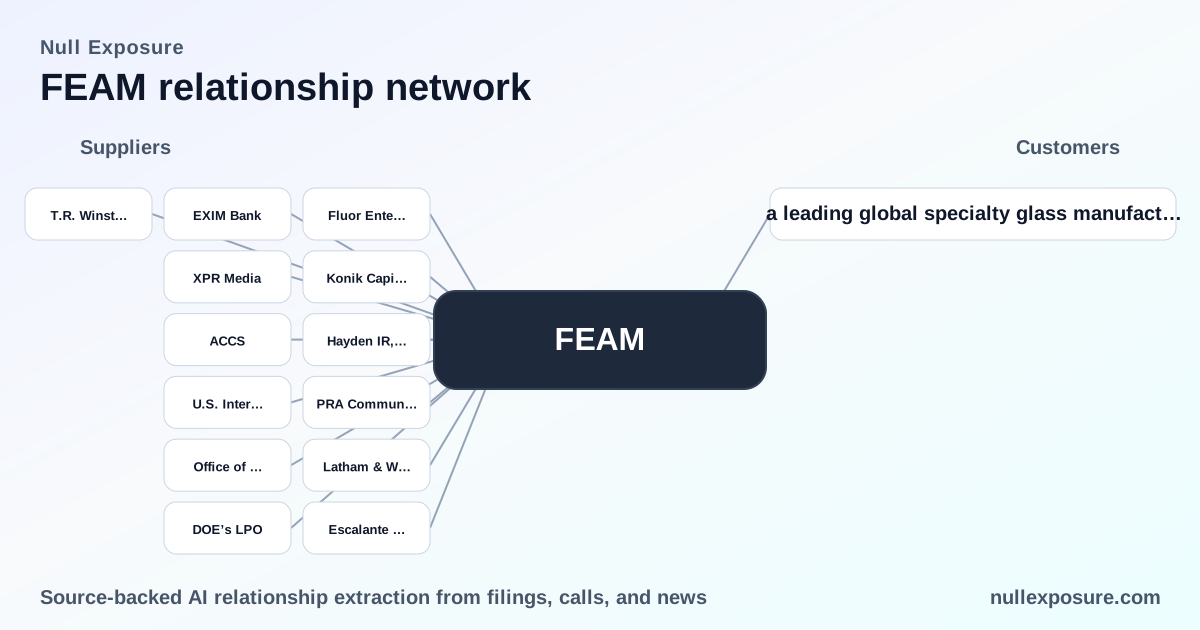
FEAM’s early commercial wins: pilot customers validate boric-acid product while binding contracts remain absent
5E Advanced Materials (FEAM) operates as a development-stage miner and processor targeting refined borates and advanced boron derivatives; it plans to monetize by selling boric acid and related products to industrial end users (glass, semiconductors, life sciences, aerospace and automotive) as it scales its commercial facility. Revenue today is nascent and largely driven by customer qualification shipments and non‑operating income, while future upside depends on successful ramp to commercial-scale production and offtake contracting.
If you want a concise view of FEAM’s customer progress and commercial constraints, see Null Exposure’s summary for investors: https://nullexposure.com/
How FEAM’s business model translates into early commercial activity
FEAM is a vertically oriented developer: it explores, extracts, and plans to refine borates into market-ready boric acid and derivative products. The firm’s near-term monetization strategy is to convert technical qualifications into binding offtake agreements and recurring truck‑load sales once its commercial-scale facility is online. Today’s revenue profile is low and episodic; income primarily derives from qualification shipments, scrap sales and limited third‑party services. According to FEAM’s FY2025 Form 10‑K, large enterprise customers have tested and qualified FEAM’s boric acid, signaling product fit but not yet establishing committed demand.
A single named customer interaction — what it tells investors
During April 2025, FEAM was notified by a leading global specialty glass manufacturer that they successfully produced specialty glass using FEAM’s boric acid. This is a concrete, product-level validation from a large industrial counterparty and it confirms that FEAM’s boric acid meets technical requirements for at least one commercial glass application. (Source: FEAM FY2025 Form 10‑K, filed June 30, 2025.)
Every reported customer relationship (one-by-one)
- a leading global specialty glass manufacturer — In April 2025 this large enterprise successfully produced specialty glass using FEAM’s boric acid, representing a completed qualification step and a demonstration that FEAM’s product functions in a demanding, high‑volume industrial application. This example comes directly from FEAM’s FY2025 10‑K disclosure describing customer qualification results.
What the company disclosures say about the broader commercial picture
FEAM’s filings and public statements make four consistent company-level points that shape investor expectations:
-
No binding supply agreements today. FEAM explicitly states it has not begun large‑scale production and therefore does not have binding supply contracts with customers. This is a structural constraint on predictable revenue until commercial production and offtake contracts are executed. (Company filing: FY2025 Form 10‑K.)
-
Large enterprises are the target counterparty class. The company reports interaction with, and qualification by, large corporate buyers — the April 2025 glass manufacturer is described as a “leading global specialty glass manufacturer.” This signals FEAM’s go‑to‑market focus is enterprise industrials with rigorous qualification processes. (FY2025 10‑K.)
-
Qualification pipeline is active but early-stage. FEAM noted in the second half of fiscal 2025 that approximately 14 customers successfully qualified its boric acid through lab evaluation, field trials and truckload‑scale shipments, while additional prospects remain in advanced testing phases. That positions the company in a pilot-to‑early commercial stage, not yet at scale. (FY2025 Form 10‑K.)
-
Global market opportunity and scale potential. FEAM frames its long‑term target as becoming one of the largest borate suppliers in U.S. and international markets following completion of its commercial facility, indicating strategic ambition beyond niche sales. This is a company-level growth thesis rather than a present revenue reality. (FY2025 10‑K.)
These points together create a clear risk/reward lens: technical validation exists; commercial scale and contractual certainty do not.
How these signals define FEAM’s operating posture and investor implications
FEAM’s disclosures imply several actionable operating and commercial characteristics:
-
Contracting posture: uncommitted and non-binding at present. The absence of binding supply agreements leaves FEAM exposed to execution risk and revenue volatility until offtake deals are signed.
-
Customer concentration and criticality: early customer validations include large enterprise buyers, which is positive for potential long-term anchor customers, but current activity is concentrated in qualification shipments rather than recurring contracts—so counterparty importance is high, but current revenue criticality is low.
-
Relationship maturity: FEAM operates across prospect → pilot → active stages simultaneously. The company reports 14 qualified customers (pilot/active signals) while continuing to qualify additional prospects.
-
Commercial role: FEAM is positioned as a seller of refined borates and a provider of limited services (e.g., third‑party well use and scrap sales). That mixed role reinforces revenue diversification once scale is achieved, but services are presently peripheral to the core product strategy.
-
Geographic ambition: a global distribution target increases addressable market but also raises logistics, regulatory and pricing complexity that FEAM will need to manage as volume grows.
Short, practical investor checklist
- Proof of product fit: Positive — large glass manufacturer validation and 14 qualified customers in FY2025.
- Binding demand: Absent — no binding offtake contracts reported as of FY2025.
- Revenue base: Minimal and episodic; higher near-term operating losses continue until scale.
- Execution risk: High — ramping a commercial facility and converting qualified customers into contracted buyers is the primary operational milestone.
If you want to track these customer developments and contract milestones in real time, Null Exposure aggregates these public relationship signals and filings for investors: https://nullexposure.com/
Bottom line — investment framing
FEAM has crossed the most important technical threshold for a materials supplier: product validation with large industrial end users. That validation materially de-risks the product itself. However, company value will follow the conversion of qualification into binding offtake agreements and a successful scale-up of commercial production. Investors should treat the current customer signals as confirmation of demand potential rather than evidence of revenue durability.
Major catalysts to watch: announcements of binding offtake agreements, commercial facility commissioning, and initial recurring truckload shipments. Major risks: failure to secure long-term contracts, capital or execution delays for the commercial facility, and customer defections during scale-up testing.