Fenbo Holdings (FEBO): A manufacturing story built on one anchor customer
Fenbo Holdings manufactures and sells personal-care electric appliances and toys and monetizes primarily as an OEM/ODM manufacturer for branded customers, generating revenue by producing third-party consumer electronics — most notably hair-styling products sold under the Remington brand for Spectrum Brands. Investors should evaluate Fenbo through the lens of customer concentration and contract-critical manufacturing rather than retail brand economics. For more relationship-level diligence and comparable issuer work, visit https://nullexposure.com/.
Executive takeaways for investors
Fenbo reported trailing revenue of $108.7 million with negative operating and net margins (operating margin TTM -8.45%, EPS -$0.19), and a small market capitalization (~$12.8 million), which frames the company as a capital-light manufacturer with fragile profitability. The company’s commercial model is highly concentrated: public disclosures repeatedly identify Spectrum Brands as the company’s OEM/ODM partner and sole customer for electrical hair-styling products sold under the Remington brand. That concentration is the central investment thesis driver — it is the primary source of revenue stability and simultaneously the primary single counterparty risk.
Business model characteristics that matter
- Contracting posture: Fenbo operates as a contract manufacturer (OEM/ODM) to global consumer brands; this implies supplier-like contracting terms, pricing pressure risk, and dependence on volume commitments rather than retail margins.
- Concentration: Public filings and press coverage identify a single dominant customer relationship for core product lines, creating revenue concentration risk that directly affects cash flow and valuation.
- Criticality: For Spectrum Brands’ Remington hair-styling products, Fenbo provides manufacturing capacity that is operationally critical to finished-product supply into Europe, the U.S., and Latin America; disruption at Fenbo could translate into brand supply issues for the buyer.
- Maturity: The relationship is longstanding (dating to 2006), which indicates commercial maturity and operational integration, but maturity does not eliminate the strategic risk that a single large buyer could re-source or renegotiate terms.
Customer relationships, one by one
Below I cover every customer relationship in the public results set.
Spectrum Brands (SPB)
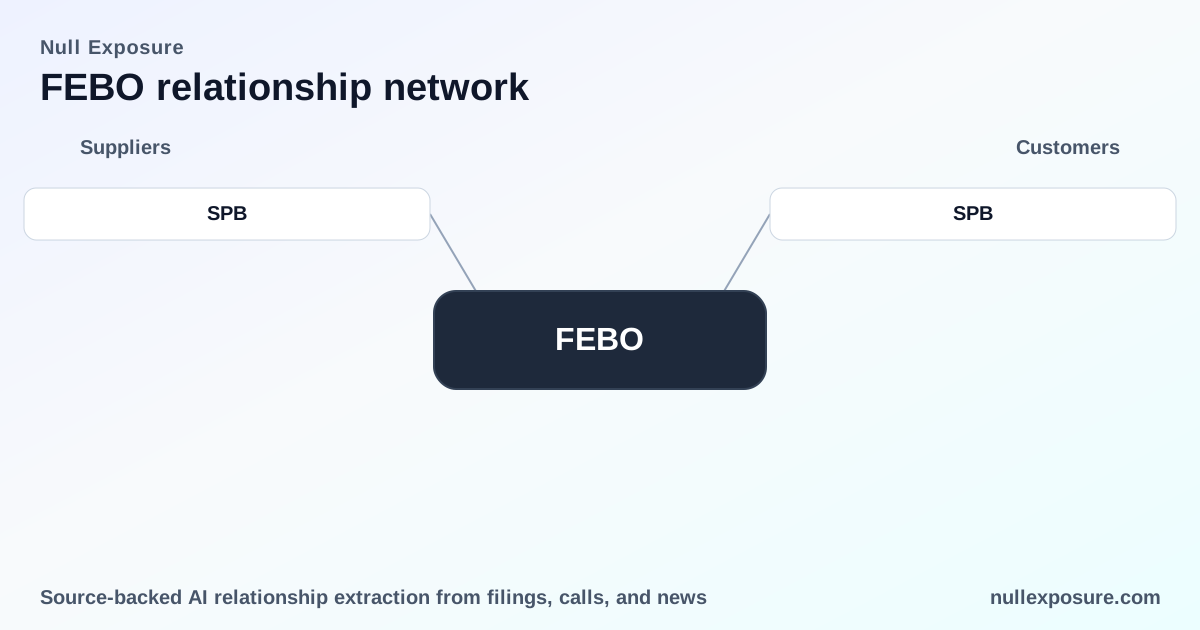
Fenbo has served as an OEM and ODM for Spectrum Brands since 2006, producing electrical hair-styling products sold under the Remington brand across Europe, the United States and Latin America; press releases and market notices describe Spectrum as the company’s sole customer for those Remington products. (GlobeNewswire, Jan 3, 2024; Yahoo Finance notices March 9, 2026; ARC-Group IPO overview).
Source: GlobeNewswire press release (Jan 3, 2024) and multiple company notices reported on Yahoo Finance (Mar 9, 2026) documenting Fenbo’s OEM/ODM role with Spectrum Brands and production under the Remington name.
There are no other distinct customer relationships surfaced in the provided results; all disclosed customer-level content points to the Spectrum Brands partnership.
What the relationship structure implies for valuation and risk
Fenbo’s economics should be modeled as a small, manufacturing-focused business with concentrated counterparty exposure. The long-term OEM/ODM relationship with Spectrum Brands provides revenue visibility but also creates single-buyer dependency that compresses valuation multiples for two reasons: (1) buyer re-sourcing risk — a third-party brand can shift suppliers or internalize production — and (2) margin leverage — contract manufacturers typically operate on thin gross margins and are exposed to commodity and input-cost swings.
Financially, the company’s negative operating and net margins combined with small absolute market capitalization amplify counterparty risk: any material change in order volume from Spectrum Brands would quickly pressure cash flow and solvency metrics. Investors should treat Fenbo as a play on contract-manufacturing continuity rather than on brand growth.
Constraints and company-level signals
The data payload provided does not list binding constraints or extracted contractual clauses. Treat this absence as a company-level signal: there are no extracted contractual constraints flagged in the review, which means public disclosures emphasize commercial facts (OEM relationship) rather than granular contract terms in the reviewed documents.
From an operational-risk angle, the absence of extracted constraints should not be interpreted as the absence of contractual risk — instead, it signals that publicly available materials emphasize relationship duration and role, not detailed contractual protections (for example, minimum purchase commitments, exclusivity clauses, or termination notice periods are not present in the results). Investors should therefore prioritize direct contract diligence or supplier audits when possible.
Near-term monitoring checklist for investors and operators
- Confirm the revenue share attributable to Spectrum Brands in the most recent financial statements and any subsequent disclosures.
- Obtain clarity on contract terms: minimum purchase commitments, pricing adjustment mechanisms, and termination provisions.
- Monitor supplier-side indicators: raw-material cost trends, production capacity utilization, and any operational notices that could affect delivery to Remington channels.
- Track newsflow from Spectrum Brands for sourcing or supply-chain strategy shifts that could alter Fenbo’s order book.
For more structured relationship intelligence and comparable issuer profiles, see our platform at https://nullexposure.com/ — the hub for customer-concentration analysis and supplier counterparty mapping.
Bottom line
Fenbo is a specialized OEM/ODM whose near-term prospects and valuation rest squarely on its long-term manufacturing relationship with Spectrum Brands. That relationship provides operational continuity but creates acute counterparty concentration risk, which investors must price and monitor through contract-level diligence and continuous operational checks. Key investor actions: verify revenue exposure, clarify contractual protections, and stress-test Fenbo’s cash flow under reduced order scenarios.
— End of analysis —