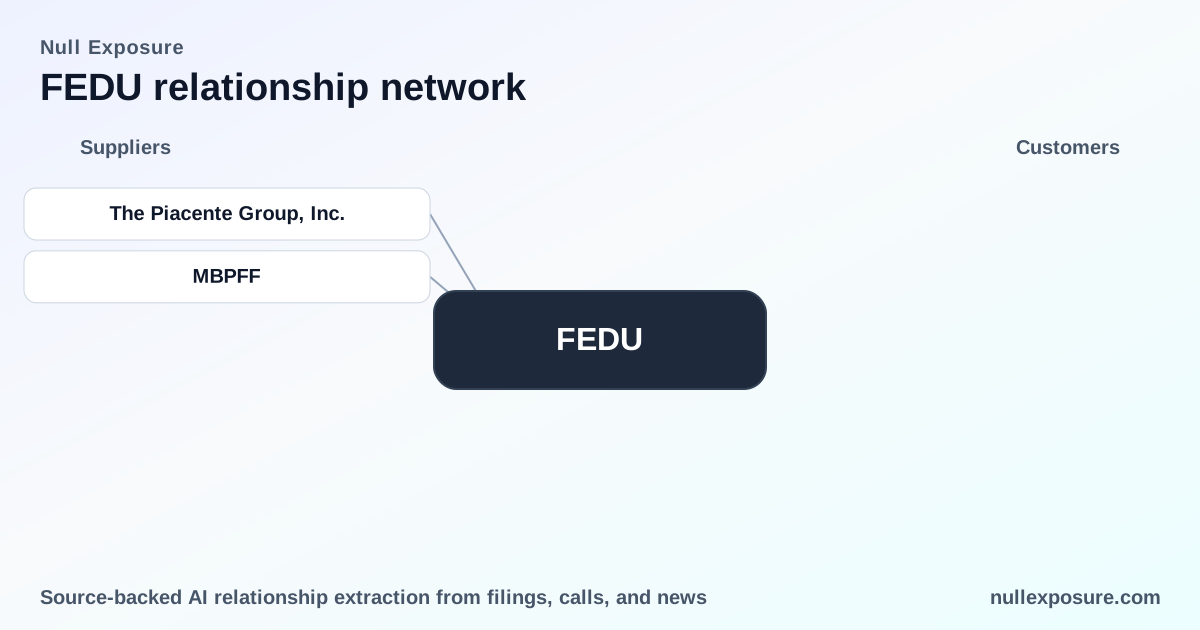
FEDU customer relationships: what the record shows and what investors should note
Four Seasons Education (Cayman) Inc. (FEDU) operates a pure-play after-school mathematics education business in China, monetizing primarily through tuition revenue collected from K–12 students enrolled in its brick-and-mortar and online blended programs. Revenue is tuition-driven and concentrated by geography and subject focus, producing predictable seasonality and gross-margin profiles typical of tuition models; FY2025 revenue was $261.7 million with a slim operating margin (~6.3%). For primary-source relationship references and raw article links, visit the NullExposure homepage: https://nullexposure.com/.
Executive summary: the relationship records returned for FEDU point to a single counterparty cluster — BHR-P-D — referenced across three independent news items that link BHR-P-D holdings to a Four Seasons hotel asset (Four Seasons Scottsdale). These items do not document typical customer-supplier activity (e.g., tuition contracts) between FEDU and BHR-P-D; instead they place the Four Seasons brand and property names in proximity to BHR-P-D reporting. Investors should treat these entries as brand/property mentions rather than proof of revenue-driving commercial contracts, and should prioritize direct customer lists or binding contract disclosures for counterparty risk analysis.
H2: What the reported relationships are — concise, source-linked descriptions
- BHR-P-D — investing.com (Earnings call transcript, FY2026): A transcript of an earnings call noted that the Four Seasons Scottsdale delivered strong performance in Q4 with RevPAR up 12.2% and Hotel EBITDA growing 21.6% year-over-year, a line that links the Four Seasons Scottsdale to BHR-P-D’s portfolio discussion. According to the investing.com earnings-call transcript (May 2026), the mention highlights asset-level hospitality performance associated with BHR-P-D.
- BHR-P-D — Hotel Management (Transactions coverage, FY2025): A Hotel Management write-up on Braemar Hotels & Resorts’ portfolio sale process lists properties operated under luxury flags including Four Seasons, and explicitly references a mixed portfolio of resorts and urban properties; this places Four Seasons-branded hotels within the scope of BHR-P-D coverage. The Hotel Management article (March 2026) documents the portfolio composition and flags Four Seasons among the operators.
- BHR-P-D — SEC/8-K reporting (summary coverage, FY2026): A filing synopsis and secondary coverage of Braemar Hotels & Resorts’ material event discloses “High Exposure to Luxury Hotels and Resorts” and names Four Seasons Scottsdale among high-exposure assets, linking the property to BHR-P-D’s reported holdings. The 8‑K synopsis (March 2026) provides a regulatory-level confirmation of the asset mention.
H3: How to read those relationship entries as an investor
The three relationship entries all reference the same counterparty tag, BHR-P-D, and all three tie back to Four Seasons Scottsdale as an asset-level mention. For FEDU-focused due diligence, these entries are brand/asset references rather than documented commercial customers delivering tuition or services to FEDU. Treat them as signals you should validate: if the Four Seasons name matters to your thesis (branding, partnership, licensing), demand contractual evidence or financial disclosure that demonstrates revenue attribution.
H2: Constraints and operating-model signals (company-level view)
There are no explicit constraints listed against FEDU in the relationship constraints feed. That absence should be interpreted as a neutral company-level signal rather than positive assurance of low risk: absence of constraints in this feed does not replace conventional risk checks in filings and contracts. From the company fundamentals and ownership structure, investors can read several operating-model characteristics:
- Contracting posture: FEDU’s revenue base is tuition contracts with parents and students; contractual complexity is low per-account but high in aggregate and seasonal. The business relies on standard enrollment/tuition contracts rather than large, bespoke enterprise contracts.
- Concentration: Ownership concentration is material — insiders hold ~28.9% of shares while institutions hold only ~3.7% — signaling governance dynamics where insider decisions carry weight and limited institutional oversight could influence strategic flexibility.
- Criticality: For enrolled families, FEDU’s services are mission-critical academic support; for investors, the business is commercially sensitive to regulatory and demographic shifts that alter enrollment demand.
- Maturity: Financial metrics (Revenue TTM ~$261.7M; gross profit ~$56.3M; operating margin ~6.34%) indicate a mature revenue-generating education operator with modest profitability and tight margins typical of tuition-led models.
H3: Key takeaways for portfolio managers and credit analysts
- Relationship quality: The relationship entries naming BHR-P-D are informational; they reference Four Seasons hotel assets in third‑party hospitality coverage rather than documenting tuition or service contracts with FEDU. Source citations are primarily news and SEC filing summaries (Investing.com, HotelManagement.net, and a press-coverage copy of an 8-K).
- Revenue exposure signal: No customer in the relationship results connects directly to tuition revenue lines for FEDU; investors should not infer material revenue concentration from these mentions alone.
- Governance and concentration risk: Insider ownership at nearly 29% and low institutional ownership create idiosyncratic governance risk that is material to long-term strategic moves, including partnerships or brand licensing decisions.
H2: Actionable steps for further verification
- Request or review FEDU’s management discussion and notes in FY2026 filings to confirm whether any hospitality brand or property licensing agreements exist that would create cross-sector revenue links. FEDU’s own site and filings (official site: https://www.sijiedu.com) are the primary sources for binding customer and partner disclosures.
- For each external mention (Investing.com, Hotel Management, 8‑K coverage), trace back to the original article or filing to confirm context and whether an operational relationship exists beyond brand mention; the three items cited here are linked to BHR‑P‑D’s reporting on a hospitality asset (Four Seasons Scottsdale).
H3: Final verdict for investors
The reported customer relationships for FEDU in this feed all point to a single counterparty cluster (BHR-P-D) that mentions Four Seasons-branded real estate; these mentions do not document revenue-driving customer contracts with FEDU. For investors evaluating customer concentration or counterparty credit risk, these entries are low-value until direct contractual evidence is produced. Conduct targeted follow-up on contractual disclosures and prioritize enrollment and tuition revenue trends and regulatory risk as the dominant drivers of FEDU’s valuation.
For source-level access and to inspect the referenced articles and filings, see the NullExposure hub: https://nullexposure.com/.