ENvue Medical (FEED): Customer Map and Commercial Risks for Investors
ENvue Medical operates as a medical-device and enteral-care company that sells an integrated ENvue System and consumable feeding tubes into hospitals, distributors, and direct-to-patient channels. The company monetizes through one-time system sales and recurring consumable sell‑in to distributors and end customers, with recent commercial expansion into non-acute and international channels via distribution deals. Revenue today is small and concentrated, but the business model is explicitly built around recurring consumables and distributor reach as the primary commercialization lever. For more background on coverage and signals, visit https://nullexposure.com/.
Quick take: what investors should know up front
ENvue’s revenue base is low-single-digit millions and loss-making, yet it exhibits classic medtech economics: high gross-margin consumables anchored by installed-system adoption and dependency on a handful of distribution partners to scale. Recent 2026 distribution agreements broaden market access beyond acute care into retail, home health, and selected international markets — an important strategic ramp given current concentration.
Customer relationships: who buys from FEED and what that implies
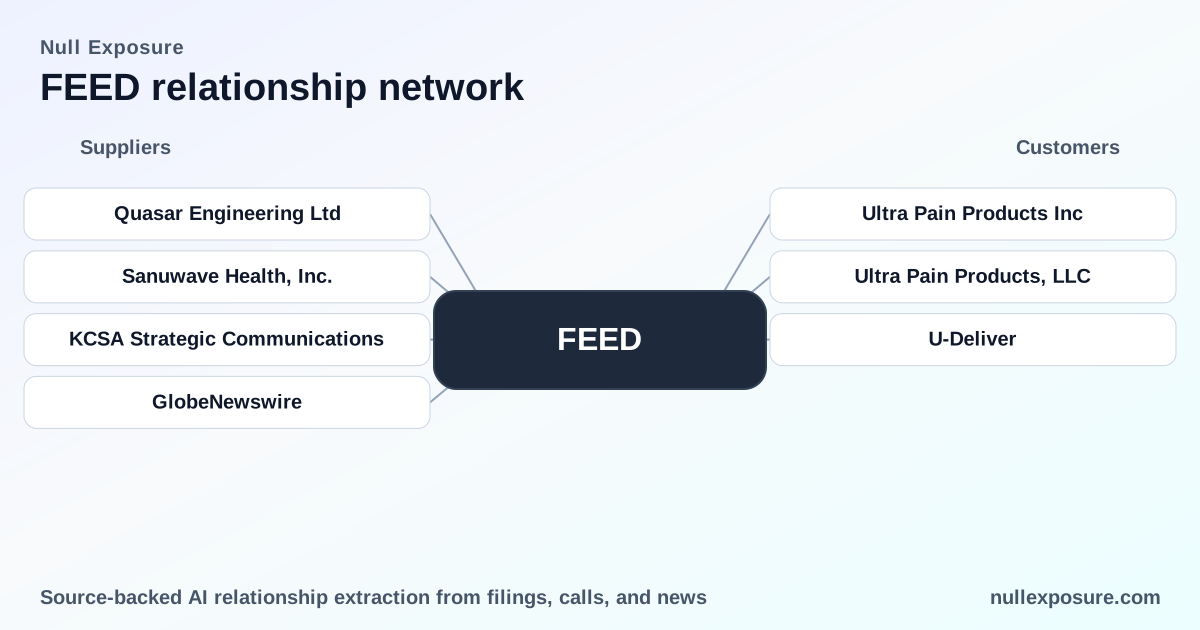
Ultra Pain Products Inc
ENvue reported that Ultra Pain Products Inc was its largest customer for the year ended December 31, 2024, accounting for approximately 31% of total revenues, indicating meaningful concentration around a single purchasing counterparty in FY2024. According to ENvue’s 2024 Form 10‑K, this customer relationship materially influenced FY2024 revenue mix.
Ultra Pain Products, LLC
The company separately identified Ultra Pain Products, LLC as its largest direct medical distributor, generating approximately $800,000 in revenue in FY2024. This figure and role are documented in ENvue’s 2024 Form 10‑K and underline the company’s reliance on distributor sell‑in for near‑term consumable revenue.
U‑Deliver
ENvue executed a U.S. distribution agreement with U‑Deliver to place the over‑the‑counter reusable ENFit Syringe line into non‑acute channels, including home health and long‑term care; the deal was announced in a GlobeNewswire release and covered broadly in March 2026 business press. This partnership expands ENvue’s addressable market beyond hospitals and represents a tangible route to growing recurring retail and home‑care sales.
Peak Medical
ENvue named Peak Medical as its exclusive distributor for initial UK market entry, leveraging the inclusion of the UroShield® Kit on the UK NHS Drug Tariff Part IX to enable nationwide prescription reimbursement. The company disclosed this linkage in an April 2026 stockholder letter and related press releases, signaling a pathway to reimbursed prescription sales in the UK via an exclusive local partner.
How the commercial model actually works — constraints and commercial posture
Investors need to read the customer disclosures together with the filing excerpts to understand operational constraints and upside:
-
Contracting posture: spot and sell‑in. ENvue recognizes revenues at delivery to distributors and records much business as ad‑hoc purchase orders for consumables; contracts are predominantly spot purchases rather than long‑term blanket orders. The 10‑K details monthly ad‑hoc ordering by customers and sell‑in revenue recognition to distributors, indicating limited contractual revenue visibility beyond near‑term deliveries.
-
Distribution-led go‑to‑market. The company sells both directly and through distributors; the filing states that revenues from distributors are recognized at delivery and the company does not provide returns or price protections to distributors. This supplier‑centric pricing posture reduces post‑sale exposure but concentrates commercial execution in distributor partners.
-
Concentration and materiality are real but bounded. FY2024 revenue shows material concentration (a single distributor/customer representing ~31% of revenue), yet the company explicitly reports a broader base of customers and notes top four customers account for under 20% in other disclosures — a mixed signal that warrants monitoring as revenue scales.
-
Counterparty mix is heterogeneous. The filing identifies purchasers that include hospitals, government facilities (Veterans Administration), distributors, and individuals/patients, implying multiple distribution channels and payer types that affect collection, reimbursement complexity, and sales cycles.
-
Geographic footprint is expanding but nascent. Revenue is primarily U.S. today, but the company has CE Mark approvals and appointed distributors in the UK, Malta, Australia and New Zealand and reports sales in select international markets; Peak Medical enables UK reimbursement access while U‑Deliver targets U.S. non‑acute channels.
-
Commercial maturity: early / ramping. ENvue describes its commercialization as still ramping — marketing began in 2020 and the business has not yet reached large‑scale production and proven widespread clinical adoption. This makes short‑term revenue growth dependent on distribution execution and GPO / hospital adoption cycles.
-
Spend bands and economics. FY2024 revenue magnitudes place significant customers in the $100k–$1m band, consistent with early commercial traction where distributor sell‑in drives recurring consumable purchases but per‑account spend remains modest.
Investment implications: risk and opportunity
-
Upside: Distribution deals with U‑Deliver (U.S. non‑acute channels) and Peak Medical (U.K. reimbursed entry) materially improve addressable markets and reduce single‑channel dependency; these agreements provide a credible path to scale consumable economics that underpin long‑term margin expansion.
-
Risk: Revenue concentration and limited contractual visibility are the primary near‑term risks. A single distributor representing ~31% of revenue in FY2024 combined with spot ordering creates earnings volatility and makes FY performance sensitive to distributor purchasing cadence.
-
Operational sensitivity: Adoption by large hospitals and GPOs remains the gating factor for installed base growth; ENvue must convert system placements into predictable consumable flow‑through to realize durable revenue streams.
For deeper signal analysis and monitoring of FEED customer relationships, visit https://nullexposure.com/ for ongoing coverage.
Bottom line
ENvue’s commercial model is classic consumable‑plus‑system medtech: small current revenue base, concentrated distributor reliance, and clear strategic moves to broaden channels and geographies. The next 12–24 months of execution on distribution partnerships and conversion of system placements into recurring consumable sales will determine whether the company can translate product approvals and distributor agreements into predictable, scalable revenue.