Frequency Electronics (FEIM): customer map, concentrations and what investors should price in
Frequency Electronics designs, manufactures and sells precision frequency and time control products—atomic clocks, oscillators and RF/microwave modules—primarily to government and defense prime contractors and government procurement entities. The company monetizes through contract and subcontract revenue streams: direct government contracts, subcontracts with primes, and export sales to allied programs, with reported segment revenue from satellite electronics and RF hardware driving the lion’s share of cash flow. For deeper analysis and continual monitoring of FEIM counterparty exposures, visit https://nullexposure.com/.
The short investment thesis
FEIM is a niche supplier of mission‑critical timing and RF components whose revenue and valuation are tightly linked to defense and space prime spending. Revenue is concentrated and contract‑driven, which amplifies upside when prime programs ramp and increases downside if a major customer re‑prices or shifts suppliers. Investors should underwrite both the structural moat—specialized product set and program qualification barriers—and the counterparty concentration risk embedded in FEIM’s contract mix.
How FEIM contracts, who pays, and why that matters
FEIM’s operating model is contract-centric and program-tied rather than broad commercial recurring revenue. The company discloses that a very large share of sales are to the U.S. Government or subcontractors for U.S. Government end use, with satellite program revenue representing a meaningful portion of the business. These dynamics translate into:
- High counterparty concentration: a small number of primes and government agencies account for material portions of consolidated revenue.
- Criticality and maturity: FEIM supplies qualified timing hardware—components that undergo long qualification cycles and can secure multi‑year program revenue once approved.
- Geography and export scope: domestic procurement dominates, but FEIM reports measurable sales in Europe and Asia; APAC represented a notable foreign customer in FY2025.
These are company‑level signals drawn from FEIM’s FY2025 disclosures and segment commentary.
What the filings say about concentration and scale
FEIM’s FY2025 10‑K makes the company’s revenue profile explicit: approximately 94% of sales in FY2025 were under contracts to the U.S. Government or subcontracts for U.S. Government end use, satellite program revenue to government end users was 53% of total for FY2025, and the loss of any one of the leading customers would be material to the business. The 10‑K also discloses domestic revenues far exceeding foreign sales and a single FEI‑NY segment customer that generated $26.9 million in the year. (Source: FEIM FY2025 10‑K filing.)
Customer relationships: the counterparties named in FEIM’s public record
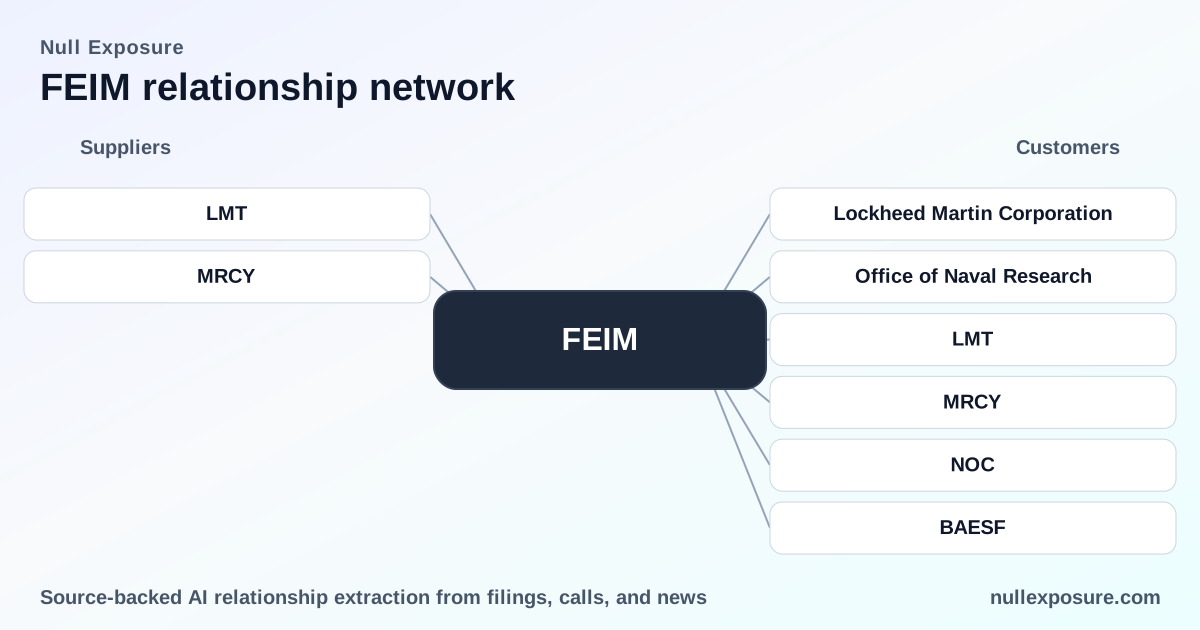
Below are the counterparties that appear in FEIM’s filings and press mentions, with concise, source‑backed summaries.
Lockheed Martin / LMT
FEIM identifies Lockheed Martin as a customer that accounted for more than 10% of consolidated revenues in the FY2024/FY2025 period; press coverage also calls FEIM a primary supplier of timing standards to Lockheed and other primes, underscoring Lockheed’s role as a program anchor for FEIM’s space and defense work. According to Simply Wall St coverage in 2026, FEIM won a $5.9 million Lockheed Martin contract to qualify atomic clocks for potential use on next‑generation GPS IIIF satellites. (Sources: FEIM FY2025 10‑K; MarketMinute/FinancialContent Jan 8, 2026; Simply Wall St reporting, May 2026 / Oct 6 contract date.)
Office of Naval Research
The FY2025 10‑K lists the Office of Naval Research as one of the customers that each accounted for more than 10% of consolidated revenues, which signals direct government program work and budget‑funded procurement. This is an explicit government counterparty disclosed by FEIM in its annual report. (Source: FEIM FY2025 10‑K.)
Northrop Grumman / NOC
Northrop Grumman is disclosed in FEIM’s FY2025 10‑K as having accounted for over 10% of consolidated revenues, indicating a material prime‑contract relationship on classified or unclassified programs that require precision timing and RF components. (Source: FEIM FY2025 10‑K.)
Mercury Systems / MRCY
Industry press links FEIM’s timing products to the component needs of Mercury Systems, whose AI‑driven sensor processing units require accurate timing; Mercury is cited in MarketMinute coverage as a beneficiary of renewed adoption that indirectly validates demand for FEIM components inside electronic warfare suites. The mention frames FEIM as a supply‑chain bellwether for firms like Mercury. (Source: MarketMinute/FinancialContent Jan 8, 2026.)
BAE Systems / BAESF
BAE Systems is named in FEIM’s FY2025 10‑K as a customer representing more than 10% of consolidated revenues, another signal that FEIM’s customer base includes large international primes that source timing and RF hardware for defense programs. (Source: FEIM FY2025 10‑K.)
(Note: multiple entries in FEIM’s public results reference the same prime under ticker and corporate name variants—Lockheed Martin/LMT, Northrop/NOC, BAE/BAESF—each appearance in filings or press corroborates the materiality of those relationships.)
For continuing, curated coverage of FEIM’s counterparty exposures and how they evolve with contract awards, visit https://nullexposure.com/.
Implications for valuation and downside risk
Investors should price FEIM using a program‑level lens rather than a pure growth multiple. Key inputs that flow from the customer map:
- Revenue volatility tied to prime program wins and qualification cycles. A single major program award or failure to qualify can swing annual revenue materially.
- High counterparty concentration increases idiosyncratic risk. The 10‑K’s explicit statement that losing any one large customer would have a material adverse effect is a governance‑grade red flag for portfolio sizing and downside scenarios.
- Defense budget tailwinds are real but lumpy. When primes like Lockheed and Northrop increase procurement on space and EW platforms, FEIM benefits quickly; conversely, re‑scopes or supplier consolidation can reduce order flow.
- Export and geographic risk are limited but present. Foreign sales are small (single‑digit percent of consolidated revenues) but growing, which moderates but does not eliminate U.S. government concentration.
Quick checklist for investors evaluating FEIM exposure
- Confirm the timeline and size of program awards (e.g., the $5.9M Lockheed atomic‑clock contract) and whether awards convert into multi‑year production revenue.
- Track prime contractor program budgets for Lockheed, Northrop, BAE and Mercury—these drive FEIM order books.
- Monitor qualification milestones; FEIM’s products require formal acceptance to unlock production phases.
- Stress test models for a 10–30% reduction in prime orders given the materiality disclosures in the FY2025 10‑K.
Bottom line
FEIM is a specialized supplier whose upside is program‑driven and whose downside is concentrated. Its balance of technical gating (qualification cycles) and customer concentration demands investor discipline: size positions to reflect the single‑counterparty risk disclosed in the FY2025 10‑K, and value future cash flows on program awards rather than headline growth rates. For persistent monitoring of FEIM’s counterparty landscape and contract developments, return to https://nullexposure.com/.