Femasys (FEMY): Commercial roll‑out is distributor-led abroad and clinic‑direct in North America
Femasys monetizes by selling a narrow portfolio of women's‑health devices—chiefly FemaSeed, FemBloc and FemVue—directly to U.S. fertility and gynecology practices while relying on third‑party distributors to open international markets. Revenue is recognized at shipment; the business model is product sales with a classic med‑tech go‑to‑market split: direct, higher‑margin U.S. sales to physicians and clinics, and lower‑touch distributor relationships overseas that accelerate reach. Investors should value execution of distributor launches and conversion at clinical sites as the primary drivers of near‑term revenue growth.
Explore more company relationship intelligence at NullExposure.
How Femasys’ commercial engine is structured — concise operating thesis
Femasys is a small, early commercial medical device company focused on minimally invasive women’s‑health solutions. The company sells directly to individual healthcare practitioners and fertility clinics in North America while contracting spot sales to international distributors under shipping terms that transfer control on shipment or EX‑Works. Company filings show revenue recognition on shipment with standard payment terms (30–60 days). This structure yields fast order recognition but exposes Femasys to distribution execution risk and customer concentration: two customers represented over 10% of revenue in 2024. Financially, the business is early stage—revenue measured in millions with negative EBITDA—so commercial partnerships are functionally critical to scale.
Company‑level constraints that shape commercial risk and opportunity
- Contracting posture: spot sales and shipment recognition. Femasys’ disclosures state that control of goods transfers upon shipment for U.S. sales and generally at shipping point for international distributors, indicating a classic product sale model rather than long‑term take‑or‑pay contracts.
- Customer type: individual practitioners and clinics. The primary customers are reproductive endocrinologists, gynecologists and women’s‑health provider organizations, highlighting a sales motion that is clinician‑driven and relationship‑based.
- Geographic focus: North America first, distributors overseas. Filings show the company concentrates selling effort in North America and uses partners to access international markets.
- Concentration: material reliance on a few customers. For FY2024 two customers each accounted for more than 10% of revenue, a signal of customer concentration risk at current scale.
- Commercial maturity: active early commercialization. Public updates reference first commercial uses and ongoing international launches, signaling active rollout rather than a mature recurring revenue base.
- Product focus: core product revenue. Sales are primarily from FemaSeed and FemVue, concentrating revenue exposure on a small set of offerings.
These company‑level signals collectively indicate a high‑operational‑leverage, execution‑sensitive model: wins in distributor rollouts and clinic adoption translate directly into revenue, while failure to convert channels or concentration loss would disproportionately hurt near‑term results.
Every partner relationship reported — who does what and why it matters
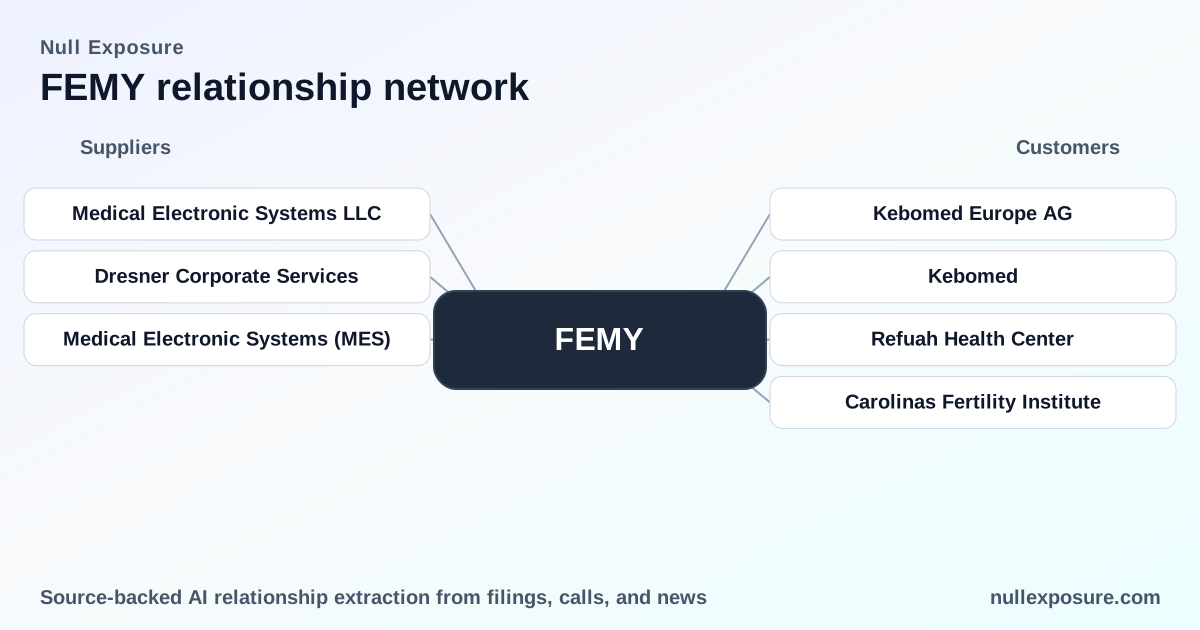
Kebomed Europe AG (commercial launch in France and Benelux)
Femasys announced an initial order valued at approximately $500,000 to support the commercial launch of FemBloc in France and the Benelux countries through Kebomed Europe AG; this is an early, commercially meaningful distributor order that accelerates European rollout. According to Yahoo Finance (March 9, 2026), the order underlines the distributor channel’s role in unlocking regional markets.
Kebomed (European distribution referenced in company releases)
Femasys has referenced Kebomed in its own investor communications as a leading European distributor that will commercialize FemBloc across France and Benelux, reinforcing the company’s European distribution strategy. The company disclosed this partnership in its 2025 financial communications and related press materials (GlobeNewswire, November 14, 2025; March 2026).
OR Consulting (Switzerland distribution)
Femasys entered a strategic distribution partnership with OR Consulting to support commercial launches of FemBloc, FemaSeed and additional portfolio products in Switzerland, positioning the company to access Swiss clinics and hospitals via a localized distributor. Market coverage noted that FEMY stock rose on the announcement (Investing.com, May 2026), and company materials reiterated the Switzerland strategy (GlobeNewswire, March 2026).
Refuah Health Center (community‑based adoption in Israel)
Femasys established a partnership with Refuah Health Center to advance adoption of FemaSeed as a first‑line infertility treatment in community‑based care, signaling a channel into non‑hospital, community clinic workflows. The company disclosed this partnership across investor PRs and partner announcements (SahmCapital press release, January 13, 2026; GlobeNewswire March 31, 2026).
AMI Technologies (Israel market entry)
Femasys named AMI Technologies as its commercial partner to introduce and commercialize the fertility portfolio in Israel, explicitly positioning FemaSeed as a first‑line infertility option in that market and expanding Israeli market access. This relationship was highlighted in Femasys’ FY2025/2026 corporate updates and press (GlobeNewswire March 31, 2026; April 16, 2026 investor release).
Carolinas Fertility Institute (U.S. clinic rollout)
Femasys announced a U.S. clinic partnership with Carolinas Fertility Institute to roll out FemaSeed across eight clinic locations, representing the direct‑to‑practice adoption channel that drives domestic revenue and clinical evidence generation. Industry coverage of Femasys’ U.S. clinic rollout referenced the arrangement (TS2.tech coverage, March 2026).
What these relationships tell an investor about execution risk and upside
- Upside path is clear and concentrated: distributor agreements (Kebomed, OR Consulting, AMI) create immediate market access inputs—initial orders such as the roughly $500k European shipment demonstrate the ramp potential when partners execute.
- Execution risk is concentrated: reliance on distributors for international scale and a small set of large domestic customers create two levers for downside—if a distributor fails to convert demand, international expansion stalls; if a large U.S. customer reduces orders, reported concentration shows meaningful revenue sensitivity.
- Commercial cadence is short‑cycle: shipment‑based recognition and standard 30–60 day payment terms translate wins quickly to reported revenue but also deliver limited recurring visibility.
- Clinical adoption is the core value driver: U.S. clinic rollouts (Carolinas Fertility Institute) and community partnerships (Refuah) are the fundamental mechanisms to build repeatable demand and clinician advocacy, which will be critical to translate pilot orders into sustained sales.
Key watch‑points for the next 12 months
- Track distributor order cadence and resale execution in France/Benelux, Switzerland and Israel; follow reported purchase orders and commercial rollouts. The initial Kebomed order is the near‑term milestone to monitor.
- Monitor U.S. clinic expansions and clinical outcomes from partner sites to evaluate physician adoption and repeat purchasing behavior.
- Watch customer concentration metrics in quarterly filings; retention of top customers and diversification across clinics/distributors will materially affect risk.
- Keep an eye on gross margins and working capital given the shipment recognition model and the company’s negative EBITDA and small revenue base.
For investors focused on supplier and customer ecosystem dynamics, these relationships are the operational levers that will determine whether Femasys transitions from early commercial proofs into scalable product sales. If you evaluate counterparties or need deeper relationship mapping, visit NullExposure for expanded coverage and partner analytics.
Visit NullExposure for more relationship intelligence.
Bold takeaway: Femasys’ near‑term revenue trajectory is driven by distributor rollouts in Europe and Israel and by clinic adoption in the U.S.; execution on those relationships, not product innovation alone, will determine commercial success.