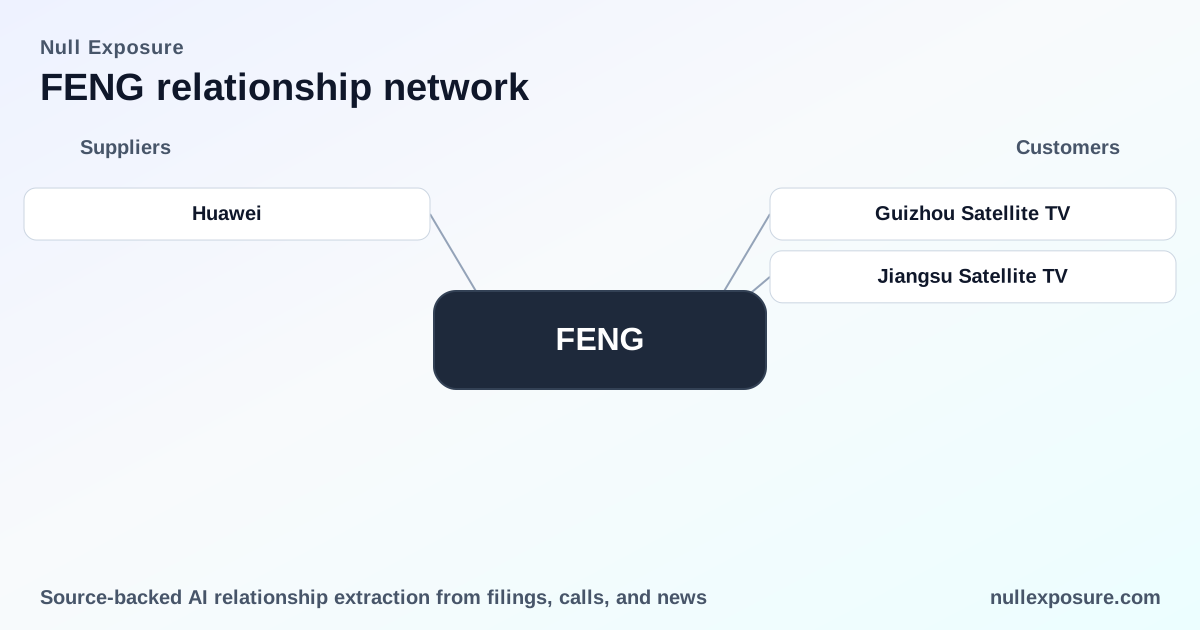
Phoenix New Media (FENG) — Broadcast partnerships underwrite content reach
Phoenix New Media operates an integrated internet content platform in China and monetizes primarily through advertising, content licensing, and strategic distribution partnerships with traditional broadcasters and digital outlets. The company leverages owned and produced programs to secure broadcast slots and licensing fees, extending audience reach beyond its digital properties into satellite television — a pathway that supports ad yield and brand licensing. Investors should view FENG’s broadcaster relationships as distribution levers that directly influence advertising scale and monetization of marquee programs.
For a focused view of Phoenix New Media’s customer relationships and how they feed revenue, see our research hub: https://nullexposure.com/
Why broadcast deals matter for FENG investors
Phoenix New Media’s core asset is content: original shows and curated programming that attract audiences and advertisers. When a program succeeds on Phoenix’s platform and is picked up by a provincial satellite channel, the company converts attention into incremental licensing revenue and broader advertising inventory. That step from digital-first distribution to linear broadcast materially increases CPM realization and advertiser reach in China’s fragmented media market.
Financial context reinforces the strategic importance of these partnerships: Phoenix reports $765.6 million in trailing twelve-month revenue, reflecting a business where content commercialization and multiplatform distribution drive scale. At the same time, the company’s market capitalization and valuation metrics point to a market pricing that discounts growth, so successful syndication and broadcast licensing are high-leverage outcomes for investors.
What the record shows about specific broadcast partners
Jiangsu Satellite TV — programming syndication for Jun Pin Tan
During its Q3 2020 earnings call, Phoenix New Media disclosed that the program "Jun Pin Tan" performed strongly and enabled a strategic partnership with Jiangsu Satellite TV to broadcast the show, extending the program’s reach from digital channels to provincial satellite audiences. This pick-up signals Phoenix’s ability to convert digital hits into traditional broadcast syndication and associated licensing economics (Motley Fool transcript of Phoenix New Media Q3 2020 earnings call, Nov 18, 2020).
Guizhou Satellite TV — another provincial broadcast outlet for the same show
The same Q3 2020 call transcript notes that Guizhou Satellite TV also agreed to broadcast "Jun Pin Tan," underscoring a multi-region syndication strategy for successful titles and demonstrating Phoenix’s capacity to place content across multiple provincial networks rather than rely on a single broadcaster for linear distribution (Motley Fool transcript of Phoenix New Media Q3 2020 earnings call, Nov 18, 2020).
Constraints and operating-model signals relevant to investors
No contract-level constraints were extracted in the current record; treated as a company-level signal, that absence highlights several operating-model characteristics investors should weight when evaluating FENG:
- Contracting posture: Phoenix operates as a content originator and licensor that negotiates distribution agreements with third-party broadcasters rather than being vertically integrated into linear TV networks. This posture creates flexibility to license titles to multiple channels and to price deals based on viewership performance.
- Concentration: The available evidence indicates a multi-buyer distribution approach (multiple provincial satellite partners for the same title), which reduces single-counterparty concentration risk for any one program’s broadcast rights.
- Criticality of relationships: Broadcast partnerships are commercially critical for scaling advertising revenue and extracting higher-value licensing fees, because they unlock audience segments and ad inventory not fully reachable on Phoenix’s owned platforms alone.
- Maturity: The relationships cited date from Phoenix’s fiscal commentary in 2020, demonstrating operational experience in syndication rather than one-off experiments; the model is established enough to repeat across multiple provincial broadcasters.
Investment implications and a short risk checklist
- Upside driver: Repeated syndication of hit programs (e.g., Jun Pin Tan) to provincial satellite channels is a direct lever on revenue quality — converting digital popularity into broadcast licensing and higher-margin ad inventory.
- Revenue sensitivity: Advertising and licensing revenue are directly sensitive to content performance and placement; a pipeline of reproducible hits is essential to sustain growth.
- Execution risk: Phoenix’s business depends on content production and successful negotiation with broadcasters; execution lapses in programming or weaker syndication terms would compress realized margins.
- Valuation opportunity: Given Phoenix’s trailing revenue scale and the market’s conservative valuation, successful expansion of broadcast syndication could unlock disproportionate upside for investors positioned at current prices.
If you want a consolidated briefing across all of FENG’s customer relationships and direct access to source-level documents, visit our research portal: https://nullexposure.com/
Bottom line
Phoenix New Media’s partnerships with Jiangsu Satellite TV and Guizhou Satellite TV for the program "Jun Pin Tan" are concrete examples of the company’s content-to-broadcast pathway that translates digital success into material licensing and ad revenue. For investors evaluating FENG, the critical questions are whether Phoenix can consistently produce syndication-worthy content and sustain favorable licensing economics as it distributes shows across multiple provincial broadcasters.