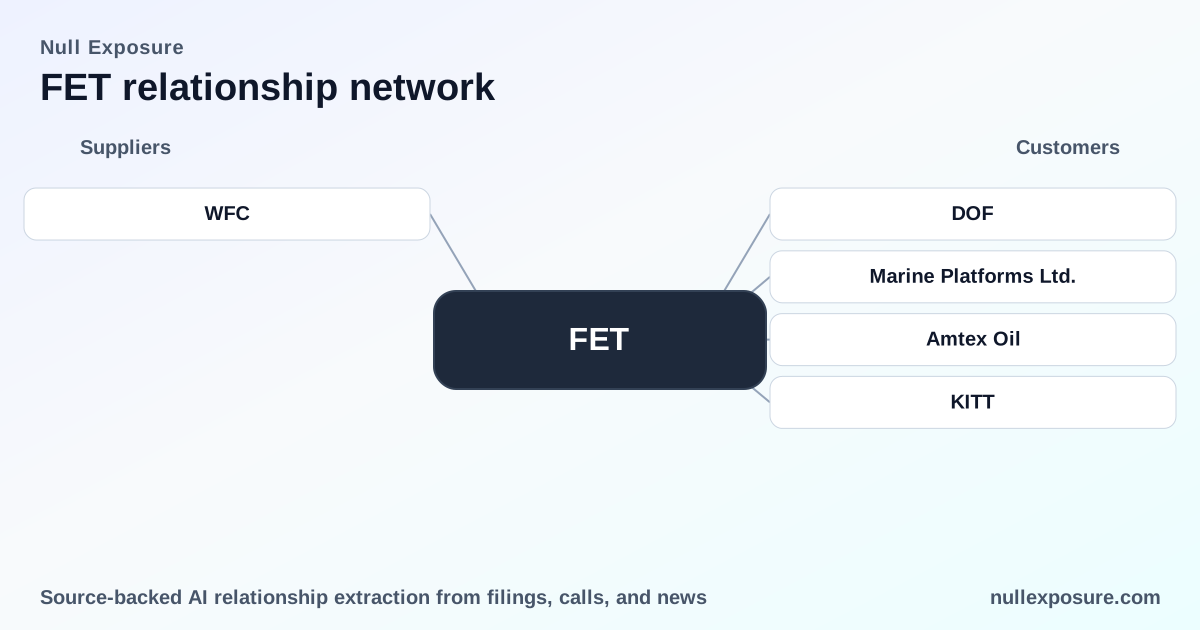
Forum Energy Technologies (FET): Customer Relationships and Commercial Profile
Forum Energy Technologies designs and manufactures equipment for the oil & gas and offshore markets and monetizes through product sales, project-based equipment contracts, and aftermarket spares and service for subsea and surface applications. Revenue is driven by industrial manufacturing cycles, concentrated North American end markets, and repeat business from large offshore service firms that buy high-value subsea systems and work-class ROVs. For a drilled-down view of partner exposures and operational constraints, see Null Exposure’s coverage for FET: https://nullexposure.com/.
Executive takeaway: what investors should watch
FET is a capital-goods manufacturer with revenue sensitivity to offshore project timing and a working-capital profile tied to short-term contracts and extended customer payment behavior. The company sells through distributors and direct channels, serves large enterprise customers globally, and reports no single customer accounting for more than 10% of revenue — a mitigation of counterparty concentration risk. Key risk vectors are receivable collection cycles, project milestone payment structure, and the pace of ROV and subsea equipment orders from major service firms.
How FET contracts and sells — operating model constraints that matter
- Contracting posture: FET discloses that substantially all contracts have original durations of one year or less, supporting a predominantly short-term sales footprint; however, for larger projects the company uses milestone progress payments, indicating the presence of longer-duration, higher-value contracts in pockets of its business.
- Customer profile and channel mix: The company identifies its subsea vehicle customers as primarily large offshore service companies, and sells both directly and via distributors — a hybrid go-to-market that balances direct account control with distribution reach.
- Geographic exposure: Shipping-destination revenue shows a North American concentration (United States and Canada form the majority) with material revenues from Middle East, Europe & Africa, Asia-Pacific, and Latin America — confirming a global manufacturing footprint.
- Materiality and concentration: Management reports no customer >10% of consolidated revenue across the last two years, which reduces single-counterparty revenue risk but leaves FET exposed to cycles across multiple large customers simultaneously.
- Working capital characteristics: Standard payment terms are 30 days, yet customers often take 65+ days to pay, creating a working-capital drag and potential financing need during order ramp-ups.
Collectively, these constraints indicate a mature manufacturing operator with mixed contract profiles: high frequency short-term orders, occasional long-term milestone-paid projects, and a receivable cycle that compresses liquidity.
Customer relationships: who’s buying FET hardware
Below I summarize every customer relationship surfaced in recent reporting and press coverage, with a plain-English note on the commercial interaction and an explicit source citation.
DOF
DOF secured an order for four of FET’s new-generation XLX EVO III work-class ROVs, reflecting a continued long-term ROV supply relationship between the offshore services firm and FET. According to Offshore Magazine (March 2026), the contract reinforces FET’s position as a repeat supplier of work-class ROVs to large service providers. A parallel story in Marine Technology News (March 2026) confirms the same four-unit order and frames it as part of FET’s subsea product momentum.
Marine Platforms Ltd.
FET’s Subsea team will deliver two XLX EVO III work-class ROVs to Marine Platforms Ltd. for offshore operations in Nigeria, demonstrating FET’s active sales into regional operators and asset operators in West Africa. Offshore Magazine reported this delivery announcement in March 2026, highlighting regional deployment for FET’s upgraded ROV platform.
Nauticus Robotics (KITT)
Nauticus Robotics signed a sales and manufacturing agreement with FET for the Olympic Arm manipulator system, positioning FET as the manufacturing partner for a robotics manipulator. MarketScreener’s coverage of the company’s filings and subsequent investor materials (FY2025–FY2026) documents the contractual relationship and FET’s role in producing the Olympic Arm. InsiderMonkey’s Q4 FY2025 transcript coverage references ongoing collaboration on design files and manufacturing drawings as of FY2026.
KITT (as referenced separately)
Public filings and press wires duplicate coverage of Nauticus Robotics (ticker KITT) and its manufacturing deal with FET; the repeated mentions reflect the same underlying manufacturing and sales arrangement for robotic manipulators. MarketScreener and other investor reports (December 2025 through early 2026) list FET as the manufacturing partner for KITT’s Olympic Arm product line.
Amtex Oil
During FET’s Q4 FY2025 earnings call, management noted positive user feedback from Amtex Oil — operators referred to the product as “the future” — indicating direct operator engagement and field validation of FET equipment with onshore drilling or service personnel. The earnings call transcript summarized by InsiderMonkey (FY2026 coverage of the Q4 earnings call) captures the anecdotal endorsement from Amtex Oil.
What these relationships imply for revenue quality and risk
- Repeat orders from major service companies like DOF and regional operators like Marine Platforms confirm FET’s competitive position in work-class ROVs, a high-ticket product line that supports aftermarket spares and service revenue.
- Manufacturing deals with robotics firms (Nauticus/KITT) diversify revenue toward advanced subsea robotics and provide assembly/manufacturing margin opportunities, while also creating dependency on third-party product development cycles.
- Operator-level endorsements (Amtex Oil) provide field validation that supports sales channels and distributor push-through, helping commercial traction for valve and drilling products sold through distribution partners.
Balance-sheet and concentration considerations for investors
- Short-term contract mix supports revenue predictability in certain product lines but raises churn risk if offshore capex slows; the existence of milestone progress payments for longer projects moderates project credit exposure but introduces receivable timing complexity.
- A working-capital pinch is visible: nominal 30-day payment terms combined with actual payment behavior of 65+ days increases FET’s need for either supply-chain financing or bank liquidity during order books.
- No single customer exceeds 10% of revenue, which limits concentration risk, but the business remains exposed to sector-wide downturns among large offshore service firms.
Final read: investment implications
Forum Energy is a manufacturing operator with stable industrial margins in a cyclic end market, revenue diversification across geographies and distribution channels, and commercial anchors in large service firms and emerging robotics partners. Key monitoring points for investors are order flow for XLX EVO III ROVs, receivable trends and days-sales-outstanding, and the cadence of milestone payments on longer projects.
For an investor-ready view of FET’s customer flows and relationship signals, explore additional analysis at Null Exposure: https://nullexposure.com/.