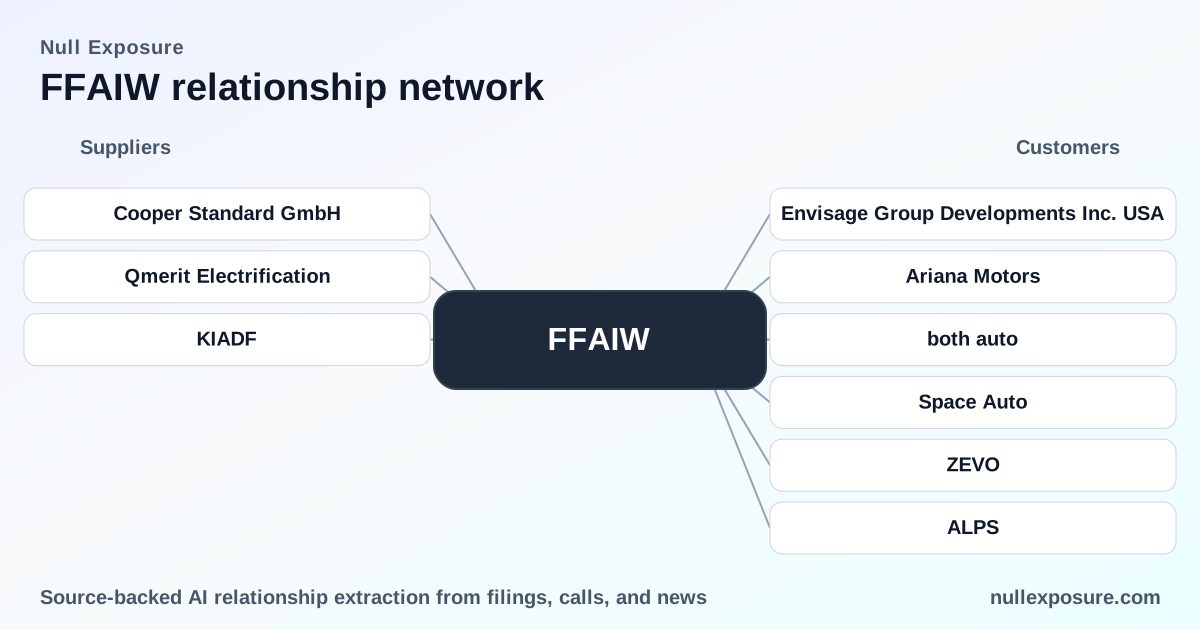
Faraday Future Intelligent Electric (FFAIW): Customer relationships that shape near-term commercial trajectory
Faraday Future designs and sells electric vehicles and related services and monetizes through direct vehicle sales, short-term operating leases up to 36 months, and paid co-creation/marketing engagements with customers and partners. Revenue today is concentrated in vehicle deliveries and related fees, while nonbinding preorder deposits and channel partnerships underpin commercialization and market expansion. For investor diligence and commercial monitoring, these customer relationships reveal both revenue upside pathways (fleet and dealer preorders, influencer-driven demand) and clear execution risks (legal disputes, immaterial current lease revenue). Learn more at https://nullexposure.com/.
What to watch: the headline implications for investors
Faraday Future’s customer footprint is small but strategically varied. Key themes:
- Dealer and fleet preorders (100–1,000 unit deposits) indicate early-channel traction beyond direct deliveries, expanding geographic reach into Nevada, Massachusetts, and Southern California as of 2025 Q3.
- Nonbinding, nonrefundable deposits are being used to convert interest into working capital and demand signals, but conversion to recognized revenue depends on delivery and contractual performance.
- Marketing and co-creation partnerships with influencer networks position the brand for awareness-driven uptake while creating a revenue line tied to content and data-sharing agreements.
- Legal and supplier disputes are active: a disclosed arbitration seeking $1.1 million signals supplier-side counterparty risk that can pressure near-term cash flow and margins.
Customer roster summarized (direct excerpts covered)
Below are the relationships identified in company disclosures; each entry includes a concise take and the disclosure source.
Envisage Group Developments Inc. USA
Faraday received an arbitration notice from Envisage on May 2, 2023, alleging unpaid invoices for professional engineering services and claiming $1.1 million in damages related to a Master Buck cube. This is a supplier dispute that represents a contractual counterparty exposure disclosed in the FY2024 Form 10‑K.
Source: According to the company’s FY2024 Form 10‑K filing, Faraday disclosed the arbitration notice and the alleged $1.1 million claim.
Ariana Motors
Faraday signed a 100-unit nonbinding, nonrefundable deposit agreement with Ariana Motors, described as one of Las Vegas’s largest independent dealerships; this represents a dealer-led retail channel preorder for the FX Super One. The commitment was announced on the company’s 2025 Q3 earnings call and signals localized retail distribution expansion.
Source: Management commentary during Faraday’s 2025 Q3 earnings call.
both auto
Faraday entered a 100-unit preorder agreement with both auto, characterized as one of Boston’s largest independent dealerships, marking the company’s entry into the Massachusetts market through dealer preorders. This is a channel-expansion move disclosed in the 2025 Q3 earnings call.
Source: Management remarks on the 2025 Q3 earnings call.
Space Auto
A preorder/partnership with Space Auto, a Beverly Hills-based luxury dealer, strengthens Faraday’s presence in Southern California’s ultra-luxury market; management positioned this relationship as part of geographic and segment targeting for premium buyers. This was disclosed on the 2025 Q3 earnings call.
Source: Management commentary during the 2025 Q3 earnings call.
ZEVO
Faraday signed a nonbinding 1,000-unit preorder agreement with ZEVO, a U.S. pioneer in peer-to-peer EV sharing platforms, indicating potential fleet-level distribution and access to mobility-as-a-service channels. The agreement was referenced in the 2025 Q3 earnings call and represents the largest preorder quantity disclosed across these relationships.
Source: Remarks in the company’s 2025 Q3 earnings call.
ALPS
Faraday expanded its co-creation network through nonbinding, nonrefundable deposits with ALPS, a global MCN agency and TikTok partner managing over 3,000 influencers; this is a marketing and co-creation arrangement intended to drive brand visibility and consumer engagement. Management discussed this on the 2025 Q3 earnings call.
Source: Statements from the 2025 Q3 earnings call.
Constraints and what they imply about the operating model
The company-level constraints disclosed provide signals about how Faraday contracts, where it sells, and what drives revenue recognition:
-
Contracting posture: Faraday uses a mix of short-term operating leases (up to 36 months) and standard sales contracts; this creates variability in revenue timing and potential for recurring revenue if leasing scales. The leasing program is explicitly for up to 36 months, splitting the contracting posture between short-term and longer-term billing structures.
-
Geographic reach and expansion: Filings list active availability in the U.S., China, and the Middle East, with potential European expansion; the relationship evidence above reinforces U.S. dealer and fleet focus (NA), while company disclosures also reference APAC and EMEA initiatives.
-
Materiality of channels: Revenue from the leasing and other ancillary services was reported as immaterial for FY2024, while company strategy emphasizes consumer adoption as a material growth driver; thus current revenues are concentrated in limited deliveries and deposits rather than scaled recurring streams.
-
Roles and engagement types: Customers act as buyers (vehicle deliveries and prepaid deposits) and service/collaboration partners (co-creator consulting and influencer campaigns), indicating hybrid monetization via hardware sales and paid marketing/feedback arrangements.
-
Relationship stage and product focus: Relationships are active and tied to the company’s core product—the FF 91 series and related offerings—with deliveries begun in 2023 and continued program rollout.
These constraints should be read as company-level signals of concentration, contractual mix, and the maturity of revenue lines—not as relationship-specific judgments unless explicitly named.
Investment implications and risk checklist
-
Positive: Large-format preorders (ZEVO’s 1,000 units) and multiple dealer preorders indicate diverse go-to-market channels (fleet, independent dealers, luxury showrooms) that can accelerate volume if Faraday converts deposits to deliveries. ALPS provides a direct marketing channel into social and influencer networks that can lower customer acquisition cost for premium buyers.
-
Negative: The immaterial contribution of leasing revenue to FY2024 P&L and continued reliance on nonbinding deposits create execution risk: deposits convert to revenue only with successful delivery and fulfillment of contractual obligations. The Envisage arbitration demonstrates liability and supplier-dispute risk that can affect cash flow and production schedules.
-
Operational watchlist: conversion rates of preorders to firm sales, deposit refund terms, lease penetration and residual values, supply-chain dispute frequency, and the effectiveness of influencer-led demand generation versus cost.
If you require a regular monitoring feed of these counterparty movements and dispute disclosures, consider tracking Faraday’s filings and call transcripts via https://nullexposure.com/.
Bottom line
Faraday Future’s customer relationships show an aggressive commercial push across dealer, fleet, and influencer channels using nonbinding but nonrefundable deposits and a nascent leasing program. These linkages provide credible channels to scale if Faraday executes on production and delivery, but current financials and disclosed supplier disputes underline execution and materiality risk that investors must price into valuation and liquidity assessments.