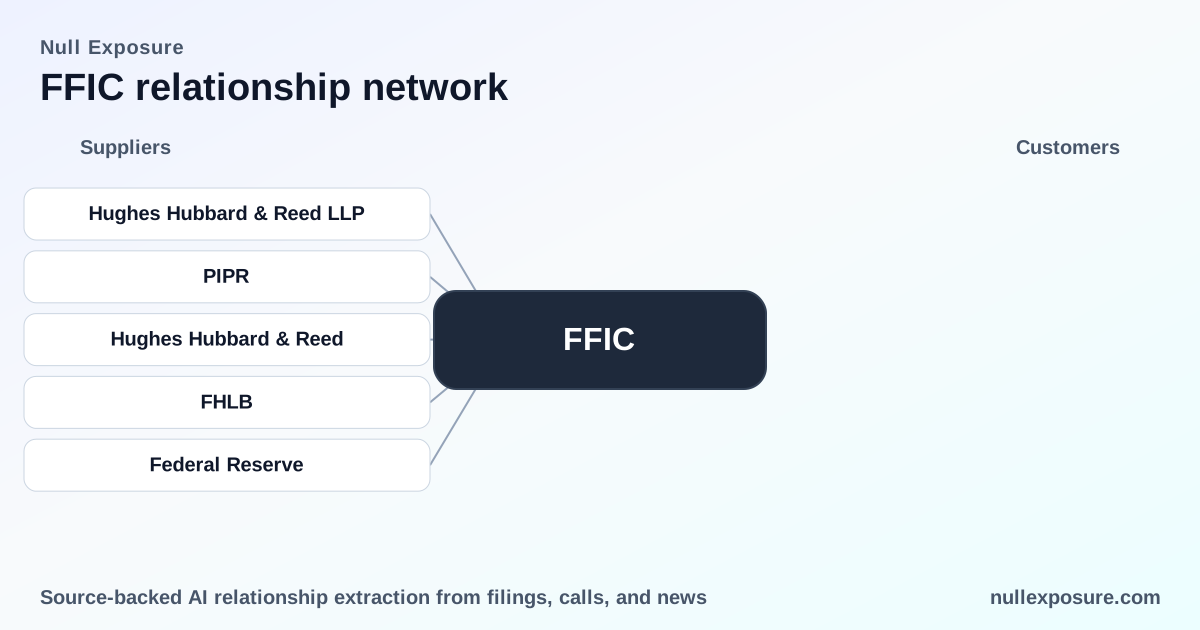
Flushing Financial (FFIC): Customer Relationships and What Investors Need to Know
Flushing Financial Corporation operates as a New York–focused regional bank holding company that earns the bulk of its revenue from interest on loans and securities, supplemented by fee income from deposit services and mortgage servicing. The company monetizes through a classic commercial banking model: deposit gathering, loan originations (notably multi-family and commercial real estate), investment in mortgage‑backed and fixed‑income securities, and ancillary fee businesses. For direct access to structured relationship intelligence and continuing updates, see NullExposure.
A transaction that reshapes the customer picture: OceanFirst acquisition
OceanFirst Financial Corp. has agreed to acquire Flushing Financial in a stock-for-stock exchange at 0.85 OceanFirst shares for each Flushing share, effectively ending FFIC’s independent customer relationships as a standalone public company and folding its client base into OceanFirst’s franchise. This transaction was reported in a Morningstar/PR Newswire release in February 2026 and subsequently covered in market commentary in May 2026. According to the announcement, the deal converts Flushing shareholders into OceanFirst equity holders and consolidates retail, municipal and commercial deposit relationships under OceanFirst’s balance sheet (Morningstar / PR Newswire, Feb 2026).
What Flushing’s customer signals reveal about its operating model
Flushing’s customer and contract characteristics give a clear picture of a mature, deposit-driven community bank with concentrated geography and mixed contract tenors.
- Contracting posture — mixed maturities, tilt to long-term funding: The bank originates fixed- and adjustable-rate mortgage loans with maturities up to 30 years and holds certificates of deposit with scheduled remaining maturities extending beyond five years, indicating a meaningful long-term asset/liability profile alongside short‑term commitments such as 90‑day loan commitments and construction lines. This combination produces structural duration exposure and a need for active liquidity management (company filings, FY2024–FY2025).
- Counterparty makeup — retail, municipal and small business: Flushing’s deposits are drawn from individuals, public entities and small businesses. The government banking unit is a large, stable deposit source ($1.775 billion in government deposits as of Dec 31, 2024), while SBA lending is small relative to the balance sheet, indicating limited direct exposure to the SBA portfolio (FY2024 disclosures).
- Geographic concentration — New York City metropolitan area: Lending and deposit operations are concentrated across Queens, Brooklyn, Manhattan and Nassau/Suffolk counties. This concentration enhances local market knowledge and cross‑sell opportunity but increases sensitivity to regional economic cycles and real estate markets (FY2024–FY2025).
- Materiality and criticality: Deposits, FHLB borrowings and securities sales are identified as primary sources of funds, making deposit retention and collateralized funding essential to ongoing operations—this is a company-level signal of funding criticality rather than a client-specific dependency.
- Relationship role and stage: The firm is a service provider to individuals, small businesses and public entities and maintains an active, longstanding retail deposit base through 28 branches and an internet branch, indicating an established, ongoing relationship footprint.
Customer mix and credit profile — concentrated CRE lending with defined ticket sizes
Flushing’s lending mix focuses on multi-family residential and commercial real estate, with one-to-four family originations skewed toward mixed‑use properties. Commercial real estate mortgage loans are typically originated between $100k and $10m, a band that positions the bank to serve middle‑market property owners and local landlords rather than large institutional borrowers. SBA loans exist but are immaterial to total loans (approximately $19.9 million at Dec 31, 2024), limiting portfolio volatility tied to small business government guarantees.
Liquidity and maturity dynamics — what anchors funding risk
The bank’s funding profile combines stable retail deposits with term certificates of deposit and access to FHLB funding. The presence of long‑dated mortgage assets and long‑term CDs creates duration tension that requires active management through securities, borrowings and loan sales. Short‑term features—90‑day loan commitments and construction lines—introduce potential near‑term drawdown risk if local credit demand shifts or if a reinsurer/acquirer adjusts underwriting following the OceanFirst transaction.
Key investor takeaways
- Consolidation re-rates shareholder optics: The OceanFirst → Flushing stock exchange at 0.85 shares per Flushing share transforms FFIC shareholders into OceanFirst stakeholders and removes Flushing as an independent franchise; investors should evaluate the deal economics and projected cost synergies versus execution risk (Morningstar / PR Newswire, Feb 2026).
- Deposit stickiness is a strength and a risk: A broad retail and municipal deposit base across 28 branches and the Internet Branch provides stable funding, but geographic concentration in the New York metro amplifies localized systemic risk.
- Asset concentration in CRE requires attention to regional cycles: Heavy exposure to multi‑family and mixed‑use commercial real estate, combined with modest loan ticket sizes, implies credit sensitivity to NYC market dynamics rather than national CRE trends.
- Liquidity management will remain core to execution: Long-term mortgage assets and staged CD maturities make funding strategy (FHLB access, securities sales, deposit retention) central to franchise stability—this is a structural operating constraint and not tied to any single customer.
- Limited exposure to SBA reduces small-business‑backstop dependency: SBA loans are present but immaterial, which limits the bank’s reliance on government guarantees for credit stability.
For a structured view of counterparties and to track post‑deal customer integrations, visit NullExposure.
Relationship inventory — concise listings for diligence
OceanFirst Financial Corp. — Flushing Financial agreed to be acquired by OceanFirst in a stock exchange at 0.85 OceanFirst shares per Flushing share, transferring Flushing’s deposit and loan customer relationships to OceanFirst and converting shareholders into OceanFirst equity holders (Morningstar / PR Newswire, Feb 2026).
Final perspective: where the investor focus should be
Post-closing, the critical investor questions shift from Flushing’s standalone funding and credit management to how OceanFirst will integrate the New York footprint, manage CRE exposure, and realize expected cost or revenue synergies. Flushing’s customer profile—stable municipal deposits, retail stickiness, and mid-sized CRE lending—represents both a strategic opportunity for scale and a concentration risk that must be actively managed through disciplined underwriting and funding execution.
If you are mapping counterparty concentration and funding vectors across regional consolidation activity, our platform provides targeted relationship intelligence and tracking to support investment decisions: NullExposure.