F5 Networks (FFIV): Customer Relationships That Drive Recurring, Hybrid-Cloud Revenue
F5 monetizes a portfolio of application delivery, security, and multi‑cloud management products through a mix of perpetual licenses, subscriptions, and usage‑based offerings, backed by hardware appliances and professional services; the result is a hybrid revenue model that blends high‑margin software with stable recurring subscriptions and service revenue. Investors should value F5 as a company that converts enterprise and service‑provider security and application needs into predictable contracts while retaining high touch through hardware and services selling motions.
For further diligence, see full coverage and sourcing at https://nullexposure.com/ — the homepage provides gateway analyses and primary links.
What the recent customer signals say in plain language
F5’s public customer signals in FY2026 highlight two relationship vectors: a regional data‑center partnership in APAC and a technology collaboration with a global systems integrator on AI security frameworks. These are not one‑off product mentions; they reflect commercial motion across channels (service providers and integrators) and product lines (security, application delivery, and AI model protection).
- Commercial posture: F5 sells via both direct and channel routes—hardware, perpetual software, subscription SaaS, and usage billing—so customer wins translate into a mix of immediate appliance sales and multi‑year recurring revenue.
- Customer profile: Counterparties include large enterprises, service providers and governments, indicating contracts with scale and often elevated renewal criticality.
- Geographic footprint: Activity is global, with notable signals in APAC, EMEA, and the Americas, supporting diversified regional exposure.
- Product mix and maturity: F5’s business includes mature hardware sales, higher‑growth subscription and usage models, and professional services that sustain long‑term relationships.
Who F5 is working with right now (FY2026 headlines)
Telkom Indonesia — partnership to deliver AI‑secure connectivity via NeutraDC
F5 joined Telkom to integrate F5’s AI security and application delivery capabilities with NeutraDC’s data‑center and managed services, positioning a scalable, secure connectivity offering for Indonesia’s digital ecosystem. This collaboration was announced by Telkom in a May 4, 2026 press release describing the integration as a strategic step to deliver AI‑based secure and scalable connectivity services (https://www.telkom.co.id/sites/berita/id_ID/news/telkomgroup-gandeng-f5-hadirkan-solusi-ai-secure-connectivity-melalui-data-center-untuk-ekosistem-digital-indonesia-3675).
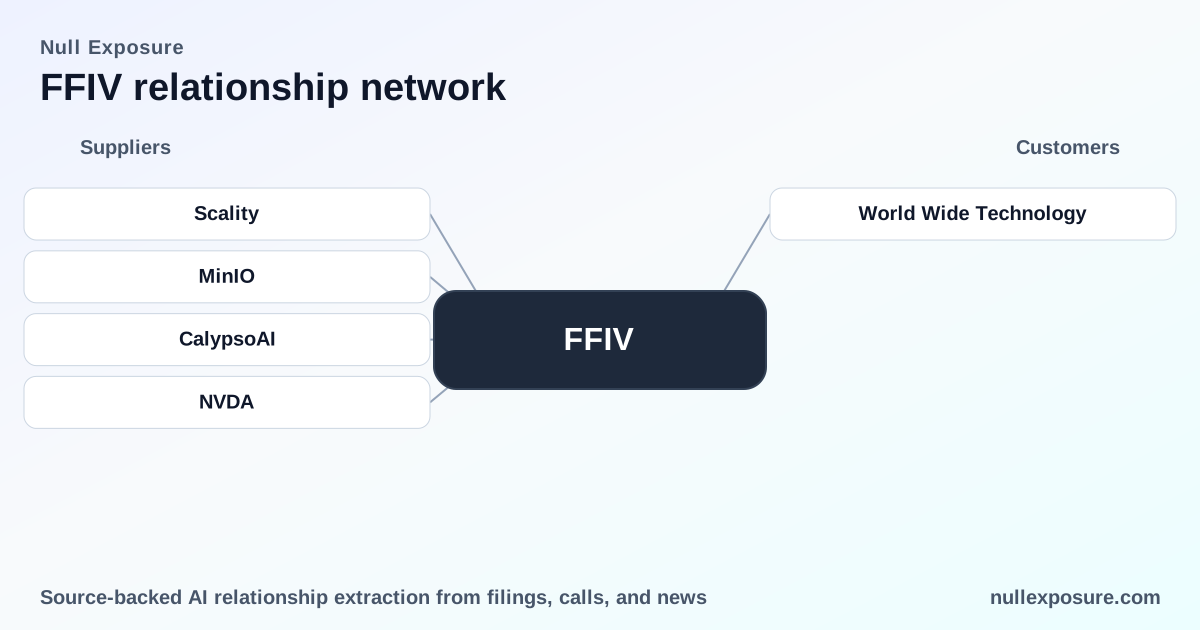
World Wide Technology — expanded support for ARMOR AI and new F5 Labs benchmarks
F5 expanded support for World Wide Technology’s ARMOR AI security framework and launched new F5 Labs benchmarks (CASI and ARS) to evaluate AI model security using CalypsoAI‑derived threat intelligence, reinforcing F5’s product leadership in AI security validation and channel partnerships with global integrators. The activity was reported in March 2026 coverage focused on F5’s benchmark launches and integration with WWT’s ARMOR AI (https://simplywall.st/stocks/us/tech/nasdaq-ffiv/f5/news/does-f5-ffiv-turning-armor-ai-benchmarks-into-standards-resh).
How these relationships translate into the operating model investors care about
These customer items exemplify F5’s dual monetization strategy: sell hardware and enterprise software to capture up‑front value, then convert accounts into subscription and usage revenue for recurring margin. The Telkom engagement illustrates service‑provider and data‑center channel penetration in APAC—an important theater for scale—while the World Wide Technology collaboration shows F5’s route to market through integrators that accelerate enterprise adoption of complex security stacks.
- Contracting posture: Expect a mix of perpetual licenses for appliances and software, term subscription agreements for SaaS and managed services, and usage‑based billing for some cloud and consumption offerings. This mix supports near‑term cash from hardware and long‑term recurring cash from subscriptions.
- Concentration and criticality: Customers are large enterprises or service providers and thus contract sizes are material to account economics and renewal discipline, even if a single customer is not reported as material to total revenue.
- Maturity and product lifecycle: Hardware remains a revenue anchor; software and SaaS are the engines for margin expansion and durability. AI security benchmarks and integrator partnerships accelerate enterprise migration to newer, recurring offerings.
Constraints and company‑level signals investors should model
The company disclosures and evidence set provide actionable constraints you should bake into financial models and risk scenarios:
- Contract types: F5 operates across licensing (perpetual), subscription, and usage‑based models; model a gradual shift toward subscriptions and consumption while preserving periodic hardware revenue spikes.
- Counterparty mix: Customers include large enterprises and governments, implying longer sales cycles, procurement rigor, and potential contract obligations tied to service levels and compliance.
- Geographic exposure: Operations are organized across Americas, EMEA, and APAC; revenue growth and margin will be sensitive to regional demand cycles and channel effectiveness.
- Segment mix: The company sells hardware, software, and services; revenue recognition timing will vary materially by segment (hardware: upfront; software/services: recurring or ratable).
- Credit exposure: Management reports allowance for credit losses as immaterial for the recent fiscal years, signaling low historical counterparty credit losses but continue to monitor for macro shifts that could change collection risk.
Risks that emerge from these relationship types
- Channel concentration risk: Heavy reliance on large integrators and service providers concentrates go‑to‑market influence; a shift in channel economics or partner strategy would affect bookings velocity.
- Transition risk: As F5 pushes customers from appliances to subscriptions, short‑term revenue volatility is possible while lifetime value improves.
- Regional execution: APAC and EMEA are growth engines, but regional regulatory or telecom policy changes (for example, data‑sovereignty rules) can alter deployment costs and timelines.
- Product complexity: AI security and benchmark products require continual investment; failure to maintain differentiation will pressure pricing power.
Investment implications and next steps
For investors, F5 represents a differentiated infrastructure security franchise with a hybrid monetization model that reduces revenue cyclicality over time while preserving margin upside through software and AI‑driven security products. The recent Telkom and World Wide Technology engagements validate both channel and service‑provider plays: one drives regional scale; the other accelerates technical adoption through integrators.
For deeper primary source reading and relationship tracking, refer to the company’s public announcements and partner releases available through the firm’s coverage at https://nullexposure.com/.
Bold, repeatable channel wins and demonstrable AI security IP make F5 a core pick for exposure to application‑layer security and multi‑cloud delivery, provided investors price in execution risk from subscription migration and regional variability.