First Financial Northwest (FFNW): Post‑sale profile and the single counterparty that changes the thesis
First Financial Northwest operated as a regional banking holding company that generated revenue from commercial banking operations through interest income, deposit services and fee income; the company monetized its balance sheet by originating loans and capturing deposit spreads via First Financial Northwest Bank. In 2025 the company completed an asset sale that transfers the bank’s core earning capacity to a credit union acquirer and converts the holding company into a vehicle executing a cash liquidation distribution to shareholders. For investors, the core business that produced recurring revenue has been sold; the remaining value is now a function of transaction economics, liquidation execution and any contingent items retained by the holding company. Visit https://nullexposure.com/ for the underlying sourcing and transaction timeline.
Operational posture, concentration and maturity: an explicit corporate reset FFNW’s operating model has changed from an operating bank holding company to a company that completed an asset sale and is administering the post‑transaction wind‑up. That single strategic event materially alters contracting posture (from ongoing counterparty credit exposure and deposit servicing to one‑off transfer and liquidation mechanics), concentration (the business no longer depends on a portfolio of loans and local deposit relationships to produce cashflow), criticality (the former bank is no longer a continuing operating asset owned by FFNW) and maturity (the company is now in a run‑off/liquidation phase rather than organic growth). These are company‑level signals derived from the announced transaction and subsequent communications; there are no separate constraint excerpts recorded that attach explicit contractual limitations to other counterparties.
For deeper counterparty and governance analysis, see the primary documents and press reporting at https://nullexposure.com/.
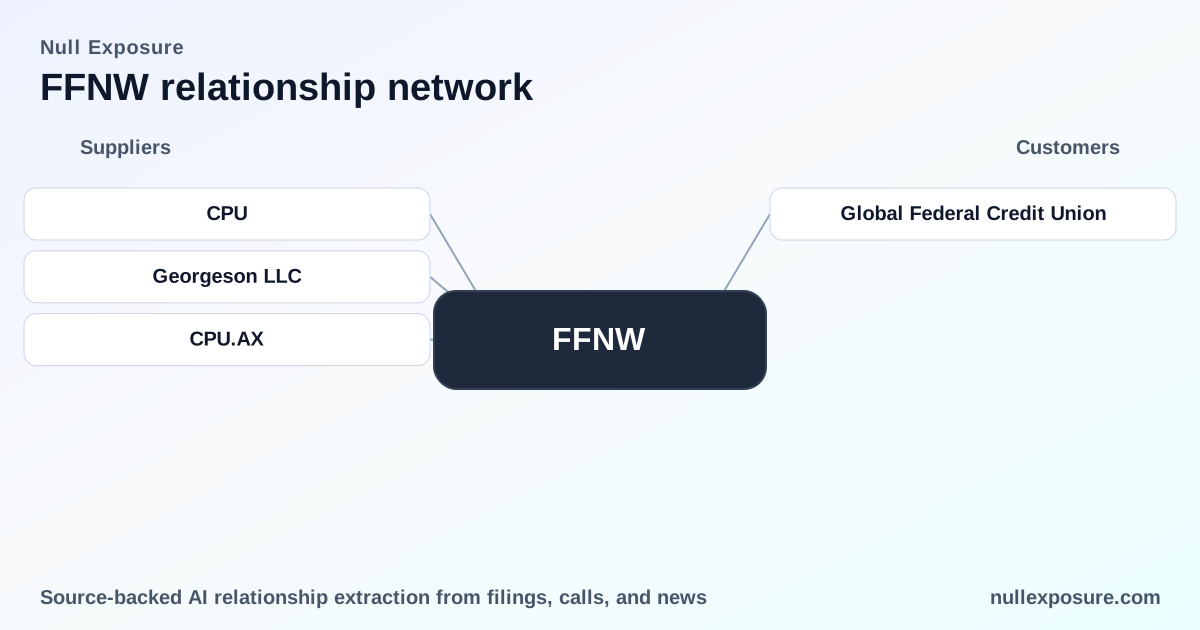
What the Global Federal Credit Union relationship is — and why it matters Global Federal Credit Union is the acquirer that purchased substantially all of the assets and assumed substantially all of the liabilities of First Financial Northwest Bank under a Purchase and Assumption Agreement. The transaction closed effective April 11, 2025, following regulatory approval from the National Credit Union Administration, and converted the bank’s assets and deposit base into the credit union’s operations; CityBiz reported the cash consideration at $228.7 million and the company subsequently announced a final cash liquidation distribution to shareholders. According to GlobeNewswire releases in March 2025 and a Reuters/TradingView notice dated April 11, 2025, Global executed the acquisition and NCUA provided the required approvals; CityBiz and later news items documented the economic terms and the holding company’s liquidation steps.
- Global Federal Credit Union: First Financial Northwest sold substantially all bank assets and deposit liabilities to Global, closing the asset sale on April 11, 2025; the deal received NCUA approval and prompted a final cash liquidation distribution for FFNW shareholders (GlobeNewswire, March 12–14, 2025; Reuters/TradingView, April 11, 2025; CityBiz, April 2025; GlobeNewswire/ManilaTimes reporting on liquidation, November 2025).
Narrative implications for investors and operators
- Revenue engine removed. The bank was the source of recurring net interest income and fee revenue; the asset sale removes those streams from the holding company and converts value into a cash payment and subsequent distributions. Investors should treat future FFNW cashflows as non‑operating and finite rather than as continuing bank earnings.
- Execution and distribution risk now dominate. Value realization depends on the integrity of the purchase and assumption mechanics, timing of liquidation distributions, tax and regulatory contingencies, and any retained or contingent liabilities at the holding company level. Monitoring filings and the company’s liquidation disclosures will capture the remaining value drivers.
- Counterparty dependency is now one transaction, not many customers. The strategic relationship that matters for valuation is the one with Global Federal Credit Union because it executed the economic transfer; operational counterparty complexity inherent to running a bank has been removed from FFNW’s balance sheet.
How to read the public record (what the press reporting shows) The public announcements and regulatory notices are consistent across multiple outlets:
- GlobeNewswire documented the NCUA approval and the initial agreement language in March 2025, framing the deal as an asset sale that transfers substantially all bank assets and deposit liabilities to Global.
- A Reuters/TradingView release dated April 11, 2025 recorded the official closing date for the transaction.
- CityBiz reported the headline cash consideration figure of $228.7 million in its closing announcement, while later press tied the closing to the company’s liquidation distribution communications (GlobeNewswire and follow‑on notices through November 2025).
Interpreting deal economics without inventing numbers The public releases and coverage identify the structure (asset sale with assumption of deposit liabilities) and headline cash consideration reported by some outlets; do not extrapolate recurring margin or net interest projections for FFNW going forward because the core earning assets were transferred. Valuation moving forward is driven by the realized cash distributed to shareholders, remaining corporate liabilities (including any transaction holdbacks or indemnities) and the tax treatment of distributions.
Risk checklist for holders and analysts
- Distribution timing risk: Verify the company’s liquidation schedule and the timeline for the cash distribution filings.
- Contingent liability risk: Confirm whether the purchase and assumption agreement contains indemnities, holdbacks or contingent claims that could reduce distributable proceeds.
- Regulatory and tax treatment: Confirm NCUA closing conditions and any tax consequences for shareholders receiving liquidation distributions.
- Information asymmetry: Maintain close monitoring of FFNW proxy statements, Form 8‑K filings and press releases to capture any late adjustments to the distribution amount or schedule.
Final read and practical steps FFNW is no longer a conventional regional bank holding company for investors to evaluate on the basis of deposit growth, credit performance or net interest margin. The company’s market value and investment case now rest on effective execution of the agreed asset sale, the integrity of the liquidation distribution process, and the resolution of residual liabilities. For a primary source review and a timeline of announcements, see the transaction documentation and press coverage consolidated at https://nullexposure.com/.
Key takeaway: treat FFNW as a liquidation/transaction exposure rather than an ongoing bank investment; focus diligence on distribution mechanics, contingent liabilities and the companies’ regulatory disclosures.