FFWM: Acquisition, servicing exposure, and what buyers should price in
Thesis: First Foundation Inc. (NYSE: FFWM) operates as a dual-segment financial services platform—commercial and consumer banking alongside wealth management—monetizing through interest spread on loans and deposits, fee income from advisory and trust services, and mortgage servicing revenues. Recent corporate actions (a proposed sale to FirstSun Capital Bancorp) and operational signals (concentrated geography, terminating advisory contracts, and retained servicing rights) change the risk-return profile for counterparties and acquirers, and deserve active scrutiny by investors and operators evaluating FFWM customer relationships. For direct access to ongoing relationship intelligence and transaction monitoring, see our homepage: https://nullexposure.com/.
The takeover story and shareholder pushback — clear terms, visible objections
First Foundation agreed to be acquired by FirstSun Capital Bancorp with a fixed exchange ratio: 0.16083 share of FirstSun common stock for each share of First Foundation common stock. That swap ratio is the commercial fulcrum for valuation and liquidity outcomes for FFWM shareholders. A Halper Sadeh LLC investor alert and legal counsel outreach encouraged shareholders to review their options shortly after the deal terms were publicized in early 2026, signaling active dissent among some holders (news post from Halper Sadeh LLC, March 2026). A separate legal notice reported by PR Newswire documents Kahn Swick & Foti’s investigation into the adequacy of the price and process in the proposed sale, underscoring material governance and process risk that could affect deal timing or terms (PR Newswire release, March 2026).
Commercial real estate disposition and Freddie Mac mention — a liquidity channel
Management has discussed potential relationships with Freddie Mac as part of a strategy to reduce commercial real estate exposure and to execute private-party sales where suitable. That disclosure was highlighted in a Mortgage Professional America piece addressing the company’s decision to pare back commercial real estate lending and explore both agency and private sales channels (Mortgage Professional America, coverage tied to FY2024 commentary). The Freddie Mac pathway represents an explicit secondary liquidity and loss-mitigation channel for commercial mortgage exposures.
Relationship inventory: what the records show
Below is a concise, investor-focused inventory covering every relationship surfaced in the source set.
-
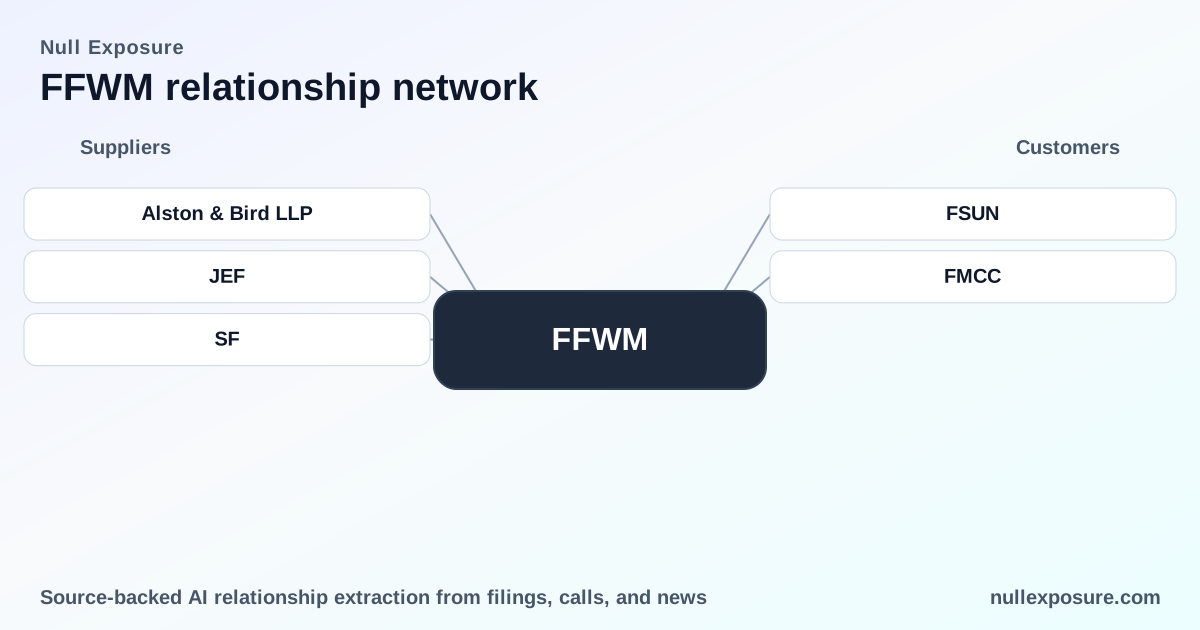
FirstSun Capital Bancorp (FSUN) — First Foundation reached a deal to sell to FirstSun at a fixed share exchange of 0.16083 FirstSun shares per First Foundation share, making FirstSun the acquirer and counterparty of record in the transaction; the deal prompted shareholder outreach and legal scrutiny (Halper Sadeh LLC investor alert; PR Newswire legal investigation notice, March 2026). Source: Halper Sadeh LLC news post and PR Newswire investor alert, March 2026 (see linked reports).
-
Freddie Mac (FMCC) — Management publicly referenced a prospective relationship with Freddie Mac as a mechanism to dispose of or securitize certain commercial real estate exposures and to complement private-party sales; this was disclosed while discussing the company’s commercial real estate strategy in FY2024 commentary (Mortgage Professional America, FY2024 coverage). Source: Mortgage Professional America article covering FY2024.
(Each relationship above corresponds to the public filings and market notices captured in vendor news streams and investor alerts; the two FirstSun entries reflect multiple press and legal notices about the same transaction.)
What the constraints tell a buyer or counterparty — operating-model signals
Taken together, the constraint excerpts form a coherent operating model for FFWM that investors should price explicitly:
-
Contracting posture: short-term and client-terminable. Investment advisory agreements are typically terminable by clients on less than 30 days’ notice, creating exposure to rapid outflows in periods of underperformance or churn. This elevates liquidity and earnings volatility risk for wealth-management fees.
-
Revenue mix: recurring fee element with retail sensitivity. Wealth management produces stable, fee-based recurring revenue, but that stability is contingent on client retention and market performance; deposit and advisory cash flows are therefore defensible but not immune to short-term shocks.
-
Counterparty base: retail-centric and institutionally relevant. Primary counterparties are high-net-worth individuals, retirement plans, charitable institutions, private foundations, small and medium businesses, and mortgage servicing clients—this mix shapes product demand, credit risk, and deposit stability.
-
Geographic concentration: materially regional. Operations are concentrated across California, Florida, Texas, Nevada and, principally, Southern California; historical data shows a high concentration of loans and clients in these states. Geographic concentration increases systemic sensitivity to local real-estate cycles and regulatory shifts.
-
Role and exposure: service provider and mortgage servicer. The firm functions as a service provider—both in wealth advisory and in loan servicing—with retained servicing rights and approximately $1.3 billion in loans serviced for others at recent year-end; servicing fees and escrow liabilities are recurring income drivers but add operational complexity and third-party counterparty risk.
-
Relationship stage and maturity: a mix of mature deposit relationships and active advisory accounts. Large depositor relationships constituted a notable portion of deposits (near 20% of deposits in late 2024), indicating mature, concentrated deposit ties that are important for funding but represent concentration risk.
-
Segments: banking and wealth management combined. The dual reportable segments (Banking and Wealth Management) mean diversified revenue channels but also a two-front operating playbook—credit and interest-rate management for banking, and performance- and retention-driven fee income for wealth.
Key risk vectors and investor takeaways
-
Deal execution and governance risk: Legal investigations and shareholder outreach around the FirstSun transaction create short-term uncertainty on deal timing and potential adjustments to consideration. That governance friction can affect stock liquidity and negotiating leverage.
-
Liquidity and deposit concentration: Large depositor relationships and a material servicing business concentrate funding and counterparty exposure; acquirers must model depositor stickiness under adverse scenarios.
-
Advisory-client volatility: Short-notice terminable advisory contracts create a fast-moving revenue runway; wealth-management revenue is recurring in normal markets but exposed to rapid AUM outflows in stress.
-
Regional credit cycle sensitivity: Heavy concentration in California and a sizeable commercial mortgage exposure mean regional CRE cycles and agency-market channels (e.g., Freddie Mac) materially affect recoveries and capital needs.
Bottom line for investors and operators
First Foundation’s strategic sale to FirstSun and its mix of advisory, servicing and regional banking businesses create a layered exposure set: governance and deal execution risk at the corporate level, operational and funding concentration in deposits and servicing, and revenue sensitivity tied to client retention. Investors should underwrite both the announced exchange-ratio economics and the operational constraints—short-term advisory contracts, geographic concentration, and servicing liabilities—when pricing counterparty or acquisition risk.
For continuing tracking of these relationships, filings, and investor notices, visit our monitoring hub: https://nullexposure.com/.
Bold, targeted due diligence on the deal process and a stress test of deposit and AUM run-off scenarios are the immediate next steps for any buyer or counterparty engaging with FFWM-related exposure.