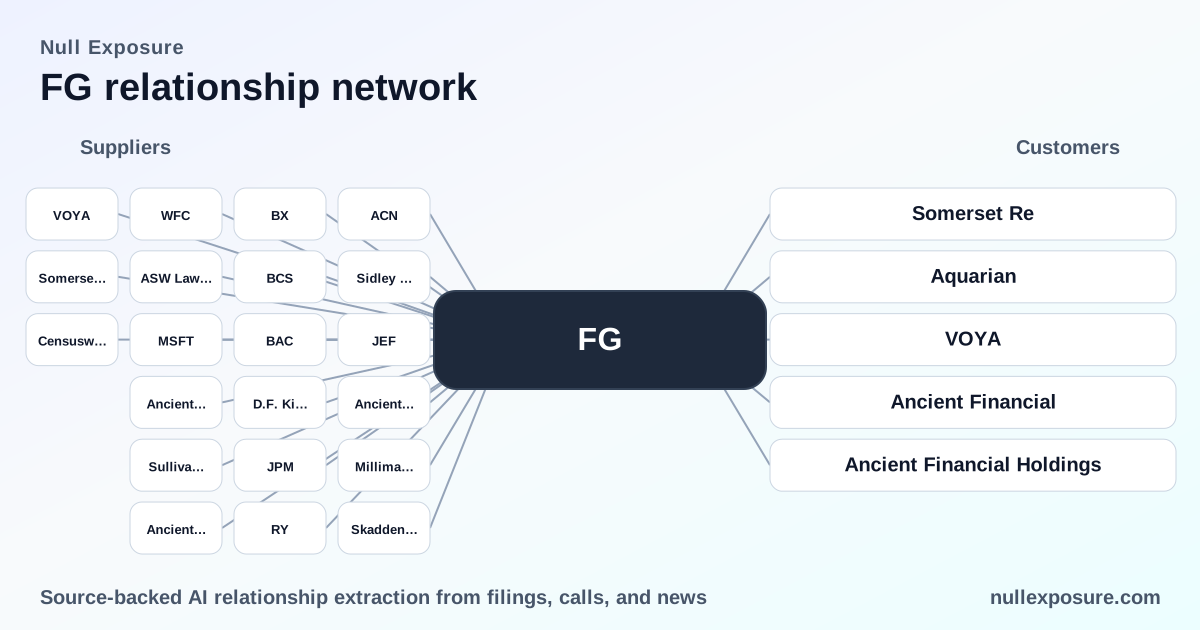
F&G Annuities & Life — customer relationships, strategic posture, and operational constraints
F&G Annuities & Life (NYSE: FG) sells life insurance and a broad suite of annuity products to U.S. retail and institutional channels and monetizes through premiums, annuity reserves that generate investment income, and fee/commission income from distribution. The company expands reach by placing products on third‑party wealth platforms and by selectively monetizing balance‑sheet exposures through reinsurance dispositions, while managing liability duration relative to assets to protect margins. For a deeper view of partner flow and relationship risk, visit NullExposure for structured relationship intelligence: https://nullexposure.com/
Quick investor thesis: what the relationships imply for value creation
- Distribution-led growth. F&G’s recent deals expand third‑party access to its annuity suite and increase potential premium flow without proportionate distribution cost increases.
- Capital strategy in play. The company is actively reshaping capital through reinsurance transactions and a mix of buybacks, which affects earnings volatility and solvency metrics.
- Concentration and geographic focus are material. Revenue is predominantly U.S.-based and focused on mid‑market channels, which concentrates underwriting risk and distribution dependency.
Customer and partner relationships you need to track
Somerset Re
F&G referenced Somerset Re during the 2025 Q4 earnings call in the context of a counterparty that has a relationship with the entity acquiring Brighthouse, indicating Somerset Re is part of the reinsurance/secondary market ecosystem relevant to F&G’s transactions (F&G 2025 Q4 earnings call, Mar 2026).
Aquarian
F&G’s 2025 Q4 earnings call acknowledged a relationship between Somerset and Aquarian, signaling Aquarian’s role in the same network of capital or reinsurance counterparties that interact with F&G’s asset or liability transfers (F&G 2025 Q4 earnings call, Mar 2026).
VOYA
F&G entered a distribution agreement to make its annuity solutions available through Voya Financial’s Wealth Management platform, extending access to financial advisors and increasing potential annuity sales across Voya’s advisor network (PR Newswire / multiple industry reports, Feb–Mar 2026).
Voya Financial, Inc.
Multiple industry outlets and PR announcements confirm the same arrangement: Voya will distribute F&G FIAs, RILAs and MYGAs through its wealth channel, with product education and support for advisors, positioning F&G as a supplier to a large national wealth platform (PlanSponsor; SimplyWallSt; 401kSpecialistMag; Feb–Mar 2026).
VOYA-P-B
Market writeups referencing VOYA‑P‑B (a Voya preferred series ticker) reported the distribution relationship in market news, reinforcing that market participants and press treat the Voya partnership as a material distribution event for F&G (StockTitan / Market commentary, Mar 2026).
Ancient Financial
Ancient Financial is the buyer contracting to acquire F&G Life Re Ltd., a transaction that offloads reinsurance/legal entity exposure from F&G and is part of the company’s broader capital and risk‑management program (InsuranceBusinessMag; MarketScreener, Mar–May 2026).
Ancient Financial Holdings
Industry coverage lists Ancient Financial Holdings as the acquirer in press accounts describing the same reinsurance sale, indicating the counterparty is a newly formed platform backed by hedge fund capital that will assume F&G Life Re Ltd.’s exposures (Insurance news outlets, Mar 2026).
What these relationships reveal about management’s strategy
F&G combines distribution expansion (Voya) with capital recycling (sale of F&G Life Re Ltd. to Ancient Financial) to lift top‑line sales while reducing balance‑sheet risk. The Voya partnership is a distribution multiplier: it converts third‑party advisor access into scalable placement of FIAs, RILAs and MYGAs without F&G having to build an equivalent direct channel. The reinsurance sale to Ancient Financial reduces on‑balance liabilities and transfers longevity or reserve risk to third‑party capital, improving regulatory capital ratios and freeing capacity for growth.
For relationship monitoring and feed‑level tracking, see additional coverage at NullExposure: https://nullexposure.com/
Operational constraints and business‑model signals (company‑level)
The relationship evidence and corporate disclosures produce several company‑level signals that affect contracting posture, concentration, and maturity:
- Long‑term contracting posture. F&G reports in‑force liabilities measured in the tens of billions and a liability duration aligned with assets, which indicates most customer/contract exposures are long‑dated and the company’s economics depend on multi‑year spreads and asset management (company filings, FY2024–FY2025).
- Mid‑market counterparty focus. F&G targets the underserved middle market and sells through Network Marketing Groups and bank/dealer channels, producing concentrated distribution segments that are durable but sensitive to partner economics (company disclosures).
- U.S. geographic concentration. Revenue is derived primarily from the United States and the top retail states account for a large share of sales, which makes economic outcomes correlated to U.S. interest rates and state regulatory regimes.
- Seller and distributor roles. F&G functions as both product seller (annuity and life carrier) and distributor via owned and third‑party channels, generating commissions and platform economics rather than purely fee income.
- Active and ramping relationship stages. Disclosures indicate core relationships are active, while new product channels (e.g., RILA) are in a ramping phase with potential medium‑term growth, implying revenue volatility during the build‑out.
- Service and distribution segment orientation. The company’s business is anchored in insurance services and distribution, which drives margin profiles tied to sales velocity and capital efficiency rather than recurring SaaS‑like economics.
Investment implications and risk checklist
- Positive: The Voya channel expands addressable distribution efficiently and can scale annuity sales without commensurate SG&A increases; reinsurance dispositions improve capital flexibility.
- Negative: Geographic concentration and mid‑market channel dependency raise execution risk if key partners change product preference or if interest‑rate movements compress product spreads. The sale of F&G Life Re Ltd. reduces balance‑sheet risk but transfers future loss experience to an external counterparty, limiting upside from favorable mortality/lapse outcomes.
Bottom line
F&G’s partner activity shows a deliberate two‑track strategy: scale distribution through large wealth platforms while de‑risking the balance sheet via selective reinsurance sales. Investors should watch the Voya channel for actual placement volumes and monitor the Ancient Financial transaction for timing and residual contingent liabilities; both will determine whether F&G converts strategic intent into sustained EPS and ROE improvement.
For ongoing coverage and relationship signal feeds that track counterparties, visit NullExposure: https://nullexposure.com/