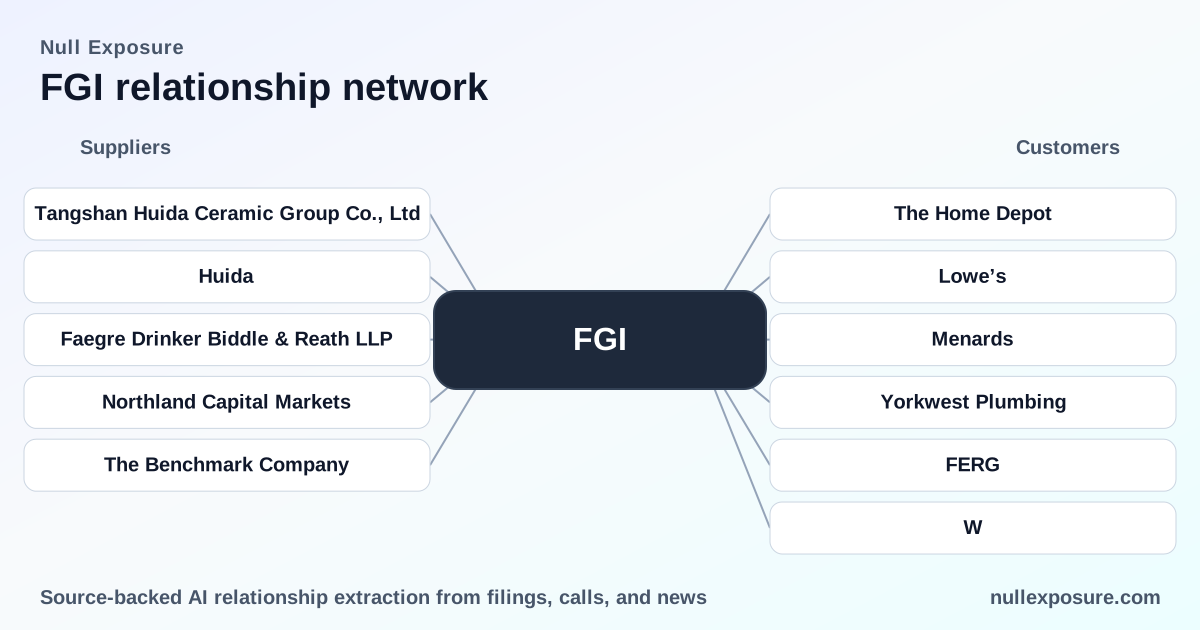
FGI Industries: Retail concentration, private‑label scale, and what customers tell investors
FGI Industries manufactures and sells kitchen and bath fixtures and accessories largely through large home centers, wholesalers and e‑commerce retailers. The company monetizes by producing both branded and private‑label product lines for major buyers, converting scale in manufacturing into margin by owning product design and supply relationships with distributors and retailers. Revenue is concentrated, payment terms are short, and private‑label programs with national chains drive volume and working capital volatility.
Learn more background at https://nullexposure.com/.
Why customer relationships are the central thesis for investors
FGI's business is distribution‑dependent: the company sells into a small number of large counterparties that control shelf space, private labels and national rollouts. That go‑to‑market posture produces high revenue concentration and operational leverage — wins with a single customer move sales materially, and losses compress utilization and margins. Financial metrics (negative EPS, narrow operating margin) underscore how dependent profitability is on sales volume and cost discipline.
Customer roster and what each relationship means for FGI
Below are plain‑English summaries of every customer relationship disclosed in FGI’s FY2024 filing, with source attribution for each entry.
The Home Depot
FGI identifies The Home Depot as one of its largest customers and explicitly notes sales under The Home Depot’s Glacier Bay private‑label brand. According to FGI’s 2024 Form 10‑K, this relationship is a material driver of private‑label volume and national retail distribution for the company.
Lowe’s
Lowe’s is listed among FGI’s largest customers and contributes to the company’s large‑retailer revenue bucket. The 2024 Form 10‑K lists Lowe’s alongside other big home centers as a core retail partner that supports scale manufacturing and private‑label placement.
Menards
Menards appears in FGI’s roster of major customers, representing part of the company’s concentrated large‑retailer exposure that helps deliver national reach in the U.S. market, per the FY2024 Form 10‑K.
Yorkwest Plumbing
In Canada, FGI notes Yorkwest Plumbing as a leading market partner, signaling Canadian wholesale distribution outside the U.S. home‑center channel. The FY2024 Form 10‑K cites Yorkwest Plumbing as a key Canadian account.
Ferguson
Ferguson is identified as a major customer and a private‑label partner, with FGI noting sales under Ferguson’s ProFlo brand in its 2024 Form 10‑K; this positions Ferguson as a strategic commercial wholesaler for FGI’s plumbing and sanitaryware lines.
FERG (duplicate entry for Ferguson)
The filing also indexes Ferguson under the ticker notation “FERG,” repeating that Ferguson/FERG is a large customer and private‑label partner that materially contributes to FGI’s wholesale channel, as disclosed in the 2024 Form 10‑K.
W (Wayfair reference)
FGI’s filing references new e‑commerce retailers and lists “W” as an example of growth channels, identifying e‑commerce as a targeted expansion avenue in FY2024. The 2024 Form 10‑K signals Wayfair‑type platforms as growth channels beyond traditional brick‑and‑mortar.
Wayfair
Wayfair is explicitly called out in the FY2024 Form 10‑K as an example of a new e‑commerce retailer where FGI expects to grow, underscoring a strategic push into direct online retail channels alongside wholesale and big‑box distribution.
Operational constraints and business model signals investors should weigh
The 10‑K disclosures produce several company‑level signals that define FGI’s operating model and risk profile:
- Short‑term payment terms and working capital sensitivity. Customer payment terms generally range from 15 to 60 days after performance, which concentrates cash‑flow timing risk during seasonality and volume swings.
- Large enterprise counterparties dominate go‑to‑market. FGI sells through some of North America’s largest bathroom and kitchen wholesalers and retailers, creating buyer power that compresses pricing and places emphasis on cost control and on‑time fulfillment.
- North America is the revenue epicenter, but product set is global. The company generated the majority of revenue in the U.S. ($82.4m in 2024), while positioning itself as a supplier of globally sourced kitchen and bath categories — a dual footprint that affects sourcing, logistics and FX exposure.
- Revenue concentration is material. Two customers accounted for 17.9% and 16.7% of revenue in 2024, and the top ten customers represented roughly 69% of net sales, which creates single‑counterparty and top‑ten concentration risk to the P&L.
- Channel mix implies different margins and dependencies. Approximately 36% of net sales flowed through wholesale partners (distributors) and about 32% to large retailers (resellers) in 2024, meaning inventory turns and margin dynamics vary materially by channel.
- Mature, long‑standing relationships reduce sales friction but raise switching exposure. FGI reports decades‑long ties with major home centers, which supports recurring revenue but also makes the company dependent on a few buyer contracts and private‑label renewals.
- Core product focus limits diversification. The business concentrates on sanitaryware, bath furniture, showers and cabinetry — a focused product set that helps manufacturing efficiency but raises cyclical exposure tied to housing and renovation cycles.
What this profile means for upside and downside
FGI’s upside is straightforward: expand private‑label penetration, win more national rollouts, and grow e‑commerce placements (Wayfair and equivalents). Margin expansion requires either higher volumes from existing partners or better cost absorption in manufacturing.
Downside follows from concentration and working capital: loss of a major account or delayed payments amplify fixed‑cost leverage and depress profitability (already negative EPS and operating margin). Management must balance pursuing new retail channels against protecting national private‑label relationships.
Investment takeaways and next steps
- Key strengths: private‑label scale with national retailers, mature distribution relationships, and a focused product portfolio that supports operational efficiency.
- Key risks: high customer concentration, short payment terms that pressure cash flow, and exposure to U.S. housing/renovation cycles.
- What to monitor next: renewal status of Glacier Bay and ProFlo programs, wins on e‑commerce rollouts, receivable days and inventory turns, and any shift in top‑customer share.
For a deeper look at customer disclosures and how they translate into commercial risk, visit https://nullexposure.com/ for additional analysis and sourcing.