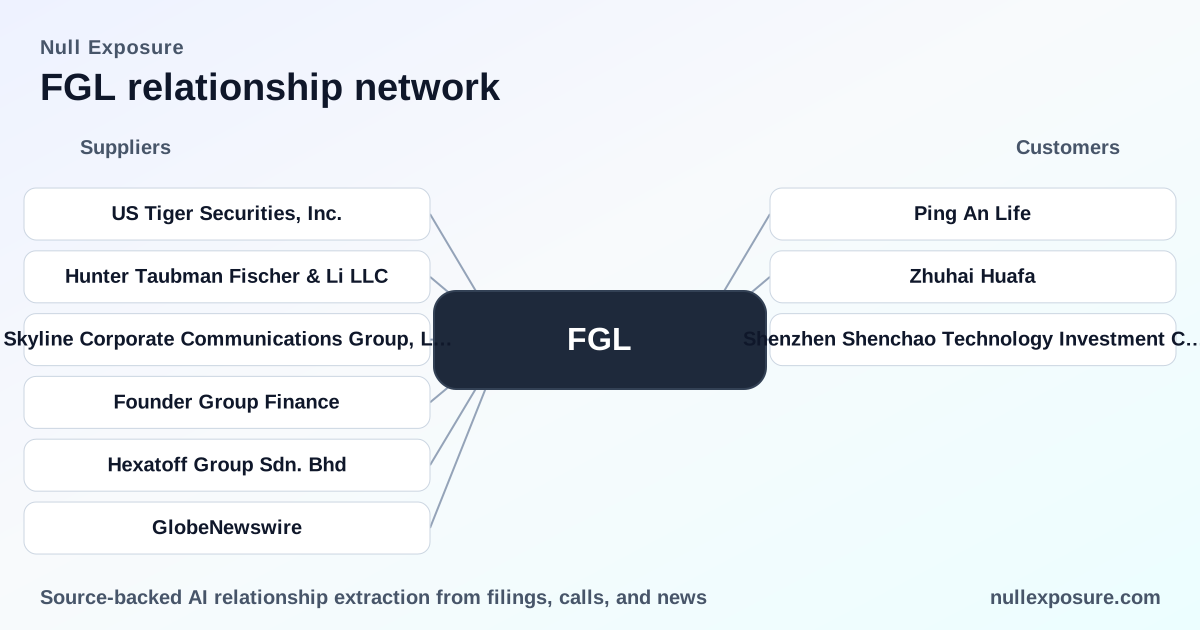
Founder Group Limited (FGL): Relationship Map and What It Means for Investors
Founder Group Limited operates as an industrial/energy project company that monetizes through large project development agreements, strategic asset disposals, and government- or insurer-backed recapitalizations. Recent public reporting shows FGL executing joint ventures in renewable energy, selling specialized semiconductor assets to state-controlled buyers, and participating in complex creditor-driven recapitalizations—an operating mix that delivers episodic cash inflows rather than predictable recurring margins. For a concise view of counterparties and documented deals, see https://nullexposure.com/.
Key investor takeaway up front
- FGL’s revenue drivers are concentrated in episodic, high-dollar transactions—project HoAs and asset sales—rather than steady product or subscription revenues.
- State and quasi-state counterparties appear repeatedly, which raises execution certainty but increases regulatory and political exposure.
- Disclosure is event-driven: most relationship evidence comes from news and filing reports describing single transactions rather than ongoing volume-based customer contracts.
The counterparties that shape recent activity
Below I summarize every customer/partner relationship surfaced in public reporting for FGL, with short, source-backed notes you can act on.
Ping An Life
Ping An Life agreed to acquire a controlling interest in NFG in a deal range that reflected a multi‑billion yuan recapitalization, indicating insurer-led consolidation as a route to liquidity. According to Caixin (May 25, 2021), Ping An Life committed to purchase between 51.1% and 70% of NFG for approximately 37.1 billion to 50.8 billion yuan; the transaction was detailed in a Ping An filing to the Hong Kong exchange.
Zhuhai Huafa
Zhuhai Huafa joined Ping An Life in a creditor-backed payment plan that, together, would cover a significant portion of the vendor price for NFG under several creditor election options. A Caixin report (May 25, 2021) notes that Ping An Life and Zhuhai Huafa would jointly pay between 52.9 billion and 72.5 billion yuan for 73% to 100% of NFG depending on creditor choices in the restructuring options.
Shenzhen Shenchao Technology Investment Co. Ltd.
Semiconductor assets formerly held by the group—including Founder Microelectronics International Co. Ltd.—were carved out and sold to a Shenzhen government-controlled buyer for a fixed cash consideration. Caixin (May 25, 2021) reports those semiconductor assets were excluded from the restructured company and sold for 800 million yuan to Shenzhen Shenchao Technology Investment Co. Ltd.
Planet QEOS Sdn. Bhd.
FGL signed a Heads of Agreement to co-develop a renewable-energy facility in Sarawak with estimated potential contract value in the hundreds of millions of ringgit. A sector report (TS2 Tech, November 2025) documents a Heads of Agreement with Planet QEOS Sdn. Bhd. to jointly develop a Baram, Sarawak renewable-energy project with an estimated value up to RM1.16 billion (≈USD 276 million).
What these relationships collectively reveal about operating posture
With no formal constraints filed in the relationship dataset, the visible partner set still implies several company-level characteristics investors should treat as part of FGL’s operating profile:
- Contracting posture — project and transaction-focused. The counterparties and reported deals are structured as large, bilateral transactions (asset sales, HoAs, insurer acquisitions) rather than recurring customer contracts, so cash flow profile is lumpy and event-driven.
- Counterparty mix — state and institutional counterparties dominate. Government-controlled buyers and major insurers are the primary partners, increasing execution certainty but concentrating political and regulatory risk.
- Concentration and criticality — high-dollar, strategic transactions. Individual deals (e.g., semiconductor carve-outs, multi‑billion yuan recapitalizations, RM1.16bn project HoA) are material to near-term liquidity and strategic positioning.
- Maturity and repeatability — mixed. The relationships include both one-off asset disposals and potential multi-year project development, indicating a hybrid maturity profile where some ties are transactional and others could evolve into longer-term revenue streams.
For a deeper, searchable map of each public relationship and how it tracks to filings and press, visit https://nullexposure.com/.
Investment implications and risk considerations
- Episodic revenue introduces execution risk. FGL’s reported monetization routes rely on closing large, complex transactions; missed closings or delayed creditor elections directly depress near-term cash flow.
- Regulatory and political exposure is elevated. State-controlled purchasers and insurer-led buyouts tie FGL’s outcomes to regulatory approvals and inter-agency negotiation dynamics.
- Disclosure timing can create information lags. The public trail for key events is driven by press reports and filings tied to discrete transactions, so market pricing can be volatile around news.
- Equity structure and shareholder base suggest limited institutional liquidity. Company-level data show modest institutional ownership and a meaningful insider share, which can amplify price moves around transaction news and limit free-float liquidity.
Final read: how to use this map
- Treat announced deals—asset disposals, insurer acquisitions, and large project HoAs—as primary value inflection points for FGL. Monitor filings and Hong Kong/Chinese regulatory notices linked to these counterparties for binary outcomes.
- Position sizing should reflect the lumpy, event-driven nature of cash flow, and investors seeking steadier exposure should demand evidence of recurring contract wins beyond single-project agreements.
Bottom line: FGL’s recent customer footprint is transaction-heavy and weighted toward state or institutional counterparties—this reduces counterparty credit risk but concentrates execution and regulatory risk around a small number of material events. For more detailed relationship traces and primary-source links, browse the mapping resource at https://nullexposure.com/.