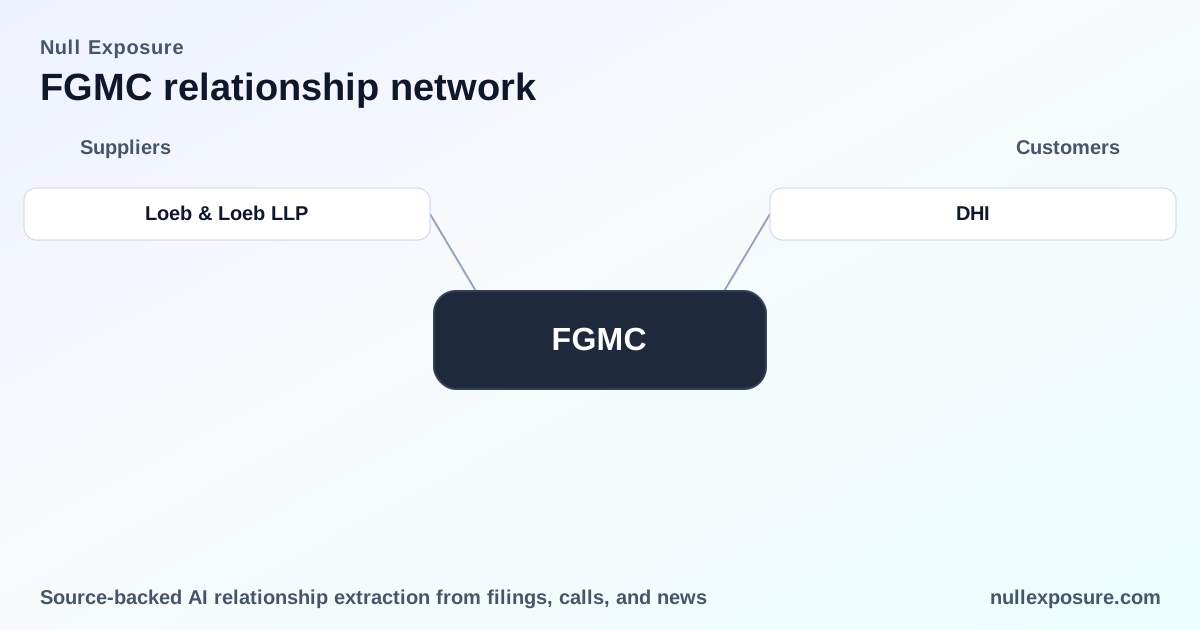
FG Merger II Corp (FGMC): customer relationships and implications for investors
FG Merger II Corp is the public vehicle that brought Boxabl to the Nasdaq, converting a blank‑check shell into an operating equity stake whose returns will be driven by Boxabl’s commercial traction. The company monetizes through Boxabl’s sales and installations of prefabricated modular housing and structures to large builders and institutional buyers, with public equity exposure created by the SPAC business combination. Investors evaluating FGMC should focus on a small set of high‑impact commercial relationships and the pace at which Boxabl converts those proofs‑of‑concept into repeatable revenue. For more context on transaction and customer signals, visit https://nullexposure.com/.
A single deal narrative that changes the profile
Boxabl’s business combination with FG Merger II gave investors exposure to a company pitched as a mass‑market modular housing innovator. According to a Benzinga report from March 9, 2026, the SPAC merger positioned Boxabl at a $3.5 billion valuation, and the same report highlights Boxabl’s early commercial wins with major counterparts including D.R. Horton and the U.S. Department of Defense. Those named partners are high‑power commercial references that materially alter the risk/return profile: they suggest the company is selling into both large private builders and institutional government programs, rather than relying solely on direct‑to‑consumer or pilot projects.
Relationship: DHI
Boxabl’s announced commercial pipeline includes a deal with D.R. Horton, listed under the ticker DHI, signaling a relationship with one of the largest U.S. homebuilders and a practical channel into large‑scale residential development. According to Benzinga (Mar 9, 2026), DHI is a named counterparty in Boxabl’s early commercial roll‑out.
Relationship: D.R. Horton Inc
The same Benzinga report (Mar 9, 2026) repeats that Boxabl “has landed deals with home builder D.R. Horton Inc (NYSE: DHI),” confirming that the company has engaged an industry leader as a commercial partner or customer. A builder relationship with D.R. Horton is a clear demand signal that supports higher potential volume than standalone retail demand.
What those relationships imply for contracting, concentration and criticality
- Contracting posture: Boxabl sells through contract arrangements to large counterparties, which implies negotiated pricing, delivery schedules, and installation obligations rather than purely transactional retail sales. The presence of D.R. Horton and the DoD suggests multi‑year or project‑level contracts will be the norm for high‑value commercial work.
- Concentration: Early revenue is likely concentrated among a handful of large customers. Concentration risk is material because outsized deals with major partners can drive headline growth but also create vulnerability if a single relationship slows.
- Criticality: Relationships with a top residential builder and the DoD are highly strategic—they provide distribution scale and institutional validation that accelerate downstream commercial adoption and investor confidence.
- Maturity: The commercial rollout is early stage in public markets—Boxabl’s profile was significantly shaped by the SPAC completion and its initial named customers. Execution cadence, repeatability of deliveries, and contract margin realization remain the next proof points investors need to observe.
No customer‑level contractual constraints were recorded in the review set for FGMC. That absence is a company‑level signal: there are no extracted constraint entries to indicate standardized disclosure of long‑term customer obligations in the available records, so investors should review the company’s filings and Form‑8‑Ks for contract terms, revenue recognition details, and contingent liability language.
Financial and ownership context that matters to operators and investors
Public market metrics through the most recent quarter (2025‑12‑31) show a market capitalization of $104.7 million with roughly 10.3 million shares outstanding, reflecting the market’s current pricing of the combined entity. Key public ownership and valuation signals include ~76.8% institutional ownership and ~18.9% insider ownership, which indicate concentrated professional attention and significant insider alignment. Reported trailing P/E is 72.64 and the stock has traded in a narrow band around the $10 mark over the prior 52 weeks, suggesting the market prices growth expectations into current equity value.
Risk and upside — a practitioner’s framing
- Upside: The two named customer relationships provide immediate credibility and a route to scale that is not available to many early‑stage manufacturers. Commercial wins with D.R. Horton and the DoD are powerful go‑to‑market accelerants and improve the probability of achieving the valuation implicit at the time of the SPAC deal.
- Execution risks: Converting announced deals into recurring, profitable revenue demands supply‑chain control, installation capability, and consistent product quality at scale. Any delivery delays, cost overruns, or contract renegotiations will have outsized earnings and sentiment effects because of concentration.
- Valuation mismatch: The $3.5 billion implied valuation at the time of the SPAC combination is far larger than the current market capitalization; investors must reconcile commercial scale projections with observable orders, backlog, and reported revenue execution over the coming quarters.
- Disclosure gaps: The lack of extracted contractual constraints signals the need for direct review of SEC filings and 8‑K disclosures to understand termination rights, volume commitments, penalties, and government contracting clauses tied to the DoD work.
Practical next steps for investors and operators
- Review the company’s most recent 8‑K and Form 10 filings to obtain contract terms, backlog figures, and revenue recognition policies tied to D.R. Horton and DoD engagements.
- Track delivery and installation milestones: quarterly disclosures that show shipped units, accepted installations, and recognized revenue are the clearest real‑time proof points of successful commercialization.
- Monitor supply chain and margin commentary: achieving volume requires predictable inputs and installation partners; margin expansion is the critical unlock to justify the post‑SPAC valuation.
For an investor‑level data and relationship overview, see https://nullexposure.com/.
Bottom line
FG Merger II’s public equity is shorthand exposure to Boxabl’s commercialization story. The named relationships with D.R. Horton and the U.S. Department of Defense are material validation events that shift the risk profile from concept to early commercialization. Investors must now focus on execution cadence: contract terms, delivery performance, and margin realization will determine whether the SPAC valuation thesis translates into durable equity value.