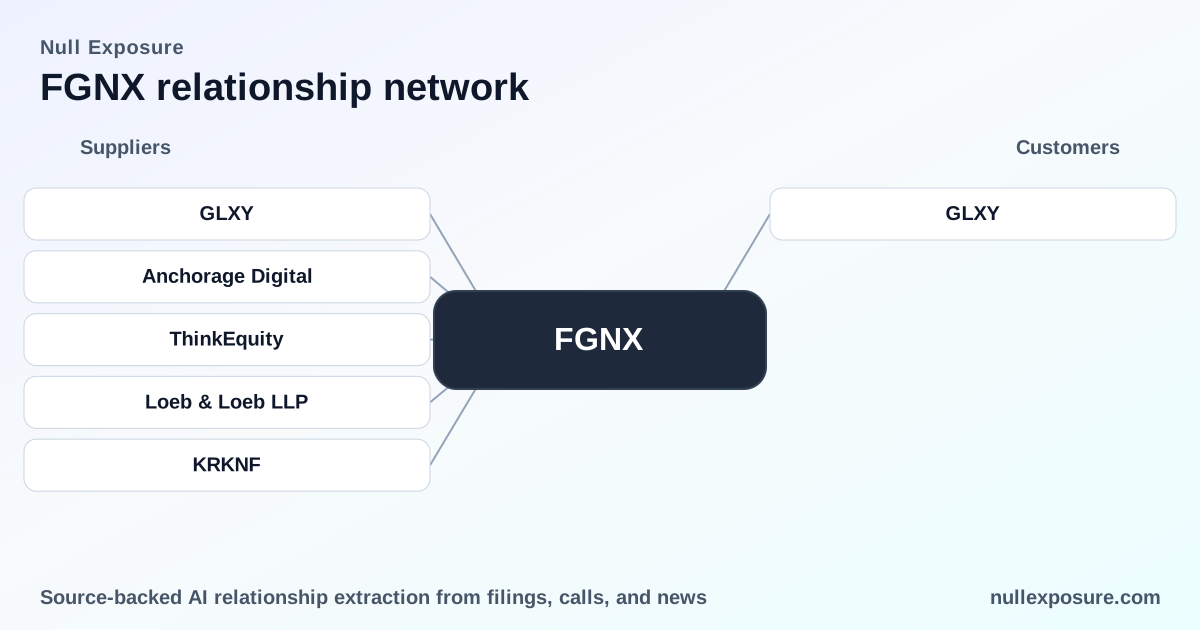
Fundamental Global (FGNX): recent counterparty moves that reshape risk and liquidity
Fundamental Global Inc. (FGNX) runs a hybrid financial-services model—reinsurance, merchant banking and asset management—monetizing through underwriting and risk transfer, disposition of insurance assets, and investment activities within its merchant banking arm. Recent counterparty actions show management is actively converting balance-sheet insurance exposure and crypto holdings into cash, a tactical shift that materially affects liquidity, counterparties and investor concentration dynamics. Learn more at https://nullexposure.com/.
Why these counterparty events matter now
FGNX is a small-cap financial company with limited revenue scale and a negative EBITDA profile; its decisions to sell business units and liquidate positions are both balance-sheet management and strategy execution. These transactions reduce operational complexity but also move risk to a small set of counterparties, changing counterparty concentration and cash runway. Below I map each reported relationship in the public record and explain the immediate investor implications.
Devondale Holdings — buyer completes FG Reinsurance purchase (Investing.com, May 2026)
FG Nexus announced completion of the sale of its FG Reinsurance Division to Devondale Holdings, LLC, following receipt of a $1.0 million cash payment, signaling a formal transfer of that reinsurance business line and an immediate liquidity infusion to FGNX. According to an Investing.com SEC-filings summary published May 2, 2026, the transaction is presented as a closing event that monetizes legacy underwriting assets and reduces operating complexity.
Devondale Holdings — initial closing recorded in bylaws filing (Investing.com, May 2026)
A separate Investing.com notice tied to FGNX’s bylaw amendment references the initial closing of the transaction transferring the reinsurance division to Devondale Holdings; that filing documents corporate housekeeping consistent with the asset sale. The May 2, 2026 Investing.com filing frames the sale as an executed step in corporate reorganization and governance adjustments related to the divestiture.
Devondale references repeated across filings (Investing.com, May 2026)
Multiple filings and press summaries from early May 2026 reiterate the Devondale transaction and the closing milestones, creating a consistent public trail that confirms both the operational handoff and recognition of proceeds in the FY2026 period. Investors should treat those multiple references as corroborating evidence of completion and immediate cash impact.
Galaxy Digital — purchaser for crypto liquidation (TradingView, March 2026)
FGNX routed a crypto asset sale through Galaxy Digital as part of a liquidity extraction strategy; TradingView’s March 9, 2026 coverage reported the route to Galaxy Digital and characterized the sale as a rapid exit to cash following heavy unrealized losses. That sale confirms FGNX is using specialized crypto financial firms to convert volatile digital assets into liquidity rather than retaining the positions.
GLXY (ticker) — trade execution counterpart (TradingView, March 2026)
The same March 2026 reporting identifies the counterparty via its market ticker (GLXY), underscoring that the transaction used established market counterparties rather than private placements. The public coverage indicates FGNX prioritized immediate cash generation over holding volatile positions through market cycles.
What the counterparties imply about FGNX’s contracting posture and business model
These transactions, and the related corporate disclosures, lead to clear, company-level signals about how FGNX manages customer and counterparty relationships:
- Contracting posture: short-term and opportunistic. Operational excerpts show many service arrangements are annual and terminable at will, and sales proceeds from asset dispositions are being used to reallocate capital quickly. This is a company behavior pattern, not a relationship-specific claim.
- Geographic focus: North America-centric. Corporate language lists US, Canada and Mexico exposures as the relevant markets, signaling regional concentration of customers and counterparties.
- Concentration is material to results. Management disclosures state the top-ten customers accounted for roughly 40% of revenues in recent years and a single customer exceeded 10% of revenues and receivables—an elevated concentration profile that magnifies counterparty risk for investors.
- Role and capability: active service provider and distributor. FGNX operates a managed-services business (Strong Technical Services) supplying mission-critical field and remote services, and operates distribution agreements with established hardware suppliers—indicating the company mixes recurring services with product distribution revenue.
- Relationship maturity: active but transactional. The firm runs active managed-service lines while also engaging in discrete asset sales and market exits, reflecting a mixed operational maturity where some parts are ongoing services and others are monetized opportunistically.
- Segments: distribution and services are core revenue drivers. The company states it operates primarily in merchant banking and managed services; the active distribution agreements and service contracts are central to near-term revenue generation.
Investor implications and risk checklist
- Liquidity vs. long-term earnings: The sale of the reinsurance division and crypto liquidations provide immediate cash but reduce future fee and underwriting income streams. Investors should value the trade-off between cleaned balance-sheet and lost recurring earnings.
- Counterparty concentration risk: Routing material disposals through a handful of counterparties heightens reliance on those firms’ pricing and settlement practices; with top customers already accounting for a large revenue share, a small-cap with limited market depth becomes vulnerable to single-counterparty dynamics.
- Operational simplicity vs. strategic optionality: Divesting the reinsurance division simplifies operations and reduces regulatory and underwriting complexity, but it also reduces strategic optionality in a cyclical insurance market.
- Signal of tactical capital management: Using Galaxy Digital and similar counterparties to generate cash during periods of mark-to-market losses signals a defensive liquidity posture rather than aggressive market redeployment.
If you want a consolidated counterparty view or a tailored watchlist built from these filings and news signals, visit https://nullexposure.com/ for detailed tracking and alerts.
Bottom line: a company shrinking exposure while concentrating counterparties
Fundamental Global is executing a clear deleveraging and liquidity strategy—selling reinsurance operations and liquidating crypto assets through market counterparties—that materially changes its revenue composition and counterparty map. For investors and operators, the core trade is between improved immediate liquidity and lower future earnings diversity, amplified by material customer concentration and a short-term contracting posture that require ongoing monitoring of counterparties and cash runway.