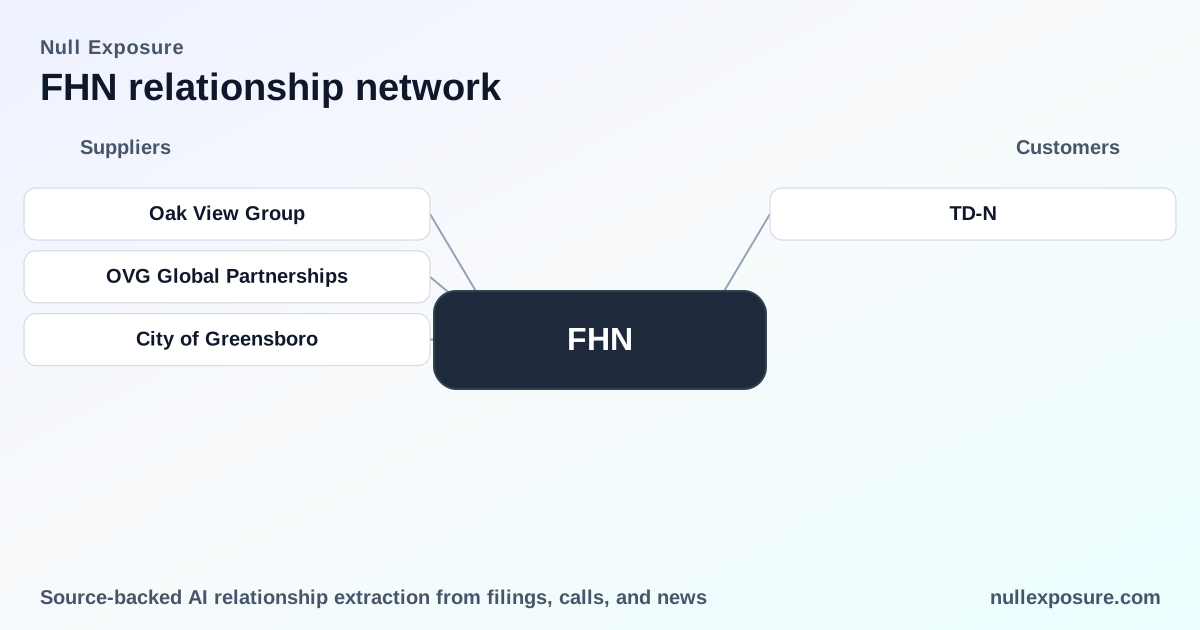
First Horizon (FHN): Customer Relationships and Commercial Profile
First Horizon Corporation operates as a regional banking holding company centered on First Horizon Bank, monetizing through net interest income on lending and deposits plus a significant stream of fee-based services (payments, cash management, wealth and capital markets). Lending is the largest asset and a core revenue driver, while fee revenues and wholesale activities diversify margins and client touchpoints. For primary source access and relationship intelligence on FHN, visit https://nullexposure.com/.
How investors should read customer links: business model implications, not anecdotes
First Horizon is a broadly diversified regional bank with a southern U.S. footprint and a wholesale presence that connects it to institutional counterparties. The operating model combines traditional deposit-funded lending with services for consumer, commercial and institutional clients; this produces a mixed contracting posture that is both transactional (deposit and payments flows) and relationship-driven (commercial lending, syndicated facilities, and capital markets work).
Key company-level signals drawn from operating disclosures:
- Geographic concentration in North America, chiefly the southern U.S. — over 450 locations in 24 states and the majority of retail/commercial activity focused in the South, indicating regional exposure and competitive positioning in chosen markets.
- Counterparty mix spans individuals, small and large enterprises, and governmental/institutional clients, reflecting diversified revenue sources from retail deposits, commercial loans, and fixed-income/wholesale services.
- Revenue mix combines interest income with fee-based services, so customer relationships produce both balance-sheet (loan/deposit) risk and fee-based, lower-capital revenue streams.
- No single-client dependency; management asserts the company is not dependent on a single customer or a very small group of clients, which reduces counterparty concentration risk relative to single-account-dependent businesses.
- Maturity and criticality: lending is a material line (loans are largest asset), while many commercial relationships are standard bank counterparties or sponsorships that are non-core to credit exposure.
These constraints indicate a resilient, diversified commercial model with localized execution risk and wholesale lines that extend reach beyond branch markets. For an at-a-glance package on these relationships, see https://nullexposure.com/.
Relationship-by-relationship reporting (source-by-source)
Below I cover every relationship flagged in the source material, with plain-English summaries and citations.
New Orleans Jazz & Heritage Festival (FY2026)
First Horizon expanded marketing and community engagement by naming itself “Official Bank and Credit Card of Jazz Fest” and launched an exclusive First Horizon Lounge for cardholders in 2026, signaling consumer-branding and cardholder activation investments. (Sahm Capital press release, April 2026: https://www.sahmcapital.com/news/content/first-horizon-bank-and-new-orleans-jazz-heritage-festival-celebrate-11-years-of-partnership-new-first-horizon-lounge-debuts-near-main-stage-for-cardholders-2026-04-02)
SWK Holdings / SWKHL — TradingView report (FY2026)
A recent report notes SWK Holdings terminated and repaid in full its credit facility with First Horizon, releasing liens and closing that bilateral credit exposure. This indicates a resolved credit relationship where outstanding obligations have been satisfied. (TradingView article, May 2026: https://www.tradingview.com/news/tradingview:40ac5921cede4:0-swk-holdings-tightens-covenants-on-9-2027-notes-after-rway-deal-adds-default-triggers/)
Cousins Properties (CUZ) — Yahoo/SG Finance (FY2026)
Cousins Properties upsized an unsecured revolving facility in which First Horizon Bank participates as a lender, positioning FHN as a participant lender rather than sole arranger; this demonstrates continued engagement in commercial real-estate lending syndication. (Yahoo/SG.Finance reporting, May 2026: https://sg.finance.yahoo.com/news/cousins-properties-upsizes-unsecured-revolving-201500819.html)
TD Bank Group (FY2022)
TD Bank Group signed a definitive agreement (announced in FY2022) to acquire 412 First Horizon branches, a material branch-sale transaction that reshaped First Horizon’s retail footprint and strategic capital deployment. (Local Memphis coverage, FY2022: https://www.localmemphis.com/article/news/local/first-horizon-td-bang-group/522-cd8e346d-961e-48b7-bc23-3d549794e4b6)
SWK Holdings / SWKHL — Investing.com (FY2026)
A separate investing.com filing corroborates that SWK Holdings and subsidiaries completed termination of commitments under a credit agreement with First Horizon Bank, with obligations repaid and guarantees released; this is consistent with the TradingView notice and confirms closure of the credit exposure. (Investing.com SEC filing summary, May 2026: https://za.investing.com/news/sec-filings/swk-holdings-completes-merger-with-runway-growth-finance-delists-from-nasdaq-93CH-4198409)
Toronto‑Dominion Bank (TD‑N) — The Globe and Mail (FY2023)
When an agreed TD/First Horizon deal did not close by a milestone date in FY2023, TD was contractually required to pay First Horizon a monthly premium of 5.4 cents per share until closing; this is a negotiated break or delay fee embedded in the M&A timetable. (The Globe and Mail, March 2026 reporting: https://www.theglobeandmail.com/business/article-bmo-td-takeover-delays-costs/)
Duplicate mention: Toronto‑Dominion Bank (TD‑N) repetition (FY2023)
The Globe and Mail article was referenced multiple times in the source set with the same detail — the recurring citation underscores the commercial significance of the M&A timeline clause and its cash flow implications for First Horizon during the delay period. (The Globe and Mail, March 2026)
Fifth + Broadway (FY2021)
First Horizon Bank was named the official bank of Fifth + Broadway (a Nashville mixed-use development), reflecting local corporate sponsorship and consumer banking positioning dating to FY2021. This relationship is a marketing and deposit-acquisition channel rather than a credit exposure. (Business Journals coverage, July 2021: https://www.bizjournals.com/nashville/news/2021/07/26/first-horizon-to-be-official-bank-of-fifth-broad.html)
What these relationships signal for risk and opportunity
- Credit exposure lifecycle: The SWKHL cancellations and repayments show First Horizon executes standard credit enforcement and exit mechanics; loan terminations reduce balance-sheet credit exposure and free up capital for redeployment.
- Syndication and participant lending: Participation in Cousins Properties’ revolving facility indicates FHN participates in syndicated or club lending, balancing origination with distribution risk.
- Fee and deposit acquisition strategies: Sponsorships with Jazz Fest and Fifth + Broadway are customer-acquisition and brand initiatives aimed at deposit and card revenue growth rather than material credit relationships.
- M&A-driven cash inflows: Contractual delay fees from the TD/First Horizon transaction generate a predictable, short-term cash stream tied to deal timing and create a modest upside while structural outcomes are resolved.
- Geographic and counterparty diversification: Company disclosures classify counterparties across individuals, small and large businesses, and governmental entities; no single client concentration reduces vulnerability to idiosyncratic counterparty failure.
Investor takeaway and action points
- First Horizon remains a regional bank with diversified revenue sources — lending is material, and fee-based services are significant for margin stability.
- Observed customer relationships are mostly non-core marketing or standard credit/syndicated interactions, not single-client dependencies that would create outsized concentration risk.
- Active credit lifecycle management is visible in recent SWKHL repayments, and participation in commercial facilities preserves lending scale while distributing risk.
For a consolidated view of FHN’s counterparty relationships and how they influence credit and fee dynamics, consult the relationship intelligence hub at https://nullexposure.com/.