Foghorn Therapeutics (FHTX): Customer Relationships and Strategic Implications
Foghorn Therapeutics is a clinical‑stage biotech that discovers and develops drugs targeting chromatin regulatory mechanisms; it monetizes primarily through strategic collaborations and licensing deals that deliver large upfront payments, cost‑sharing development arrangements, and milestone‑linked revenue, supplemented by selective equity financings to shore up the balance sheet. These partner contracts function as the firm's revenue engine today and the route to commercial optionality if clinical programs validate. Learn more at https://nullexposure.com/.
Partnering, not product sales, drives the business
Foghorn runs a partnership‑first operating model: the company performs early discovery and preclinical work and then shares development and commercialization responsibilities — and economics — with larger pharmaceutical partners. That structure concentrates clinical risk with Foghorn’s scientific platform while outsourcing late‑stage development capital intensity to collaborators. For investors, the result is asymmetric revenue and cashflow dynamics: large, lumpy upfront and deferred revenue tied to partner agreements, and recurring operational dependence on collaborator execution.
Relationship breakdown — every counterpart in the record
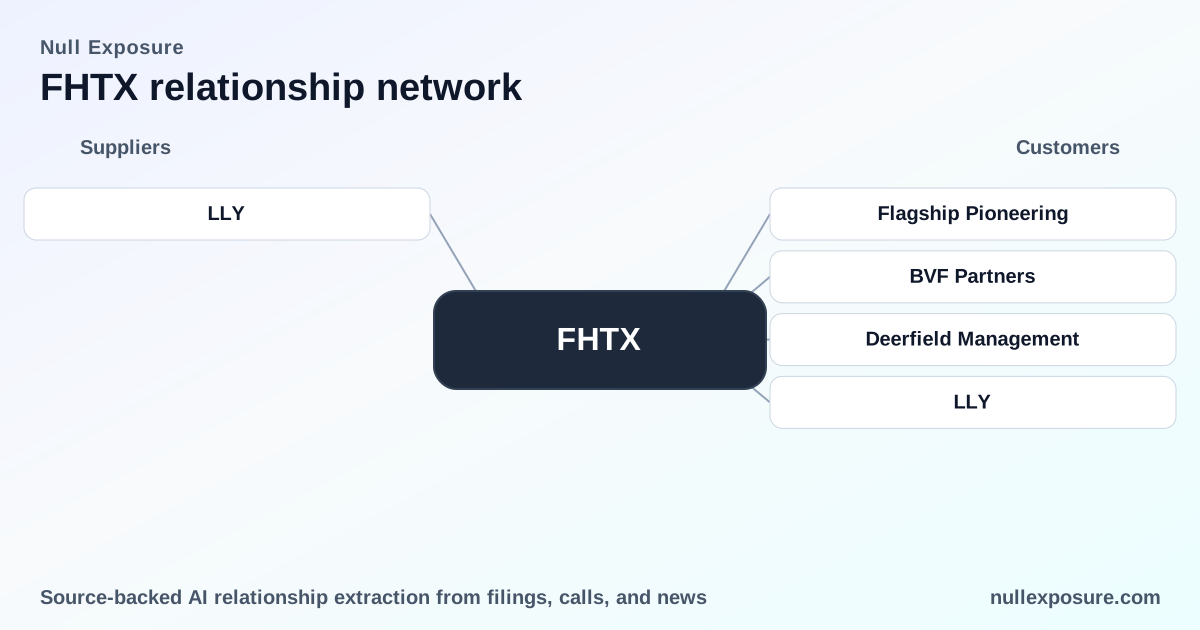
Lilly / Eli Lilly and Company (LLY)
Foghorn has a comprehensive collaboration with Eli Lilly that includes a U.S. 50/50 co‑development and co‑commercialization agreement for the selective SMARCA2 oncology program (covering both a selective inhibitor and a selective degrader) plus an additional undisclosed oncology target; the arrangement has been accounted for under ASC 606 as a customer relationship and has generated recognized revenue and deferred revenue balances. According to Foghorn’s FY2024 10‑K and company press releases in early 2026, this collaboration features significant cost‑sharing, U.S. profit split and ex‑U.S. royalty mechanics. (Sources: Foghorn FY2024 10‑K; GlobeNewswire and company financial updates, Jan–Mar 2026.)
BVF Partners
BVF Partners participated in Foghorn’s January 2026 equity financing, joining other life‑science investors in a roughly $50 million capital raise composed of common stock, pre‑funded warrants and premium‑priced warrants; the financing was priced at a 30% premium to the then‑closing share price and was expected to close January 13, 2026. (Source: Globe and Mail / press release, Jan 2026.)
Flagship Pioneering
Flagship Pioneering is one of the life‑science investors named in Foghorn’s January 2026 equity placement, providing strategic capital as part of the $50 million financing that strengthens the company’s runway and supports oncology program advancement. (Source: Globe and Mail / company press release, Jan 2026.)
Deerfield Management
Deerfield Management joined the same January 2026 investor syndicate that agreed to the $50 million financing package, signaling continued institutional support from specialized healthcare investors for Foghorn’s oncology pipeline execution. (Source: Globe and Mail / company press release, Jan 2026.)
What the contract constraints reveal about the operating model
-
Long‑duration performance obligations at the company level. Foghorn disclosed an unsatisfied portion of transaction price of approximately $280.1 million expected to be recognized as revenue through 2029 or beyond, which signals multi‑year revenue recognition tied to ongoing development work and long lead times for satisfaction of obligations. This is a company‑level signal of long‑term cash conversion timelines. (Evidence excerpt: transaction price recognition through 2029.)
-
Material strategic concentration with Lilly. Multiple constraint excerpts explicitly name Lilly: the collaboration is global in scope (worldwide development and commercial economics with U.S. profit sharing and ex‑U.S. royalties), the company acts as a service provider for discovery and early research while Lilly leads later development, and the arrangement is recognized as a single performance obligation under ASC 606. Those excerpts establish Lilly as a highly critical partner in both revenue and program advancement. (Evidence: Lilly‑referencing collaboration language in management filings and press releases.)
-
Spend scale and financial anchoring. The Lilly agreement included a nonrefundable $300 million upfront payment and an initial transaction price of $337.8 million recorded as deferred revenue; this places Lilly in the $100m+ spend band and provides a material balance‑sheet cushion that underpins near‑term operations. (Evidence: excerpt referencing $300.0 million upfront and $337.8 million deferred transaction price.)
-
Active engagement and service delivery. The collaboration is an active, service‑oriented relationship: Foghorn continues to perform research and development activities and recognize revenue as performance obligations are satisfied, which places operational emphasis on execution of discovery and early clinical tasks. (Evidence: deferred revenue being recognized as obligations are satisfied.)
Taken together, these constraints show a firm that is partner‑dependent, engaged in long‑horizon commitments, and materially capitalized by a single large collaboration while supplementing liquidity through targeted equity placements.
Financial and strategic implications for investors
-
Concentration risk is elevated but paired with material near‑term cash support. The Lilly collaboration delivers both revenue and development capital (the $300M upfront), which reduces short‑term dilution risk and funds program advancement; however, that same dependence creates concentration exposure if clinical or strategic dynamics with Lilly change.
-
Execution‑driven value realization. Foghorn’s upside to the analyst community and equity investors is contingent on clinical progress of the SMARCA2 program and successful co‑development with Lilly; revenue will remain lumpy and tied to milestone and recognition timing, while meaningful commercialization upside requires positive trial readouts and effective U.S. co‑commercial execution.
-
Capital strategy is complementary to partnerships. The January 2026 equity financing led by BVF, Flagship and Deerfield at a premium price underscores investor confidence and provides incremental liquidity to support dose‑escalation and selective degrader programs. (Source: Globe and Mail / Jan 2026 press release.)
-
Operational posture: service‑focused, discovery‑heavy, late‑stage outsourced. Foghorn’s role is to own early discovery and translational work and to deliver defined development deliverables to partners; this reduces the firm’s need to self‑fund registrational trials while increasing reliance on collaborator decisioning for late‑stage activities.
Bottom line and what to watch next
Foghorn’s business is partner‑centric: a single large collaboration with Lilly anchors revenue, development work and deferred income recognition, while equity financings with specialized life‑science investors provide liquidity buffers. Key near‑term catalysts for investors are clinical readouts from SMARCA2 dose escalation, any amendment or opt‑out decisions under the Lilly agreement, and the pace at which deferred revenue is recognized versus cash burn. For ongoing monitoring of these relationship dynamics and their financial impact, visit https://nullexposure.com/ for structured signals and reporting.
(Selected sources referenced above include Foghorn’s FY2024 10‑K and company press releases and market reports from GlobeNewswire, Globe and Mail, TradingView/QuiverQuant, InvestingNews and SahmCapital in the January–March 2026 period.)