First Interstate BancSystem (FIBK): Branch Sales, Counterparty Mix, and What Investors Should Know
First Interstate BancSystem is a regional bank holding company that monetizes through net interest income, fee-based services, mortgage loan sales, and trust/asset management across a 14‑state footprint. The company runs a classic community‑bank model: deposit gathering and commercial lending supported by payments, mortgage origination and secondary market sales, and fiduciary services. Recent branch divestitures to peers signal a tactical reshaping of retail footprint rather than a retreat from core markets. For more context on where this intelligence comes from, visit https://nullexposure.com/.
Quick take: strategy in plain English
First Interstate operates 300 offices across the Mountain West and Midwest and generates revenues primarily through lending spread and ancillary service fees (Revenue TTM ≈ $1.04bn; Market Cap ≈ $3.41bn). Its business model is regional, service‑oriented, and transactionally focused — the firm intermediates deposits and executes short‑dated liquidity contracts while selling mortgage originations and offering swap intermediation for corporate customers. Financial metrics (trailing P/E ≈ 11.6; Price/Book ≈ 1.03) reflect a mature regional bank trading near book with modest profitability (ROE ≈ 9.3%).
What the branch sales tell investors
The company announced multiple branch sales in 2025 that reduce physical scale in selected markets while transferring customer relationships to other regional banks. These divestitures are consistent with a strategic posture that prioritizes capital and efficiency over retaining every low‑productivity branch. For investors, that implies modest near‑term fee and deposit volatility but improved capital redeployment optionality. A mid‑article note: explore additional context at https://nullexposure.com/.
Constraints and what they reveal about operating risk
The textual evidence about First Interstate’s contracts and counterparties provides useful behavioral signals for underwriters and portfolio analysts:
- Contracting posture — short‑term and transactional. Repurchase agreements are overnight and routinely executed, showing the bank actively manages short‑term liquidity and takes transactional positions rather than long‑dated repo exposures.
- Counterparty breadth — mixed retail, government and nonprofit exposure. The firm deliberately serves individuals, businesses, municipalities and nonprofit organizations across its markets, indicating revenue diversification across retail depositors, public entities, and commercial borrowers.
- Geographic concentration — regional, not national. Clients and credit performance are materially dependent on economic conditions across 14 contiguous states (Arizona through Wyoming), so macro shocks in those regions will disproportionately affect First Interstate.
- Materiality profile — idiosyncratic credit risk exists. The company disclosed a single large commercial loan partial charge‑off (~$49.3m in Q4 2024), signaling credit concentration tail risk does occur despite generally diversified retail deposit flows.
- Revenue mix — services led and relatively mature. The bank identifies one operating segment (community banking) and acts as a service provider (payments, swaps intermediary, trust services) while selling mortgage loans on the secondary market; mortgage banking fees are reported as immaterial relative to total results.
- Relationship posture — active service provider and seller. First Interstate actively executes interest‑rate swaps as an intermediary and sells residential mortgages on best‑efforts or mandatory basis, showing a balanced mix of client servicing and capital‑market activity.
These constraints read as company‑level signals about maturity (established community bank), criticality (some single-name credit risk), concentration (regional exposure), and contracting style (short-term liquidity orientation).
Deal‑by‑deal rundown — every relationship captured in the source set
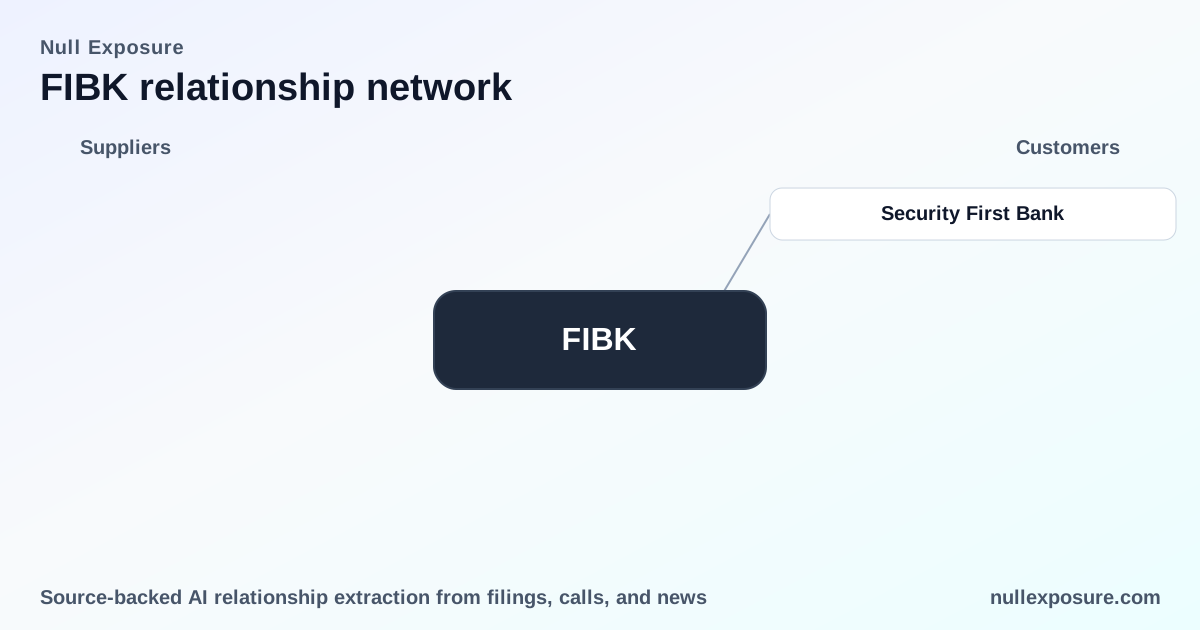
Security First Bank — branch sale announced
First Interstate announced the sale of eleven branches to Security First Bank on October 16, 2025, a discrete retail‑bank divestiture intended to rationalize branch footprint and transfer local deposit relationships. TradingView covered the announcement in March 2026 reporting the October 2025 transaction (TradingView news, published March 9, 2026).
Enterprise Financial Services Corp / Enterprise Bank & Trust (EFSC) — agreement to acquire 12 branches
Enterprise Bank & Trust, a subsidiary of Enterprise Financial Services Corp (Nasdaq: EFSC), signed a purchase and assumption agreement to acquire twelve branches from First Interstate, transferring deposits and branch staff to Enterprise’s platform. The transaction was reported on ADVFN in March 2026 as part of a FY2025 disclosure (br.advfn.com, March 2026).
EFSCP — SEC filing note on branch acquisition and geographic expansion
A TradingView summary of Enterprise Financial Services’ SEC filing noted that in 2025 Enterprise acquired 12 branches from First Interstate, expanding its footprint in Arizona and the Kansas City area, reinforcing that these were corridor‑specific transfers rather than a broad market exit. The TradingView recap referenced Enterprise’s FY2026 reporting (TradingView SEC filing summary, March 9, 2026).
EFSCP — Simply Wall St coverage of the Arizona/Kansas City expansion
Simply Wall St reiterated that Enterprise’s acquisition involved 12 First Interstate branches in Arizona and Kansas City, highlighting the geographic focus and strategic market accretion for Enterprise rather than systematic consolidation. This was covered in Simply Wall St’s March 2026 reporting (simplywall.st, March 2026).
EFSC — management commentary on closing the branch acquisition
Enterprise’s management publicly acknowledged the transaction on an earnings call, stating they look forward to closing on the branch acquisition and integrating the new clients and associates into Enterprise’s platform — an operational confirmation of the deal’s near‑term execution. This remark was recorded on an Investing.com earnings transcript in early May 2026 (investing.com earnings call transcript, May 2, 2026).
EFSC — Retail Banker International coverage of the transaction
Retail Banker International reported that Enterprise Bank & Trust (Enterprise Financial Services) agreed to acquire 12 branches from First Interstate, framing the move as a strategic regional consolidation by Enterprise. The article ran in March 2026 and framed the deal within broader industry branch reallocation trends (retailbankerinternational.com, March 2026).
EFSCP — SahmCapital write‑up on branch accretion and capital returns
SahmCapital’s analysis summarized Enterprise’s acquisition as 12 First Interstate branches in Arizona and Kansas City, noting implications for Enterprise’s capital deployment and regional scale. This commentary appeared in a March 2026 market note (sahmcapital.com, March 2026).
EFSCP — duplicate Simply Wall St reporting of the same transaction
A second Simply Wall St mention reiterated the Arizona and Kansas City branch transfers, mirroring prior coverage and confirming consistent public reporting across outlets (simplywall.st, March 2026).
Investor implications and risk checklist
- Capital redeployment vs. deposit runoff: Branch sales free capital and management bandwidth but create temporary deposit migration risk; monitor deposit retention rates and net interest margin trends.
- Regional macro sensitivity: With concentration across 14 states, local housing, energy and agricultural cycles will drive credit performance; the prior large C&I charge‑off underscores that vulnerability.
- Revenue stability: Service revenues and swap intermediary activity provide offset to loan volatility, but mortgage banking is secondary and labeled immaterial in recent periods.
- Counterparty mix and liquidity posture: Overnight repurchase activity and a broad client base (individuals, governments, nonprofits) position the bank for transactional liquidity management but require active treasury oversight.
Bottom line
First Interstate is executing tactical branch divestitures to optimize its franchise and capital allocation while maintaining a regional, service‑centric banking model with a short‑term contracting posture and pockets of idiosyncratic credit risk. These publicized transactions transfer retail deposits and client relationships to Enterprise Financial Services and Security First Bank and should be viewed as targeted market reshaping rather than a structural exit. For practitioners evaluating counterparties or exposures, prioritize monitoring deposit migration, local economic trends in the 14‑state footprint, and any follow‑on credit disclosures.
For deeper signals about counterparties and relationship flows, visit https://nullexposure.com/.