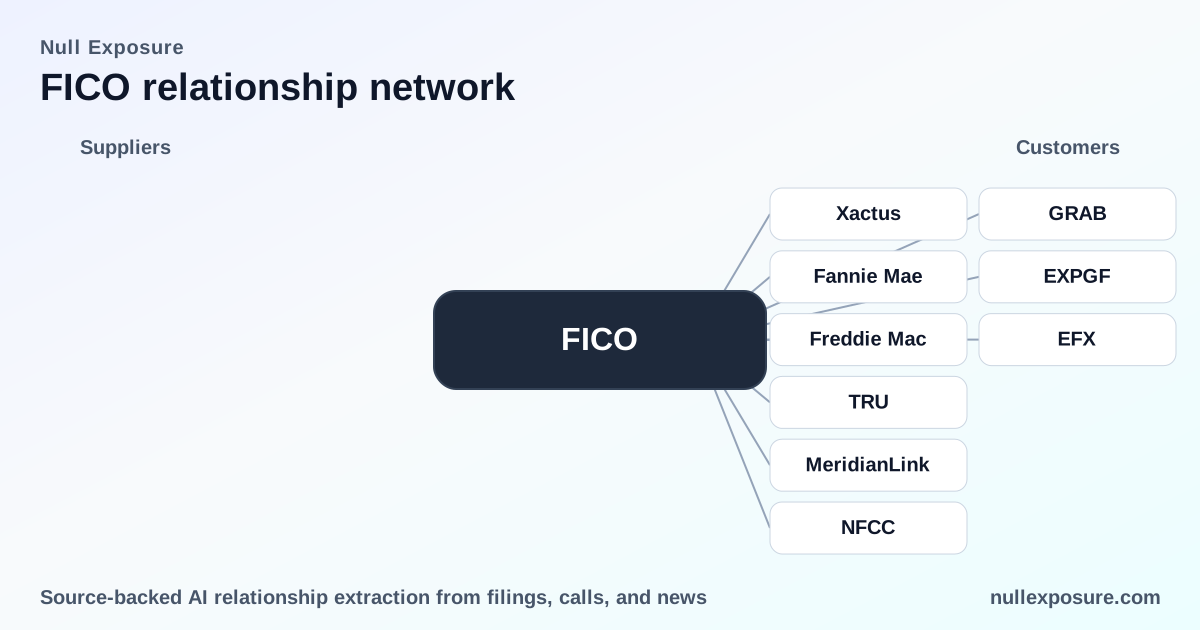
FICO’s customer map — where the score still matters and where disruption is coming
Fair Isaac Corporation builds and sells credit scoring, decisioning and optimization software largely through multi-year subscription and usage-based contracts to banks, consumer reporting agencies and other large enterprises, while also serving consumers directly; the company monetizes via recurring SaaS fees, per-decision/usage charges and professional services that drive adoption and integration. The commercial model is high-margin, concentrated and mission-critical for mortgage and credit markets, even as distribution channels and pricing collars are under renewed competitive pressure.
Explore the full customer intelligence offering
What investors need to know about how FICO sells and sticks customers
FICO sells a two-legged business: Scores — licensing FICO® Scores through the three major credit bureaus — and Software — decisioning, analytics and optimization platforms sold as subscriptions with professional services attachments. Public disclosures describe multi-year subscription contracts with usage-based pricing (accounts, transactions, decision volumes) and contracted minimums, supporting a predictable revenue base complemented by services revenue to implement and tune deployments.
- Contracting posture: Multi-year subscription commitments with material usage-based components create a recurring revenue profile but expose FICO to volume and price pass-through disputes with its distributor partners.
- Customer concentration and criticality: Agreements with the three major consumer reporting agencies accounted for a collective majority of revenue (51% in FY2025), creating concentration risk but also a lock on mortgage distribution channels where FICO historically was the accepted score for conforming loans.
- Commercial maturity: FICO’s route-to-market mixes large-enterprise sales, platform adoption across 80+ countries and consumer-facing score products; the company couples high-margin software with professional services to accelerate enterprise deployments.
- Global scale and product mix: The firm operates globally, sells both software and services, and reports Dollar-Based Net Retention above 100% for software — a signal of expansion within an installed base.
If you want a structured view of FICO’s customer dependencies and contract design, visit our platform: https://nullexposure.com/
Relationship rundown — who’s buying, distributing or partnering with FICO
Below are concise, source-backed summaries of every named relationship in FICO’s customer results.
-
Freddie Mac — Historically required lenders to provide FICO Scores for each mortgage delivered, making Freddie a major channel for FICO scoring distribution; recent press in May 2026 reports Freddie Mac will begin accepting VantageScore 4.0 for mortgage underwriting, a development that opens competition in FICO’s largest pricing channel. (FICO FY2025 Form 10‑K; Investing.com / Benzinga coverage, May 2026)
-
Fannie Mae — Long a de facto gatekeeper that accepted FICO for conforming loans; Fannie announced policy changes to accept alternative scoring models, exposing FICO’s mortgage revenue stream to substitution risk. (FICO FY2025 Form 10‑K; AccessWire / Benzinga reporting, May 2026)
-
Xactus — FICO disclosed a multiyear direct license and distribution agreement with Xactus, the tri-merge credit verification provider, expanding FICO’s distribution footprint through a direct issuer/distributor relationship. (FICO 2025 Q4 earnings call, Mar 2026)
-
TransUnion (TRU) — FICO derives a substantial portion of revenues from contracts with TransUnion, one of the three major bureaus; market commentary in 2026 highlights TransUnion’s maneuvering around FICO pass-through costs and promotional pricing to defend volume. (FICO FY2025 Form 10‑K; SimplyWall / Investing news coverage, May 2026)
-
Equifax — Equifax is another primary distribution partner; investors and press have discussed strained economics after FICO raised pricing on mortgage scores, with Equifax executives noting the low-margin nature of reselling FICO Mortgage Scores. (FICO FY2025 Form 10‑K; Equifax Q1 2026 earnings comments reported by InsiderMonkey and Investing.com, May 2026)
-
Experian — Listed among the three bureaus that generate sizeable revenue for FICO through score licensing, a structural commercial channel for FICO’s Scores business. (FICO FY2025 Form 10‑K)
-
Banco Santa Cruz — Recently adopted the FICO Platform on AWS to modernize credit decisioning for retail products, demonstrating international bank adoption of FICO’s cloud-native decisioning. (Mizuho initiation coverage reported on InsiderMonkey, May 2026)
-
Compeer Financial — Announced April 12, 2026 adoption of the FICO Platform to accelerate credit decisions in agricultural lending, illustrating vertical use cases beyond consumer retail banking. (Company announcement cited in Mizuho / InsiderMonkey, Apr 2026)
-
Absa Group — Public accounts describe Absa deploying FICO decisioning and reporting measurable improvements in fraud prevention and collections after implementation. (SimplyWall profile, May 2026)
-
Erste Group — Reported deployment of FICO decisioning and optimization technologies with measurable operational improvements, cited alongside other bank rollouts. (SimplyWall profile, May 2026)
-
MeridianLink — Partnership announced to embed FICO technology directly into mortgage platforms, reinforcing FICO’s strategy to integrate into origination workflows. (Ad‑hoc News / SimplyWall coverage, Mar 2026)
-
Grab Finance (GRAB) — Partnership intentions reported to strengthen FICO’s footprint in Southeast Asia by embedding decisioning into Grab’s financial products. (Ad‑hoc News coverage, Mar 2026)
-
CPF (Central Pacific Bank referenced as CPF) — Platform integrations reported to include FICO LiquidCredit among other industry systems, enabling tighter workflow for SMB and retail lending automation. (Aijourn coverage of Biz2X platform integrations, Mar 2026)
-
NFCC — Reported use of FICO Score Open Access to recover benefit for debt-relief program eligibility and consumer outreach, indicating FICO’s consumer-facing channels and public-interest use cases. (Finviz news item, Mar 2026)
Note: several press items repeat bureau relationships under different ticker forms (TRU, EFX, EXPGF) but all reference the same strategic dependency on the three major consumer reporting agencies as documented in FICO’s FY2025 10‑K.
What this map implies for revenue, risk and strategy
- Revenue mechanics: The mix of subscription and meaningful usage-based elements creates a resilient recurring base with upside from account and transaction growth, while professional services provide a high-touch revenue stream to drive implementation and stickiness.
- Concentration risk is real and measurable: The three bureaus collectively accounted for over half of FICO’s revenues in FY2025; this is a structural lever that drives both negotiating power and vulnerability when bureaus change distribution terms or accept alternative scores.
- Market disruption is real but not binary: Fannie/Freddie acceptance of VantageScore and bureau experimentation with pricing introduce tangible pressure on FICO’s most lucrative mortgage channel, but FICO’s embedded position across lending workflows, international banks and decisioning platforms preserves alternative revenue pathways.
- Operational maturity: Global SaaS delivery, multi-year enterprise contracts and a services-led onboarding model indicate a mature commercial posture — FICO is both a platform vendor and a systems integrator for complex lenders.
Investment takeaway
FICO retains a strong, high-margin software franchise with material captive distribution through the bureaus, but recent policy moves by Fannie Mae and Freddie Mac and bureau-level pricing dynamics introduce a near-term repricing risk to the Scores channel. Investors should weigh durable SaaS economics and global platform traction against concentration-driven revenue volatility and distributor negotiations when modeling FY2026–FY2027 cash flow.
For a deeper, structured read of FICO’s customer exposures and the contract mechanics that drive revenue, see our analysis platform: https://nullexposure.com/