Figma’s customer footprint: what enterprise adoption tells investors
Thesis: Figma monetizes a web-native design and collaboration platform through tiered, seat-based subscription contracts and enterprise add-ons (features such as Figma Make and Dev Mode), capturing value by embedding design systems and developer handoff into large engineering organizations. Revenue has crossed the $1B TTM threshold, gross margins are healthy, but operating losses persist—so the investment case rests on sustained enterprise expansion and platform stickiness from design-system adoption. Learn more at https://nullexposure.com/.
Why this matters to investors: Figma’s growth profile is not only top-line expansion but also the conversion of high-value customers into long-term, enterprise agreements where design artifacts become mission‑critical intellectual property. That commercial dynamic simultaneously drives pricing power and creates concentration risk around a relatively small set of strategic accounts.
H2: How Figma earns—and why its customers matter Figma sells collaborative design tools that teams use to prototype, document, and ship digital products. Monetization comes from enterprise subscriptions, per-seat licensing, and platform features (for example, Figma Make and Dev Mode). Enterprise customers frequently integrate Figma into product development workflows and design systems, which makes churn costly and upsell opportunities sizable. Financially, Figma reports roughly $1.056B revenue TTM and $870M gross profit, but operating losses and negative EPS indicate room for margin improvement as scale continues.
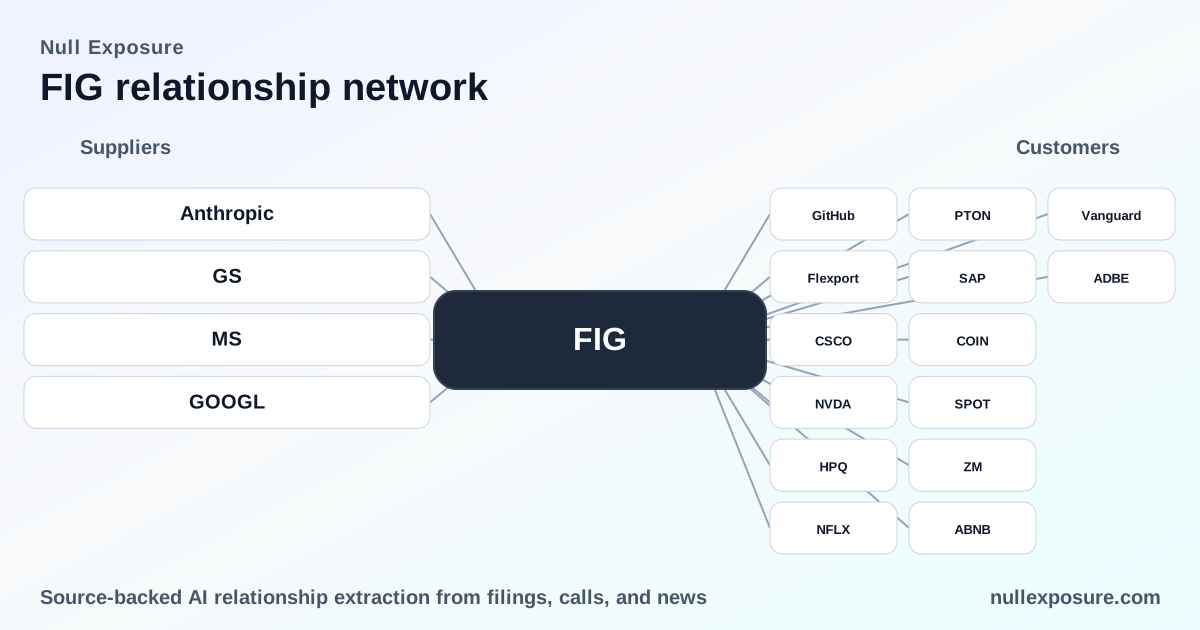
H2: The customer roll call — names, use cases, and sources Below I list every relationship captured in the recent results, with a brief plain-English summary and the originating source for investor diligence.
-
Flexport — Teams at Flexport use Figma Make to accelerate problem-solving across functions, signaling adoption of Figma’s newer workflow features. Source: Figma 2025 Q4 earnings call (2025Q4).
-
GitHub — GitHub reported that Dev Mode MCP materially improved its ability to evolve and ship Primer, their design system; Figma is embedded in their code/design workflow at scale, affecting thousands of tokens and lines of code. Source: Figma 2025 Q4 earnings call (2025Q4).
-
Cisco (CSCO) — Cisco’s design and product teams actively move between Figma Design and Figma Make to align decisions and speed delivery, indicating enterprise process integration. Source: Figma 2025 Q4 earnings call (2025Q4).
-
NVIDIA (NVDA) — NVIDIA used Figma for high-fidelity creative work (example cited: a 20-robot group shot for a CES keynote), highlighting Figma’s role in large-scale creative and marketing executions. Source: Figma 2025 Q4 earnings call (2025Q4).
-
HP (HPQ) — HP was listed among prominent clients in press coverage during Figma’s S‑1 filing window, confirming brand-level enterprise adoption. Source: Crain’s Grand Rapids reporting on Figma’s draft Form S‑1 (FY2025).
-
Netflix (NFLX) — Netflix is named repeatedly in press coverage as a Figma client, underscoring media/consumer brand penetration. Source: Crain’s Grand Rapids on Figma’s S‑1 filing and TradingView commentary (FY2025–FY2026).
-
Peloton (PTON) — Peloton was identified in news coverage as a Figma client, supporting adoption beyond pure software companies into consumer hardware/software incumbents. Source: Crain’s Grand Rapids on Figma’s S‑1 filing (FY2025).
-
SAP — SAP was cited among client names in S‑1‑era coverage, reflecting enterprise software penetration in Figma’s customer base. Source: Crain’s Grand Rapids on Figma’s S‑1 filing (FY2025).
-
Coinbase (COIN) — Multiple news items reference Coinbase as a client, indicating fintech usage and cross-industry traction. Source: TradingView commentary and BusinessToday coverage referencing Figma’s customer set (FY2022–FY2026).
-
Spotify (SPOT) — Spotify appears in market commentary listing Figma clients, showing adoption in streaming and consumer media companies. Source: TradingView commentary (FY2026).
-
Vanguard — Vanguard is named in anecdotal listings of Figma’s clients, suggesting institutional finance groups use Figma for design and internal product work. Source: TradingView commentary (FY2026).
-
Adobe (ADBE) — Coverage documents Adobe’s strategic interest and reported large volume of designs on Figma; historical acquisition/transaction narratives place Adobe as a consequential partner/competitor reference. Source: Betakit coverage and BusinessToday reporting about Adobe and Figma (FY2022).
-
Airbnb (ABNB) — Airbnb was cited among tech-platform clients in retrospective pieces about Figma’s industry standing and strategic transactions. Source: BusinessToday reporting on Adobe/Figma coverage (FY2022).
-
Zoom Video Communications (ZM) — Zoom was listed in media coverage as a known Figma user within the tech customer set. Source: BusinessToday reporting (FY2022).
-
Justworks (JW) — Company listings (Justworks’ public-facing profile) reference the use of Figma for design work, representing broader SME adoption. Source: BuiltIn company profile for Justworks (FY2025).
-
FTAI Infrastructure Inc. (FIP) — Press releases that mention FTAI Infrastructure note it is externally managed by an affiliate of Fortress Investment Group LLC, which is distinct from Figma; these items reference Fortress rather than Figma’s product relationships. Source: QuiverQuant and GlobeNewswire press releases (FY2025–FY2026).
-
DUOT (DUOT) — An earnings call excerpt cites a deal involving New APR Energy and Fortress Investment Group, not Figma’s product use; this reference aligns with Fortress-related coverage rather than customer use of Figma. Source: DUOT 2025 Q3 earnings call (2025Q3).
Note: some media items consolidate client lists (Netflix, Coinbase, Spotify, Vanguard, HP, Peloton, SAP, Airbnb, Zoom), and Figma’s own earnings comments provide the most granular, product-specific evidence (Flexport, GitHub, Cisco, NVIDIA). Where press coverage ties FIP/DUOT to Fortress, those references are related to the Fortress entity rather than product-level customer relationships.
H3: What these relationships say about commercial risk and runway
-
Criticality and stickiness: When clients such as GitHub and Cisco integrate Figma into their design systems, the product becomes embedded in engineering and release processes—this creates durable revenue with high switching friction. The GitHub example, where a small change impacts thousands of tokens and code, is a high‑value illustration of that stickiness. Source: Figma 2025 Q4 earnings call (2025Q4).
-
Concentration and diversification: Figma’s roster includes large technology platforms, consumer brands, and financial institutions; this breadth reduces single‑industry concentration risk, but enterprise revenue can still concentrate among large accounts. Company filings through the S‑1 window and subsequent coverage list multiple marquee clients. Source: Crain’s, TradingView, BusinessToday (FY2022–FY2026).
-
Contracting posture and monetization cadence: The product is sold primarily as a subscription, with seat-based enterprise contracts and modular feature add-ons (examples cited in earnings commentary: Figma Make, Dev Mode). This supports predictable recurring revenue and upsell mechanics across large design organizations. Source: Figma 2025 Q4 earnings call and public S‑1 period coverage (2025Q4; FY2025).
-
Maturity and margin profile: Figma recently crossed $1B in revenue TTM with strong gross margins ($870M gross profit), but operating losses remain, consistent with an investment‑led growth phase that prioritizes product and go‑to‑market scale. Investors should weigh growth against path to operating leverage. Source: Company financial summary (LatestQuarter 2025-12-31).
H2: Investment implications and next steps Figma’s customer citations show clear enterprise adoption among mission‑critical technology companies, which supports a thesis of durable monetization through seat renewals and platform expansion. For investors, monitor three vectors closely: (1) enterprise renewal and expansion rates among large accounts, (2) margin improvement as sales and R&D scale, and (3) any evidence of customer concentration risk crystallizing into revenue volatility.
If you want deeper, structured signals on Figma’s customer map and relationship momentum, visit https://nullexposure.com/ for enterprise‑grade exposure analysis and alerting.
Bold takeaway: Figma’s competitive moat is built on design‑system lock‑in inside engineering organizations, but the path to profitability remains the key valuation hinge.