FIGR Customer Roundup: Institutional Partnerships Drive Distribution and Asset Flow
Figure Technology Solutions runs a blockchain-enabled consumer lending and capital markets platform that channels loan originations, servicing relationships, and third‑party distribution into its Democratized Prime architecture; the company monetizes by originating and facilitating loans, selling or securitizing assets, and licensing platform access to institutional partners. Investor thesis: FIGR is scaling via strategic partnerships that supply assets and distribution rather than through linear bank-style branch expansion — the pace and quality of those relationships will determine revenue cadence and valuation multiple expansion.
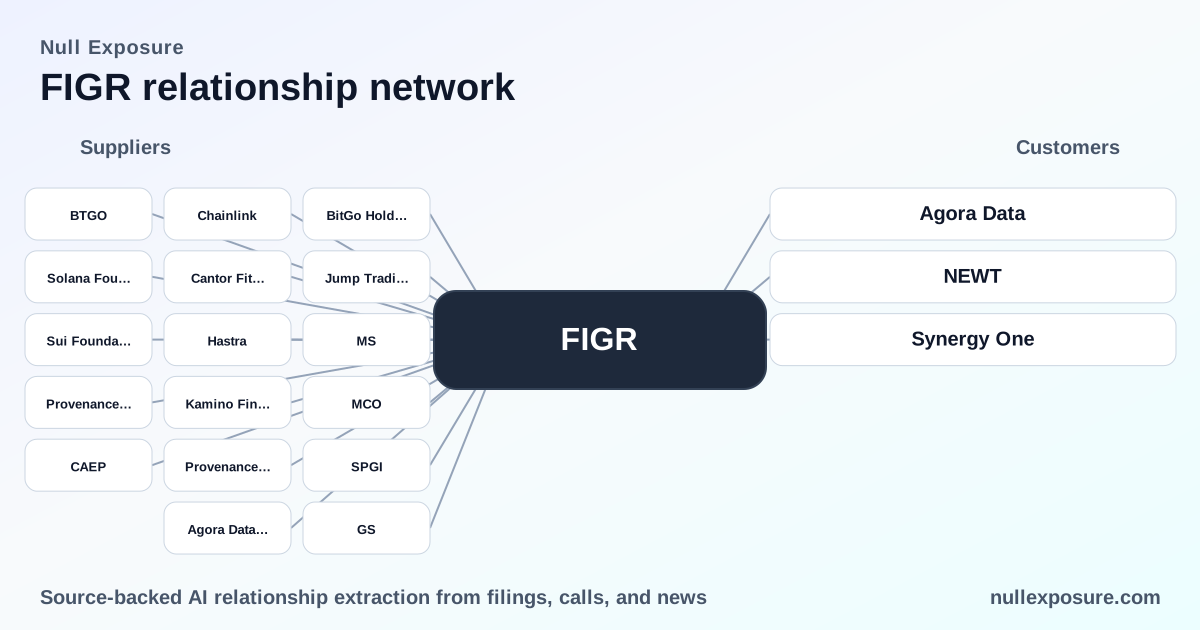
Explore a concise vendor/customer map at https://nullexposure.com/ for cross-reference.
Why customer relationships matter for Figure right now
Figure’s growth narrative pivots on institutional clients and distribution partners that can provide both loan inventory and channels to borrowers. These relationships are not peripheral marketing deals; they are operational levers that influence origination volumes, capital deployment, and the company’s ability to securitize or warehouse assets. For investors, tracking the mix of mortgage, auto, and small‑business channels offers direct insight into revenue durability and concentration risk.
Agora Data — a fintech pipeline for auto finance assets
Figure announced a major partnership with Agora Data to bring auto finance assets into the Democratized Prime product, positioning Agora as a provider of analytics, capital markets access, and loan performance data that helps originators originate, fund, and manage auto loans more efficiently. According to Figure’s Q4 2025 earnings call transcript (Mar 7, 2026), this linkage supplies a fintech pipeline of auto loans into Figure’s platform and supports asset-level underwriting and distribution.
Newtek — strategic small-business finance distribution
Figure confirmed it is finalizing a strategic partnership with Newtek, an established player in small-business financial services, as disclosed during the Q4 2025 earnings call (Mar 7, 2026). Newtek brings institutional brand recognition and small‑business customer access — a complementary distribution channel to Figure’s consumer and mortgage initiatives.
Synergy One — the platform’s first institutional mortgage client
Synergy One joined the Democratized Prime platform as the first institutional mortgage client, marking a step from retail or boutique mortgage activity toward institutional adoption, per Figure’s Q3 2025 results press release (GlobeNewswire, Nov 13, 2025). This is a milestone in institutionalizing Figure’s mortgage pipeline and demonstrates early traction for large-scale partner deployments.
LoanDepot (LDI) — Express Path loan product distribution
MarketScreener coverage in April 2026 reported that LoanDepot has partnered with Figure to offer Express Path loan products to loanDepot customers (reported Apr 2 and Apr 8, 2026). LoanDepot’s integration ups Figure’s retail mortgage distribution and creates potential cross‑sell and volume upside through a high‑profile mortgage originator.
(Each relationship above was disclosed in company filings, earnings commentary, or press distribution between Q3‑Q4 2025 and April 2026.)
What these partnerships imply about Figure’s operating model
Figure’s customer roster and recent announcements reveal several structural features investors should internalize:
- Contracting posture — partnership‑first, platform licensing and flow agreements. Figure secures growth by embedding its platform into partner origination and distribution channels rather than building traditional branch networks.
- Concentration — moderate near-term concentration with a few institutional clients. The company’s earliest institutional clients (Synergy One, LoanDepot, Newtek) are strategically important and therefore represent concentration risk until the partner base diversifies.
- Criticality — relationships are operationally critical. Partners supply both loans and distribution; loss or underperformance of large partners would directly compress originations and related fee revenue.
- Maturity — a mix of emerging platform deployments and established partners. Synergy One represents early institutional adoption, while LoanDepot and Newtek offer incumbent distribution capabilities that accelerate scale.
These are company‑level signals derived from the set of disclosed customer relationships; they frame how revenue growth and volatility should be modeled.
Investment implications and risk checklist
- Upside drivers: Institutional adoption accelerates fee and servicing revenue and improves securitization economics; high‑profile partners like LoanDepot and Newtek reduce customer acquisition friction and can materially lift originations.
- Key risks: Partner concentration, integration execution, and asset quality control are primary operational risks; underwritten loans sourced through third parties require robust performance data and governance to avoid credit shocks.
- Near‑term catalysts to watch: cadence of new partner announcements, pipeline conversion rates from partnerships into funded loans, and public disclosure of asset performance or securitization activity.
Bottom line for investors
Figure’s near‑term growth is execution dependent: the company’s business model is increasingly driven by strategic partnerships that supply assets and distribution rather than legacy deposit or branch economics. If Figure converts these announced partnerships into sustained originations and predictable securitization flows, the stock’s premium multiple has a path to justify itself; failure to scale partner deployments or control asset quality will compress margins and investor sentiment.
For a compact tracking view of FIGR’s evolving customer map and what each relationship implies for origination flows, visit https://nullexposure.com/.