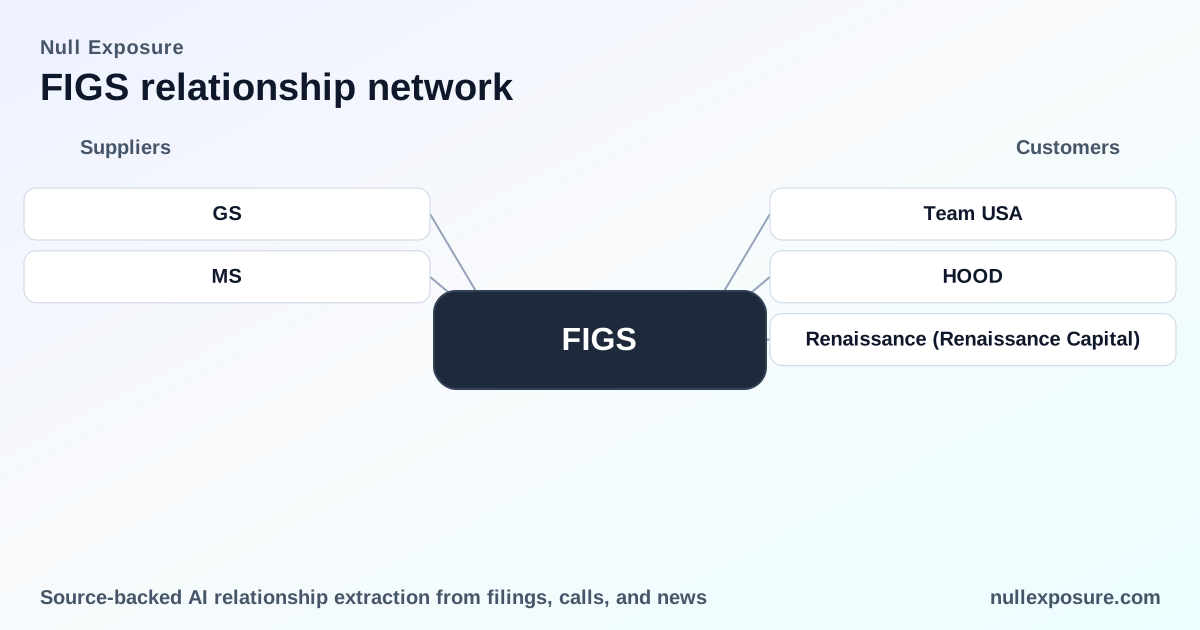
FIGS customer relationships: strategic partners, retail touchpoints, and distribution signals
FIGS is a founder-led, direct-to-consumer apparel company that monetizes by selling healthcare-focused clothing and lifestyle products through its DTC channels (website and mobile app) and a B2B TEAMS channel to institutions; the business captures value through high-margin core scrubwear, repeat retail demand from a large active customer base, and selective institutional partnerships that amplify brand reach. According to company disclosures, FIGS reported roughly $631 million in trailing revenue and ~2.7 million active customers as of year-end 2024, anchored by 15 core scrub styles that generated over 66% of net revenues—a concentrated but profitable product backbone. For deeper background on FIGS and its customer posture, see https://nullexposure.com/.
How FIGS sells and where the economics live
FIGS’ operating model is centered on product-led retail economics. The company sells a defined set of core scrubwear year-round while building ancillary lifestyle purchases and institutional TEAMS deals; this mix produces a high gross-profit base (gross profit of roughly $420 million TTM) and a retail-first contracting posture. The company manages distribution and customer acquisition centrally—marketing and site experience drive repeat purchase behavior among individual healthcare professionals, while TEAMS provides volume, institutional credibility, and co-marketing opportunities.
- Core product concentration: 15 scrub styles drive the majority of revenue, creating both pricing power and product risk given the concentration in a limited SKU set.
- Distribution strategy: DTC channels are primary, with TEAMS as a complementary B2B engine; international shipping exists (32 countries) but the business is still predominantly U.S.-focused for revenue recognition.
The relationships that show up in public reporting and press
Below are the customer and market relationships surfaced in public sources. Each entry is a plain-English description with its original source.
Team USA — a high-visibility institutional outfit
FIGS expanded a partnership to outfit more than 150 healthcare professionals at the Milano Cortina 2026 Olympic and Paralympic Winter Games, leveraging a Team USA relationship to extend brand visibility in a global, high-profile setting. Source: Yahoo Finance coverage of the partnership announcement (Mar 9, 2026), https://finance.yahoo.com/news/why-story-behind-figs-changing-171659782.html.
HOOD — retail distribution touchpoint at IPO allocation
A limited allocation of FIGS Class A shares was made available to retail customers through Robinhood during the company’s IPO, with Robinhood receiving about 1% of Class A shares for its users; this reflects an early retail distribution tactic to engage the mass-market investor community and broaden retail visibility. Source: Los Angeles Times coverage of the IPO (May 27, 2021), https://www.latimes.com/business/story/2021-05-27/figs-scrubs-shakes-up-medical-apparel-with-ipo.
Robinhood — retail platform participation in IPO mechanics
Robinhood, specifically as a retail brokerage channel, played a role in FIGS’ IPO allocation by facilitating pre-market share access for a limited number of retail investors—a move that demonstrates FIGS’ interest in retail reach beyond product customers and highlights the company’s engagement with retail-oriented platforms. Source: Los Angeles Times, IPO reporting (May 27, 2021), https://www.latimes.com/business/story/2021-05-27/figs-scrubs-shakes-up-medical-apparel-with-ipo.
Renaissance (Renaissance Capital) — institutional distribution via ETF channels
Renaissance Capital included FIGS shares in funds it manages, offering another institutional avenue for FIGS’ publicly traded equity to be distributed to investors through ETFs, which supports secondary-market liquidity and institutional investor access. Source: Los Angeles Times article noting Renaissance’s offering of FIGS through an exchange-traded fund (May 27, 2021), https://www.latimes.com/business/story/2021-05-27/figs-scrubs-shakes-up-medical-apparel-with-ipo.
(For more on FIGS’ market positioning and relationship signals, view additional analysis at https://nullexposure.com/.)
Operating constraints and what they signal for investors
Public constraint excerpts and filings surface operational characteristics that matter for credit and commercial counterparties:
- Contracting posture — retail-first, founder-led DTC: FIGS manages the business as a single consolidated segment focused on DTC and TEAMS, indicating centralized decision-making and a consistent brand-led contracting stance that favors standardized online terms and scalable fulfillment. This is a company-level signal drawn from the firm’s management commentary on segment reporting and distribution.
- Customer concentration and counterparty type — individual retail scale: The firm reports ~2.7 million active customers, signaling a high-volume retail counterparty mix where revenue durability depends on brand loyalty and repeat purchase economics rather than a small number of large institutional buyers.
- Geographic posture — U.S.-centric with international reach: FIGS recognizes revenue primarily in the U.S. but ships to 32 countries; this indicates expansionary distribution but current revenue concentration in North America—useful when modeling currency, logistics, and regional collection risk.
- Product concentration and criticality — core scrubwear dominance: With 15 core styles accounting for over 66% of net revenues, product risk is concentrated; supply-chain disruption or a product-market shift in scrubs would have outsized earnings impact.
- Maturity and spend posture — receivables scale: Accounts receivable for trade and other customers totaled roughly $8.6 million at year-end 2024, which suggests working-capital exposure exists but is modest relative to revenue scale; this is a company-level working-capital signal rather than a counterparty-specific limitation.
- Relationship roles — both buyer and seller dynamics: FIGS functions as a seller to individual healthcare professionals and institutions (TEAMS) while operating a DTC platform that effectively buys customer attention via marketing spend—this duality shapes contract terms and credit exposure across both sides of the ledger.
Key investment takeaways and risk framing
- Strengths: Brand-led DTC model, large active customer base, healthy gross-profit base, and high retail engagement via both consumer and institutional touchpoints (Team USA, TEAMS) support top-line resilience and marketing leverage.
- Risks: SKU concentration in core scrub styles, U.S.-centric revenue recognition despite global shipping capability, and the dependence on digital acquisition economics increase sensitivity to marketing costs and product life-cycle shifts.
- Market-access signals: Participation in the public markets via IPO allocations (Robinhood) and ETF inclusion (Renaissance) improved equity liquidity and broadened ownership, which reduces single-investor concentration risk but raises expectations for public disclosure and earnings cadence.
FIGS is a brand-driven retail operator with clear monetization through product sales and institutional partnerships; its value hinges on sustaining core product preference among healthcare professionals while scaling international distribution without diluting gross economics. For further relationship mapping and ongoing monitoring of material partnerships, visit https://nullexposure.com/.