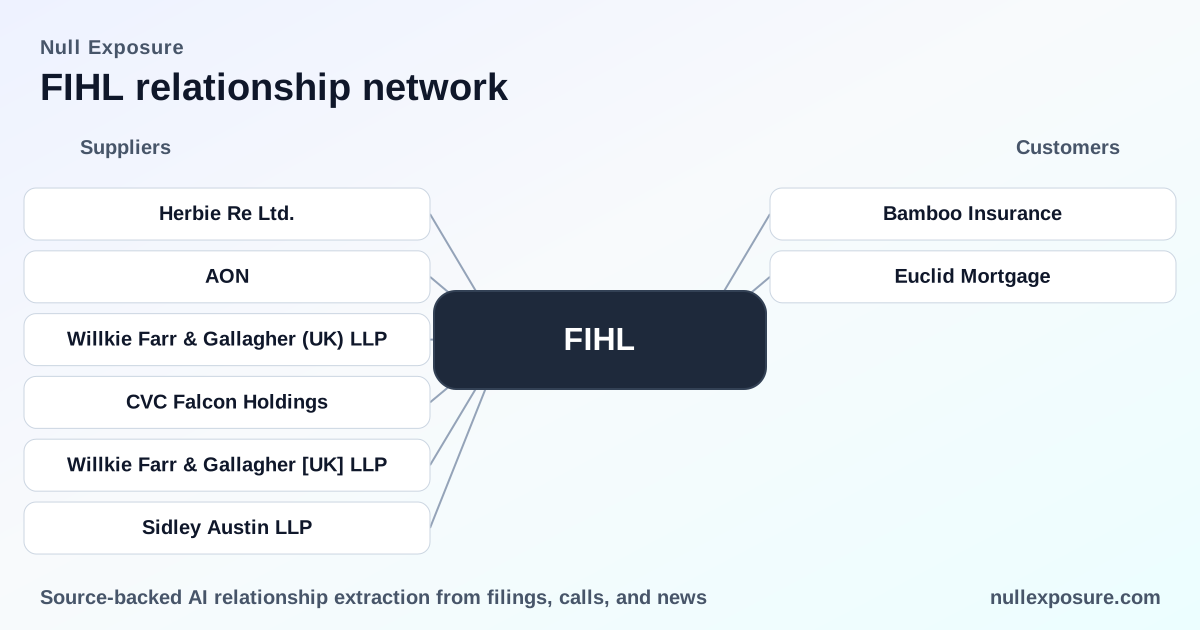
Fidelis Insurance monetizes through underwriting and capital solutions: it writes specialty insurance and reinsurance across Bermuda, Ireland and the U.K., and generates returns from net written premiums, investment income and fee arrangements with distribution partners and MGAs. For investors, Fidelis’s model is capital-light distribution plus risk-bearing underwriting, where strategic partnerships accelerate premium growth while the balance sheet captures underwriting profit and investment yield.
FIHL customer relationships: what the recent disclosures tell investors
High-level read: growth through partnerships, underwriting income retained
Fidelis executes a partner-driven growth strategy: it provides underwriting capacity and balance-sheet support to third-party distributors and niche mortgage and property channels. This approach scales premium volume without proportionate increases in fixed operating cost, while preserving control over pricing and risk selection that translate into underwriting margin and investment income on reserves.
If you want a consolidated view of Fidelis’s market signals and customer links, visit https://nullexposure.com/ for our broader coverage and source aggregation.
What Fidelis disclosed in the 2025 Q4 call — the customer roster
Management used the 2025 Q4 earnings call to highlight new partner relationships that are actively contributing to premium growth. The call names two partners explicitly: Bamboo Insurance and Euclid Mortgage. Each relationship is concise in public disclosure but strategically significant in how it channels products to end customers.
Bamboo Insurance — a distribution partnership in property
Fidelis announced a partnership with Bamboo Insurance, a property MGA backed by industry talent, initiated later in 2025. This relationship positions Fidelis as the capital and underwriting partner for property business sourced by Bamboo, augmenting Fidelis’s property portfolio and distribution reach. According to the 2025 Q4 earnings call (March 2026), management emphasized this as a strategic partnership to scale property underwriting capacity.
Source: FIHL 2025 Q4 earnings call (management remarks, disclosed March 7, 2026).
Euclid Mortgage — mortgage portfolio expansion via distribution
Management reported growth in the mortgage portfolio through an engagement with Euclid Mortgage that began at the start of 2025, indicating direct growth in mortgage-related insurance exposure and associated premium income. The Euclid relationship is described as a partner-driven channel for mortgage products that lifts the company’s written premium in that vertical, per the 2025 Q4 earnings call.
Source: FIHL 2025 Q4 earnings call (management remarks, disclosed March 7, 2026).
Why these partners matter to investors
Both relationships reinforce Fidelis’s operating playbook: provide underwriting capital and expertise to distribution specialists, enabling faster premium scale than through captive sales forces alone. The benefits to investors are concrete:
- Revenue acceleration: Partnerships translate into near-term premium growth without proportionate SG&A expansion.
- Underwriting leverage: Fidelis keeps control over risk commutation and pricing, which supports underwriting margin and profitability metrics.
- Portfolio diversification: Adding property and mortgage channels broadens exposure across product lines and distribution ecosystems.
Operational constraints and business-model signals investors should weigh
While the public disclosures are brief, company-level signals from Fidelis’s profile and these partnership announcements point to several operating characteristics investors must factor into valuation and risk analysis:
- Contracting posture: Fidelis operates as a capital-provider and underwriting counterparty to MGAs and distributors rather than as a pure retail incumbent; this implies standardized capacity agreements and actuarial oversight are central to commercial terms.
- Concentration: Partnerships introduce concentration risk at the channel level (e.g., a single MGA or mortgage partner can drive material premium), so investor diligence should assess partner durability and exclusivity.
- Criticality of relationships: These customer links are business-critical for top-line growth because Fidelis’s strategy intentionally relies on third-party distribution to scale; loss of a productive partner would have measurable premium and profit implications.
- Maturity and scalability: The model exhibits scalable characteristics—partners can replicate product rollouts across regions—while remaining contingent on Fidelis’s capacity and risk appetite to support rapid portfolio accumulation.
These are company-level signals; specific contractual terms and the precise economic split with each partner are not disclosed in the call.
Financial context investors should keep front of mind
Fidelis is a diversified specialty insurer with a market capitalization around $1.79 billion and trailing PE near 10x, reflecting a valuation anchored in current earnings and underwriting performance. The balance between premium growth (supported by these partners) and sustained underwriting discipline will determine whether multiples expand toward analyst targets. Management’s disclosure that new partner relationships contributed to portfolio growth aligns with reported revenue and profit figures for recent periods.
How to incorporate these relationship signals into analysis
- Price in partner concentration scenarios when modeling premium growth and persistence.
- Stress-test loss ratios for rapid portfolio accumulation, especially in property and mortgage lines that can have correlated claims.
- Track subsequent filings and quarterly commentary for disclosure of economic terms (fees, fronting arrangements, limits) because these determine margin capture.
If you want direct access to the transcripts and a complete relationship map, our platform curates and timestamps these disclosures — learn more at https://nullexposure.com/.
Bottom line — partner-led growth underwritten by Fidelis’s balance sheet
Fidelis’s recent public statements confirm a deliberate strategy: use balance-sheet capacity to underwrite distribution partners and accelerate premium growth. Bamboo Insurance and Euclid Mortgage are clear, named examples of that strategy in action. For investors, the decision calculus centers on whether Fidelis can sustain underwriting profitability as these partner-originated portfolios scale and whether contractual economics sufficiently monetize distribution without over-concentration risk.