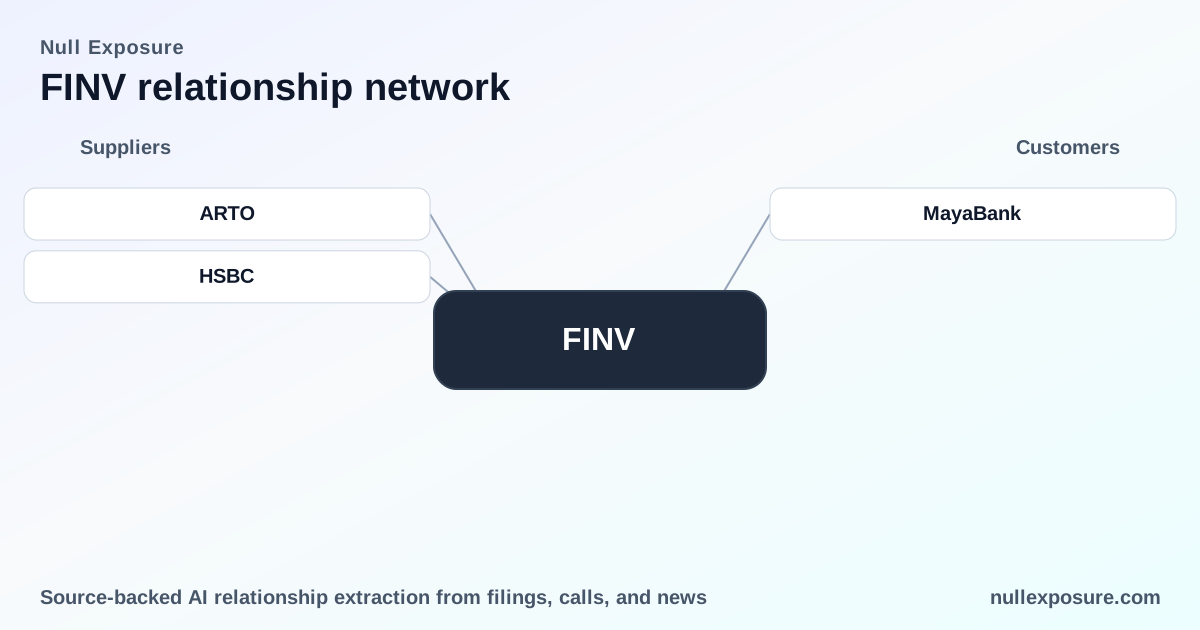
FinVolution Group (FINV) — Partner Ecosystem and Customer Relationships That Drive Distribution
FinVolution Group operates an online consumer finance marketplace headquartered in Shanghai and monetizes by originating and servicing consumer credit through platform fees, loan underwriting spreads, and embedded finance partnerships with third‑party platforms and institutional lenders. The company’s revenue base is anchored in marketplace loan volumes and value‑added services that extend distribution into non‑bank channels, while quarterly disclosures show continued emphasis on embedding financial products into regional marketplaces and telecom platforms (Revenue TTM: 13.57bn USD; Operating margin TTM: 34%). For a concise view of FinVolution’s positioning and market signals, visit the NullExposure homepage: https://nullexposure.com/
Why the partner list matters to investors
FinVolution’s public disclosures and media transcripts from FY2025–FY2026 reveal a deliberate distribution strategy: partner with high‑traffic consumer platforms and select financial institutions to scale originations without proportionate balance‑sheet growth. These relationships translate into incremental loan volume, lower customer acquisition cost, and access to new geographies or verticals (used goods marketplaces and telecom prepaid customers). The partner roster therefore functions as a leading indicator of origination growth and product diversification.
Relationship snapshots — what the filings and calls disclose
MayaBank — selective lending into pools and individual borrowers
FinVolution described options to fund either commingled pools or pick individual borrowers, and MayaBank has negotiated the latter model to select borrowers directly through FinVolution’s tooling. This structure signals a tailored funding arrangement that allows MayaBank to control credit selection while leveraging FinVolution’s origination engine (DigFinGroup, March 2026: https://www.digfingroup.com/finvolution-juanhand/).
Carousell — embedding finance into a second‑hand marketplace
FinVolution is working with Carousell, the regional second‑hand goods marketplace, to embed financial services directly into the transaction flow, expanding reach into consumer‑to‑consumer commerce. This partnership represents a distribution extension that converts marketplace traffic into financed transactions, as disclosed in FinVolution’s Q4 2025 earnings call transcript and reported in May 2026 (InsiderMonkey and The Globe and Mail, May 2026: https://www.insidermonkey.com/blog/finvolution-group-nysefinv-q4-2025-earnings-call-transcript-1720415/; https://www.theglobeandmail.com/investing/markets/markets-news/Motley%20Fool/800348/finvolution-finv-q4-2025-earnings-transcript/).
Smart (SMRN) — BNPL on mobile top‑ups through a major telecom
FinVolution has partnered with Smart (inferred symbol SMRN), a major telecom operator, to deploy Buy‑Now‑Pay‑Later products specifically for mobile top‑ups, tapping into high‑frequency, low‑ticket transactions. Telecom integrations like this accelerate repeat usage and build credit behavior data at scale, as highlighted in the company’s Q4 2025 commentary reported in May 2026 (InsiderMonkey and The Globe and Mail, May 2026: https://www.insidermonkey.com/blog/finvolution-group-nysefinv-q4-2025-earnings-call-transcript-1720415/; https://www.theglobeandmail.com/investing/markets/markets-news/Motley%20Fool/800348/finvolution-finv-q4-2025-earnings-transcript/).
What these partner relationships imply about FinVolution’s operating model
- Contracting posture: The partnership language indicates a flexible contracting posture that supports both commingled funding and bespoke credit selection arrangements; this flexibility lowers barriers to onboarding institutional funding partners while preserving underwriting control where required.
- Concentration: Current disclosed partners are diverse in sector (bank, marketplace, telecom), which reduces single‑counterparty concentration risk at the distribution layer but still requires monitoring as individual large partners can drive substantial origination flows.
- Criticality: Embedded finance deals with marketplace and telecom partners are operationally strategic—they convert platform users into borrowers and can materially affect origination velocity; however, none of the public results show a sole reliance on a single distribution partner.
- Maturity: The cited interactions are recent (FY2025–FY2026) and reflect early to mid‑stage commercial rollouts rather than long‑standing, deeply integrated legacy relationships; these are growth‑oriented partnerships rather than mature syndication programs.
No relationship‑level contractual constraints are recorded in the available results, which is a company‑level signal indicating there are no publicly flagged contractual restrictions or exclusivity conditions in the sample of disclosures. This absence of recorded constraints should be treated as a neutral signal on public documentation rather than proof of unrestricted commercial freedom.
How to read commercial risk and upside from these ties
FinVolution’s model benefits from lower balance‑sheet capital intensity when partners fund loans or originate via marketplace arrangements; this amplifies return on equity when originations scale. The Carousell and Smart collaborations directly address acquisition and product stickiness: marketplace embedding reduces marketing spend per borrower, while telecom BNPL drives frequency.
Key risks for investors:
- Regulatory tightening in consumer finance can compress origination volumes and increase compliance costs — a systemic risk for platform lenders operating in China and adjacent markets.
- Partner dependency for distribution: although partners are diversified by sector, a large share of incremental volume could become concentrated with a few platforms, increasing counterparty risk.
- Execution risk on integrations: embedded finance requires smooth UX, fraud controls, and data sharing; execution failures would slow adoption and retention.
Bottom line and investor takeaways
- FinVolution’s go‑to‑market is partner‑centric: it scales origination through embedded deals and selective institutional funding, preserving capital efficiency and expanding reach into non‑bank channels.
- Partnership mix is strategically diverse: deals with a bank (MayaBank), a regional marketplace (Carousell), and a telecom (Smart/SMRN) indicate balanced channel expansion across credit‑centric and commerce platforms.
- Commercial signals are growth‑oriented but still early stage: recent FY2025–FY2026 disclosures point to product rollouts and testing rather than fully mature volume streams.
For a concise portfolio monitoring feed and to track subsequent relationship disclosures, review more signals on the NullExposure homepage: https://nullexposure.com/
Bold takeaway: FinVolution is executing a distribution‑led growth strategy that monetizes origination scale without proportional balance‑sheet growth; the partnership set reported to date supports incremental volume and product diversification, but investors should monitor regulatory developments and partner concentration as primary risk vectors.