FinWise Bancorp (FINW): Strategic program partnerships drive a Banking-as-a-Service revenue mix
FinWise Bancorp operates as a bank holding company that monetizes through a mix of originated loans, deposit gathering tied to third‑party programs, BIN sponsorship and banking‑as‑a‑service (BaaS) arrangements with fintech partners that originate and service loans or card products. Revenue is generated from interest on originated loans, fee income tied to program services, and deposit balances associated with strategic partners, while the bank leverages a credit‑enhanced balance sheet to provide funding flexibility to program managers.
For a focused profile of FINW’s customer relationships and program counterparties, visit NullExposure research.
How FinWise’s operating model actually works for investors
FinWise sells banking capabilities to fintechs and non‑bank lenders: it originates and funds loans, serves as BIN sponsor for card programs, and provides access to a credit‑enhanced balance sheet that partners use to scale receivables. These arrangements create recurring, program‑level deposit balances and interest income while exposing FinWise to partner performance and program concentration. Strategic program balances were meaningful at year‑end, and the bank’s product mix spans consumer, small business and SBA lending alongside deposit services.
Operational characteristics investors should note as company‑level signals:
- Contracting posture: long‑term lending tenor (evidence shows loan terms generally run 120–300 months), which implies duration risk on the asset book and the need for stable funding.
- Counterparty mix: individuals and small businesses—FinWise’s partners enable nationwide consumer and SMB lending rather than a narrow corporate client set.
- Geography: U.S. national exposure—all program activity is focused in the United States.
- Materiality and stage: strategic programs are active and material, with business checking and money market balances associated with strategic programs reported at approximately $113.6 million (including collateral) as of December 31, 2024.
- Business segment: services and deposit products are core — FinWise provides retail and commercial deposit accounts that underpin program economics.
For a deeper dossier of partner names and specifics, see more at NullExposure.
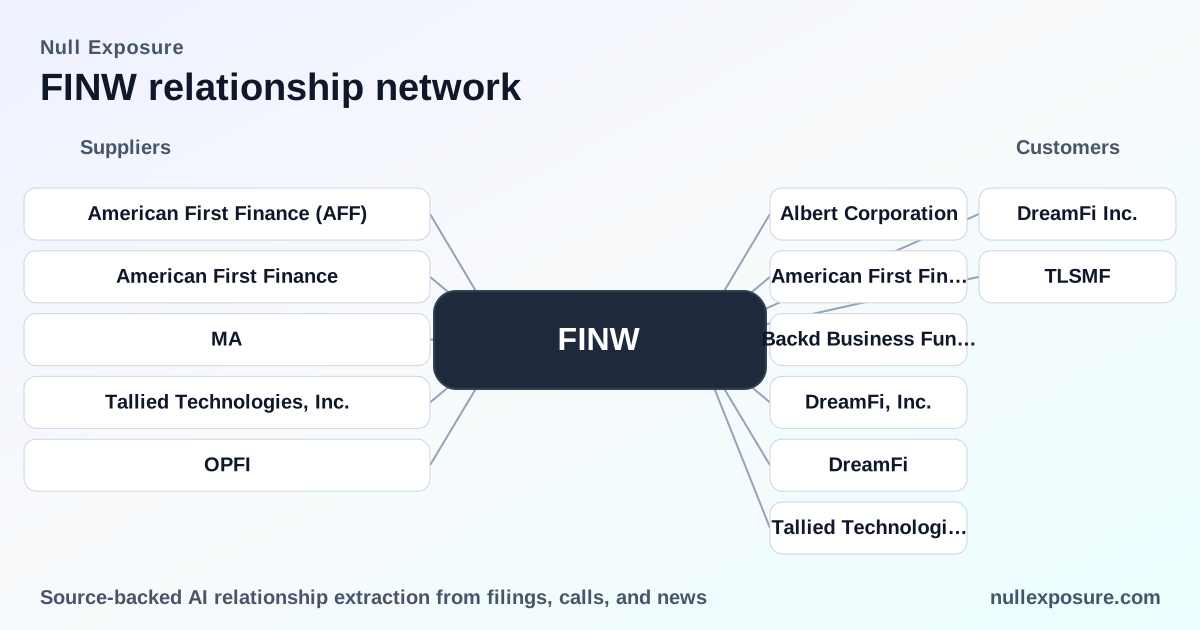
Customer relationships: who FinWise is working with and what they do
Below I cover every customer/program partner cited in public filings and press coverage. Each entry includes a concise plain‑English summary and a source reference.
Vera (VERA / Vera, Inc.)
FinWise agreed to a BIN sponsorship arrangement with Vera to launch an unsecured consumer credit‑card program targeting prime and near‑prime U.S. consumers; Vera will act as program manager and purchase receivables while FinWise serves as the BIN sponsor. (GlobeNewswire press release, April 14, 2026 — https://www.globenewswire.com/news-release/2026/04/14/3273910)
Backd (Backd Business Funding)
FinWise will provide business installment loans to SMBs through a strategic program with Backd and will give Backd access to its Credit‑Enhanced Balance Sheet program to improve capital efficiency and diversify funding for Backd’s warehouse facilities. (GlobeNewswire release, April 29, 2025 — https://www.globenewswire.com/news-release/2025/04/29/3070791)
Albert Corporation (Albert)
FinWise partnered with Albert to offer millions of Americans short‑term, transparent lines of credit via Albert’s app, with FinWise supplying the banking infrastructure and lending capability behind the product. (GlobeNewswire release, February 23, 2026; SahmCapital summary, Feb 24, 2026 — https://www.globenewswire.com/news-release/2026/02/23/3243070)
American First Finance (AFF)
FinWise serves as the originating bank and funding source for installment loans offered through American First Finance; a reported insider data breach in 2025 highlighted operational and data‑security exposure tied to these program relationships. (BleepingComputer report, March 2026 — https://www.bleepingcomputer.com/news/security/finwise-insider-breach-impacts-689k-american-first-finance-customers/; The Register coverage Sep 15, 2025)
DreamFi (DreamFi Inc.)
DreamFi launched a strategic program with FinWise that combines the bank’s mobile banking and payments infrastructure with DreamFi’s financial‑literacy tools to deliver products aimed at underbanked consumers. (GlobeNewswire program announcement, Oct 22, 2025; Insidermonkey earnings call transcript Q4 2025)
Tallied (Tallied Technologies)
Tallied is listed among FinWise’s expanded fintech partnerships intended to broaden nationwide lending, card and payments services, indicating Tallied uses FinWise as a program sponsor for card or lending products. (TradingView summary of FinWise 2025 10‑K and related commentary — https://www.tradingview.com/news/tradingview:bed11b3c17dc1:0-finwise-bancorp-2025-10-k-92-478m-interest-income-eps-1-13-diluted/)
Plannery
Plannery is named in FinWise disclosures as part of the cohort of fintech partners for lending, card and payments services, suggesting Plannery relies on FinWise’s infrastructure for program execution. (TradingView / FinWise 10‑K commentary, 2025)
PowerPay
PowerPay is identified alongside other fintech partners in FinWise’s strategic program roster and is positioned to expand the bank’s reach into payments and card-related programs. (TradingView / 2025 10‑K summary)
Tali (TLSMF / Tali)
FinWise describes Tali as a card sponsor partner that has been a significant contributor; FinWise is also providing Tali access to its credit‑enhanced balance sheet, which management cited as a source of upside and funding flexibility. (InsiderMonkey earnings transcript Q4 2025 — https://www.insidermonkey.com/blog/finwise-bancorp-nasdaqfinw-q4-2025-earnings-call-transcript-1685983/)
OppFi (OPFI / OppFi Inc.)
OppFi collaborates with bank partners including FinWise to originate consumer loans via OppFi’s digital platform, leveraging FinWise’s national charter and funding to scale loan origination. (TradingView coverage of OppFi SEC filings / 10‑K, 2025)
Key operational constraints and what they mean for value and risk
FinWise’s model delivers outsized revenue leverage from scale in program relationships, but that leverage comes with concentrated exposures:
- Duration risk from long loan terms (120–300 months) requires consistent funding and interest‑rate management.
- Program concentration is real: strategic program balances (~$113.6 million at 12/31/2024) are material to liquidity and deposit composition.
- Counterparty credit and operational risk: the bank’s credit risk is indirectly tied to fintech partners’ underwriting and fraud controls; operational incidents (e.g., the 2025 insider breach tied to AFF data) translate directly into reputational and compliance costs.
- Geographic single‑market exposure (U.S.) reduces diversification but aligns regulatory and market focus.
These characteristics make FinWise a service‑oriented, program‑dependent bank: growth scales with successful partner product launches, while downside concentrates if several partners underperform or if funding markets seize up.
Investment implications and next steps
FinWise trades with a mid‑single digit ROE profile and a P/E around current market multiples (trailing P/E ~13.4 per recent public data), reflecting a bank that is profitable but dependent on continued program growth and stable funding. Positive catalysts include successful rollouts of BIN and lending programs (Vera, Albert, DreamFi) and sustained deposit inflows from partner activity. Principal risks are concentration, duration/funding mismatch and operational security exposures.
For investors evaluating FINW, the thesis is clear: FinWise is a BaaS‑focused regional bank that monetizes partner programs through originations, deposits and sponsoring services — upside scales with partner adoption while risks center on concentration and operational controls. For a structured research brief and ongoing monitoring of these partner relationships, visit NullExposure research.