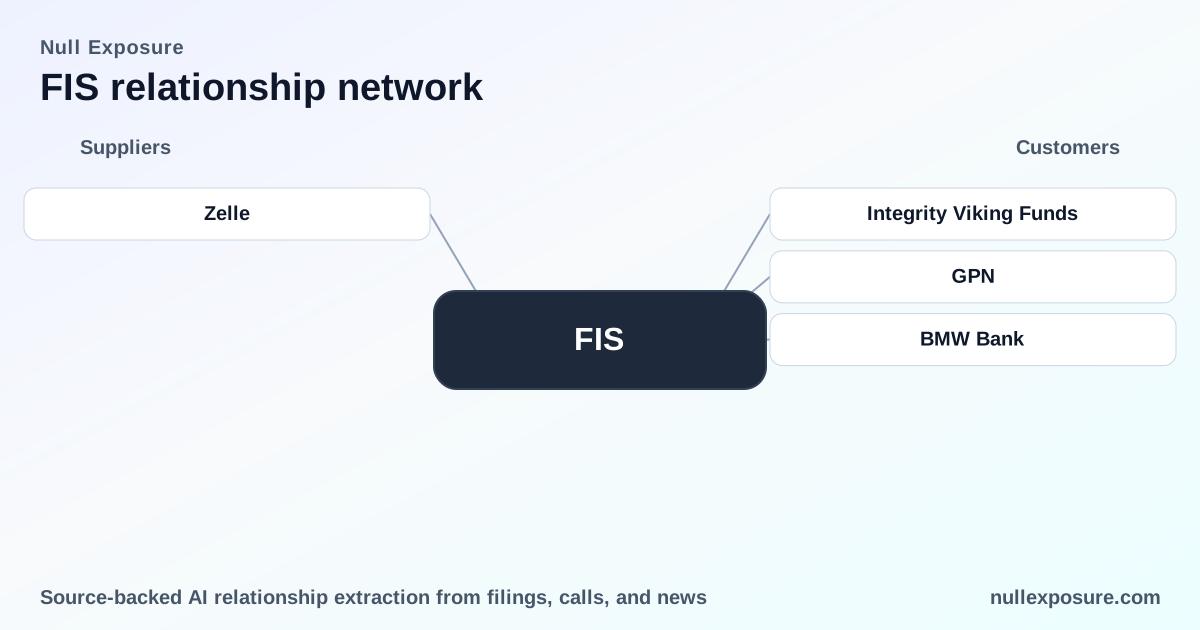
FIS customer map: where revenue, risk and strategic optionality converge
Fidelity National Information Services (FIS) monetizes through a mix of multi‑year processing contracts, software licenses and an accelerating SaaS/BPaaS shift, selling core banking, payments and capital‑markets infrastructure to banks, asset managers and corporates and collecting recurring fees and transaction revenue. For investors, the relevant lens is simple: scale and stickiness from long‑term core contracts underpins cash flow stability, while cloud and SaaS transitions drive growth and execution risk. Learn more about how we surface customer signals at the source: https://nullexposure.com/.
Client-by-client read — what the relationship means for revenue and risk
Below are the principal customer relationships surfaced in public reports and filings; each entry includes a plain-English summary and a concise source citation.
Integrity Viking Funds
Integrity Viking selected FIS Investment Accounting Manager to modernize investment accounting, giving FIS a foothold in complex, data‑intensive asset‑management workflows and recurring SaaS revenue potential. Reported in March 2026 by TradingView and Business Wire coverage summarized across Finviz and SimplyWall.st (Mar 2026).
Barclays US Consumer Bank
Barclays extended its multi‑year core banking partnership with FIS and selected the cloud‑ready Profile platform to support deposit growth and digital modernization, reinforcing FIS’s large‑bank core footprint. Payment and industry coverage documented the extension in April 2026 (PaymentsDive; Marketscreener; SahmCapital, Apr–May 2026).
ACAD
A clinical‑stage firm disclosed a manufacturing collaboration mentioning FIS alongside Corden and Flamma in a 2025 filing related to DAYBUE drug product manufacturing workflows, indicating FIS’s role outside strictly banking use cases where software or integration services are required. Cited from ACAD’s FY2025 filing (10‑K excerpt, filed Dec 31, 2025).
BFST (Business First Bancshares)
Business First identified investment in a new FIS large‑bank core processing system as a driver of efficiency and scaling following acquisitions, signaling FIS revenue from mid‑sized banks upgrading cores. Reported by SahmCapital in Oct 2025 (company commentary citing core migration benefits).
PFS (Provident Financial Services)
Provident described the FIS core upgrade as enabling more functional capabilities for a complex commercial bank, highlighting expected efficiency and product benefits from the migration. Earnings call transcript coverage, Q1 2026 (Investing.com / InsiderMonkey, May 2026).
GPN / Worldpay
Worldpay (now a commercial customer) uses FIS loyalty, premium payback and network routing capabilities, producing cross‑sell revenue after separation and demonstrating FIS’s continued commercial relationship with payments firms. Management remarks captured in Q4 2025 earnings call transcripts (InsiderMonkey, Mar 2026).
FBP (First Bancorp)
First Bancorp referenced its use of FIS as a service provider in quarterly commentary, confirming FIS’s role as an outsourced technology supplier for community and regional banks. Earnings call transcript, Q1 2026 (InsiderMonkey, May 2026).
IDAI (Trust Stamp / Orchestration Layer)
Trust Stamp reporting shows 114 institutions onboarding the FIS Orchestration Layer (over $350B in assets), illustrating adoption momentum for a middleware product that drives platform stickiness and potential services revenue. Reported in March–May 2026 (Trust Stamp press/coverage on SahmCapital and EDGAR summaries).
COF‑P‑L (Capital One preferred listing referenced)
An industry article cited a power failure at FIS Global as the root cause of a major third‑party outage for a bank, underscoring operational‑risk exposure where FIS infrastructure is critical to client operations. Coverage in The Financial Brand, FY2025 reporting (Mar 2026 write‑up).
HNVR (Hanover Bancorp)
Hanover announced a conversion to FIS Horizon core processing to be completed by mid‑February 2025, a classic example of smaller banks executing vendor migrations to improve efficiency and customer experience. TradingView reported on the conversion (Feb 2025 / reported Mar 2026).
Mizuho Financial Group
Mizuho selected FIS Balance Sheet Manager, indicating FIS penetration into large global banks for treasury and balance‑sheet risk tooling that complements core processing revenue. Marketscreener summarized the announcement (Apr–May 2026).
INDB (Independent Bank Corp)
Independent Bank outlined a major core conversion from Horizon to IBS within the FIS ecosystem scheduled for October, highlighting execution risk and the productivity upside banks expect from FIS migrations. Cited in earnings commentary and press (The Globe and Mail; InsiderMonkey, May 2026).
Pinnacle (PNFP) and Synovus
Analyst and market write‑ups noted FIS captured Synovus and Pinnacle in 2025, reflecting FIS’s active pipeline of regional bank deals and continued commercial traction in core conversions. Investor‑facing blogs and Tikr analysis referenced these deals (2025–2026).
BMW Bank
Coverage on Finviz and related outlets highlighted BMW Bank’s digital transformation with FIS, illustrating industry vertical adoption (captive finance) for core‑plus banking solutions and digital retail finance capabilities. Finviz summary and related reporting (Mar 2026).
M1
M1 selected FIS to replace legacy infrastructure with real‑time proxy voting capabilities, showing FIS’s reach into asset‑servicing and governance tooling beyond pure core processing. Marketscreener brief noted the selection (Apr 29, 2026).
Why these relationships matter: operating model signals and constraints
FIS’s customer mix and contract language produce several clear operating model characteristics:
- Contracting posture: long‑term and recurring. Public disclosures emphasize multi‑year processing contracts and recurring revenue, producing predictability but increasing the consequence of execution failures during major migrations.
- Product mix: hybrid software + services. The company sells software (licensing and SaaS), managed processing and professional services, so revenue growth can be captured via SaaS adoption while legacy licensing still contributes cash.
- Counterparty breadth: from community banks to global enterprises. Client profiles span large global banks, regional banks, asset managers, government institutions and small business channels, reducing single‑customer concentration but increasing operational complexity.
- Geography: U.S.‑centric with global reach. Majority of revenue is U.S.‑generated while FIS operates globally—this concentrates regulatory and macro risk in North America but preserves growth opportunities abroad.
- Criticality: high. FIS products are described as critical to clients’ operations, making outages or migration missteps an immediate operational and reputational risk that can trigger client remediation costs.
- Role duality: seller and service provider. FIS functions as both vendor (software seller) and outsourced service provider, meaning it captures more wallet share per client but also assumes execution obligations and operational SLAs.
- Infrastructure maturity: modernization underway. The firm has invested in private cloud and platform modernizations, signaling transition risk and long‑term margin upside as clients move to cloud and SaaS.
Investment implications — what to watch
- Upside: Large‑bank renewals (Barclays), new SaaS wins (Integrity Viking) and orchestration layer adoption (Trust Stamp/IDAI) point to sustainable, high‑quality recurring revenue and cross‑sell expansion. These relationships validate FIS’s strategy to grow higher‑margin software and cloud services.
- Risk: Core migrations (INDB, Hanover, Business First) and operational events (third‑party outages cited by Capital One coverage) create execution and availability risk that can pressure earnings or drive remediation costs. Investors should monitor migration timelines, churn after migrations, and SLA incidents.
- Catalysts: Quarterly disclosures on net new core wins, SaaS ARR progression and margin expansion from cloud migrations will materially affect the story. Analyst target shifts and large renewals are immediate near‑term catalysts.
For a structured feed of relationship‑level signals and excerpts like the ones above, visit our research hub for investors and operators: https://nullexposure.com/.
Final take
FIS’s customer map shows durable, recurring revenue anchored in long‑term core contracts, with a credible pathway to higher‑margin SaaS growth—but the company’s value realization depends on disciplined execution of core migrations and cloud transitions while avoiding service interruptions that threaten client trust. Investors should weight the stability of multi‑year contracts against concentrated operational risk inherent to mission‑critical banking infrastructure.