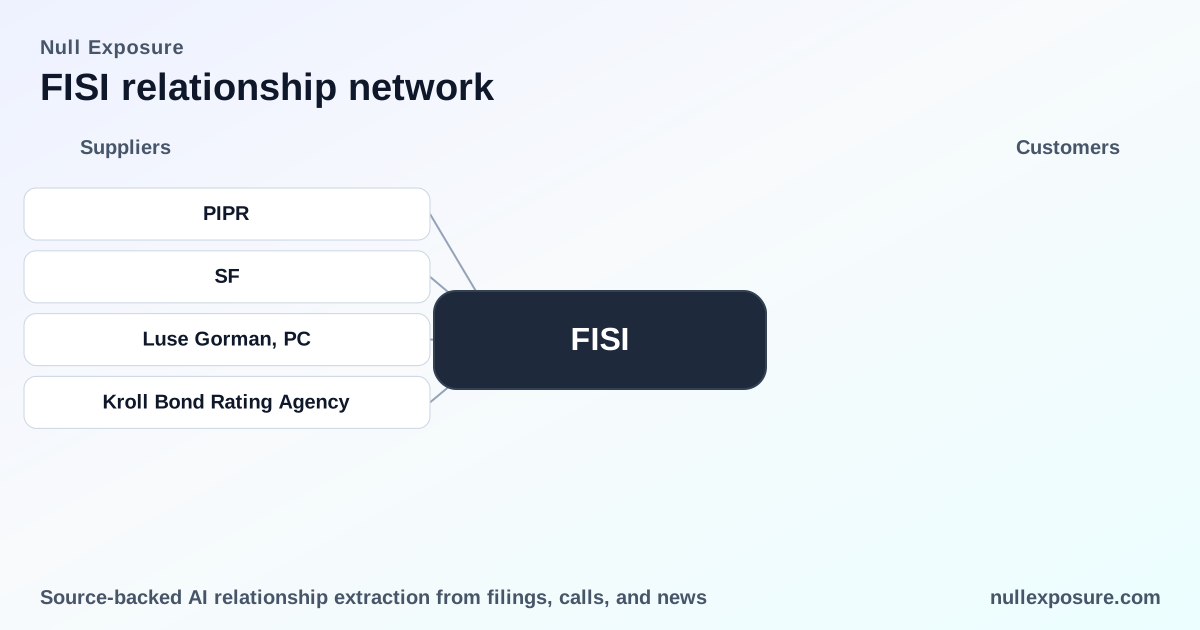
Financial Institutions Inc (FISI): Customer Relationships and Strategic Constraints for Investors
Financial Institutions Inc (NASDAQ: FISI) operates as the holding company for Five Star Bank, monetizing through interest income on lending, fee income from deposit and transaction services, and wealth-management advisory fees. The bank’s model is community-focused commercial and consumer banking concentrated in Western and Central New York with selective Mid‑Atlantic commercial lending, generating stable net interest margin and recurring service revenues from a diversified set of local counterparties. For direct coverage and relationship intelligence, see https://nullexposure.com/.
One partnership that matters: the Safe Harbor (SHFS) tie-up
A public announcement in May 2023 reported a partnership between Five Star Bank and Safe Harbor Financial (SHFS) to expand access to cannabis banking nationwide through the bank’s chartered capabilities. This initiative positions Five Star Bank as a correspondent for specialized merchant and deposit services tied to the cannabis sector via Safe Harbor’s platform, extending Five Star’s addressable market beyond its traditional geographic footprint. (Source: Globenewswire release, May 2023.)
All customer relationships found in this review
This brief identified one explicit customer relationship in public sources:
- Safe Harbor Financial (SHFS) — Five Star Bank entered a partnership announced in May 2023 to provide banking access to cannabis-related businesses, leveraging Five Star’s charter and compliance infrastructure to support Safe Harbor’s nationwide offering. (Source: Globenewswire press release, May 2023.)
That relationship is singular in the searchable public results provided here; the Safe Harbor arrangement is a strategic, compliance‑anchored customer partnership that extends Five Star’s service portfolio into a high‑growth vertical.
How the company’s operating model shapes customer dynamics
Financial Institutions’ operating model embeds several material constraints and signals that determine how customer relationships are structured, priced, and risk-managed:
-
Contract tenor is mixed. The loan book includes both long‑term commercial mortgages (up to ten years for many commercial mortgages) and shorter commercial construction facilities (commonly three years or less). This combination creates a layered asset maturity profile that supports stable interest income while keeping a pipeline of renewals. (Company disclosures on loan terms, 2024.)
-
Deposits are functionally short‑term. Company filings show that as of December 31, 2024, roughly $3.56 billion of deposit liabilities—or about 70% of total deposits—have no contractual maturity and are withdrawable on demand. That deposit structure produces funding flexibility but elevates liquidity sensitivity to local economic shocks. (Company filings, Dec 31, 2024.)
-
Counterparty mix is regionally concentrated and relationship‑driven. Municipal deposits comprised $1.07 billion, or 21% of total deposits as of year‑end 2024, and the bank advertises a core customer base of individuals, small‑ and mid‑sized businesses, and community organizations. This profile produces stable fee and municipal deposit flows but concentrates exposure to regional fiscal cycles and employment trends. (Company filings, Dec 31, 2024.)
-
Role versatility: buyer, seller, and servicer. Five Star functions as a traditional retail and commercial lender, sells qualifying residential mortgage originations into the secondary market, and provides loan servicing for third parties (residential servicing balances were ~$280.8 million at year‑end 2024). These multiple roles diversify revenue streams across net interest margin, secondary market gains, and recurring servicing fees. (Company disclosures, 2024.)
-
Maturity and selective product wind‑down. Management describes many customer relationships as long‑standing and “mature” given the community‑bank orientation; concurrently, the company announced an orderly wind‑down of Banking‑as‑a‑Service (BaaS) offerings in September 2024, with BaaS deposits and loans roughly $100 million and $29 million, respectively, at year‑end 2024, targeted for completion in 2025. The BaaS exit reduces non‑core deposit volatility and compliance complexity but removes a fee income stream tied to embedded fintech partners. (Company announcement, Sept 2024; filings, Dec 31, 2024.)
-
Loan sizing targets mid‑market and small business. Underwriting generally targets commercial loans up to $25 million for small‑ to mid‑sized businesses, positioning the bank in relationship lending rather than large corporate finance. That underwriting posture supports tighter credit oversight but concentrates credit risk in the regional economic cycle. (Company disclosures.)
Concentration, liquidity, and counterparty risk — what investors should price in
Five Star’s municipal concentration (21% of deposits) and predominantly local customer base produce predictable core funding and deposit stickiness under normal conditions; however, the high proportion of non‑maturing deposits (70%) creates liquidity sensitivity to local deposit flight during stress events. Institutional ownership is elevated, and the bank’s balance sheet metrics (price‑to‑book near 1.08; return on equity ~12.9% TTM) indicate a mature regional bank profile where capital returns and dividend policy are material value drivers.
Relationship implications: Safe Harbor in context
The Safe Harbor partnership is a targeted, product‑level expansion that leverages Five Star’s charter and compliance infrastructure to capture a national flow of cannabis payments and deposits without Five Star building a nationwide branch footprint. That arrangement fits the bank’s strategy of deploying specialty services to broaden fee revenue while maintaining a regional branch base. (Globenewswire, May 2023.)
Investment implications and tactical considerations
- Earnings mix: Expect continued reliance on net interest income from regional lending, supplemented by transaction and advisory fees; the BaaS wind‑down will reduce non‑interest income but simplify compliance and reduce deposit volatility tied to third‑party platforms. (Company filings, 2024.)
- Liquidity management: The large share of demandable deposits obligates vigilant liquidity hedging and contingency funding; investors should track loan‑to‑deposit trends and wholesale funding usage in quarterly filings.
- Credit exposure: Concentration in small‑ and mid‑market loans and regional CRE and distribution properties demands attentive underwriting through economic cycles; watch asset quality metrics and reserve build trends.
- Strategic optionality: Partnerships like Safe Harbor demonstrate a pathway to national fee revenue without wholesale branch expansion, but these are niche and compliance‑intensive lines that require continuous oversight.
For professional clients evaluating counterparty and relationship exposure, NullExposure provides structured visibility and ongoing monitoring of bank‑customer linkages — explore more at https://nullexposure.com/.
Key takeaways for investors
- Five Star Bank is a regionally focused commercial and consumer bank monetizing predominantly through lending spreads and service revenues.
- Deposit profile is heavily non‑maturing (≈70%) with municipal deposits representing a material 21% share, creating both funding stability and liquidity sensitivity.
- Customer relationships are long‑standing and relationship‑driven, with the company exiting non‑core BaaS to reduce complexity while selectively partnering (e.g., Safe Harbor) to extend fee revenue reach.
- Credit risk is concentrated in small‑ and mid‑market commercial portfolios and geographically localized CRE and distribution segments; loan sizes typically cap at $25 million for commercial borrowers.
This review synthesizes public relationship disclosures and company filings to highlight how Five Star’s customer mix and contract characteristics drive both revenue stability and event‑driven risk sensitivities. For ongoing monitoring and more detailed relationship maps, visit https://nullexposure.com/.