Empire State Realty OP (FISK) — Customer Relationships That Drive Cash Flow and Concentration
Empire State Realty OP, L.P. (FISK) operates as the operating partnership of Empire State Realty Trust and monetizes primarily through long‑term office and retail leases, specialty licensing of the Empire State Building tower and observatory concessions, and services income from property and asset management. The business model mixes high‑visibility, high‑margin observatory revenues with concentrated lease cash flows anchored by a small number of large, long‑dated tenants, creating both durable cash generation and geographically concentrated exposure to New York City real estate. For a concise view of competitive and counterparty risk, visit https://nullexposure.com/ for investor-ready relationship analytics.
Executive summary: how tenant mix and licensing underpin value
FISK’s revenue profile combines two distinct engines: (1) real estate leasing across a compact NYC portfolio—where a handful of properties produce the majority of rental revenue—and (2) the Empire State Building’s Observatory and licensing operations, which drive material non‑rental revenue. The leasing book contains both long‑term, investment‑grade anchors and shorter, cancellable arrangements, so underwriting must balance high-quality tenancy against pockets of contractual flexibility and geographic concentration.
What the direct customer relationships look like
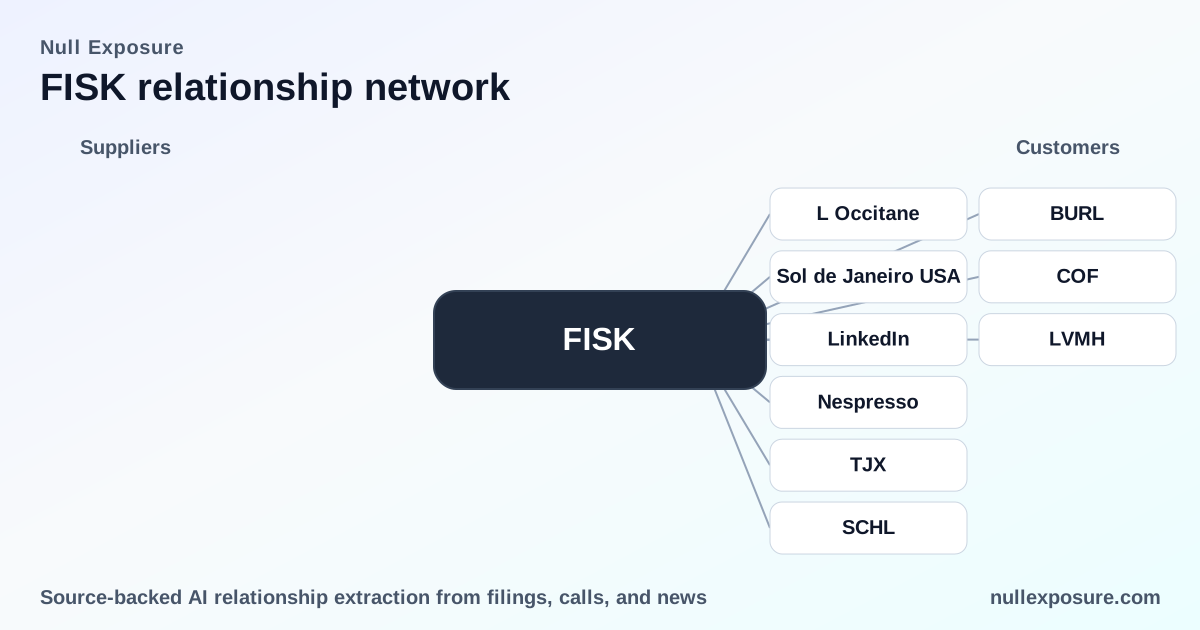
Below are the customer relationships cited in company disclosures and calls; each note includes a brief plain‑English summary and the original disclosure context.
-
L’Occitane — tenant connection via Sol de Janeiro. The FY2024 10‑K states Sol de Janeiro is a subsidiary of L’Occitane and is listed as a tenant at 111 W. 33rd Street, linking a global retail group to that property’s cash flow. According to FISK’s FY2024 10‑K filing, this is part of the tenant roster at 111 West 33rd Street.
-
Nespresso — early renewal, large footprint at 111 West 33rd Street. Management disclosed on the 2025 Q4 earnings call a 7‑year early renewal covering approximately 42,000 square feet with Nespresso at 111 West 33rd Street, indicating durable mid‑sized office/retail commitment. This detail was announced on the 2025 Q4 earnings call.
-
Sol de Janeiro USA — new lease with notable related‑party connection. FISK’s FY2024 10‑K records Sol de Janeiro USA as a tenant at One Grand Central Place with a lease projected to commence in Q1 2025 and starting annualized rent of $3.5 million; the filing also discloses a family tie between a company director and Sol de Janeiro’s CEO. This appears in the FY2024 10‑K.
-
LinkedIn — long retail term at the Empire State Building, expanding footprint. During the 2025 Q4 earnings call, management said LinkedIn agreed to a 16‑year retail lease for 15,000 square feet at the Empire State Building, bringing its total presence to about 540,000 square feet across the portfolio.
-
SCHL / Scholastic — long office commitment supporting stability. The 2025 Q4 earnings call referenced a 15‑year office lease with Scholastic and noted fully leased street retail with roughly eight years remaining, underscoring long‑dated cash flow from an education‑sector tenant. This was described in the 2025 Q4 earnings call.
-
TJX / T.J. Maxx — anchor retail renewal at 50 West 57th Street. Management disclosed a 10‑year early renewal for 46,000 square feet with T.J. Maxx at 50 West 57th Street, flagging an investment‑grade retail anchor in the portfolio on the 2025 Q4 earnings call.
-
BURL / Burlington — expansion indicating growth in retail footprint. The 2025 Q4 earnings call reported a 16‑year, 36,000 square foot expansion with Burlington at 1400 Broadway, representing roughly 20% growth in that tenant’s footprint and signaling retailers’ willingness to expand with FISK.
-
Capital One — retail anchor in AAA location. Capital One is cited as an anchor tenant alongside Sephora in a AAA retail location, which management mentioned on the 2025 Q4 earnings call as supportive of street‑level retail valuation.
-
LVMH / Sephora — luxury retail anchor that elevates location yield. Sephora (under LVMH) is referenced as an anchor alongside Capital One in the same AAA retail location, discussed on the 2025 Q4 earnings call; such luxury and national retail brands lift street retail economics.
Each of these relationships is documented either in FISK’s FY2024 Form 10‑K or the 2025 Q4 earnings call, and together they outline a tenant roster combining national retail anchors, long office leases, and notable renewals and expansions.
How the corporate constraints shape underwriting and operational posture
Evaluate FISK not as a homogeneous landlord but as an operator with mixed contracting and concentration characteristics:
-
Contracting posture is mixed — both short‑term and long‑term agreements exist. The public record highlights cancellable arrangements (tenant right to cancel on 90 days’ notice) co‑existing with multi‑year and multi‑decade leases and ground lease interests, which requires granular lease‑by‑lease analysis rather than a single duration assumption.
-
High concentration of cash flows in a few assets creates critical counterparty risk. Three properties accounted for roughly 55.5% of rental revenue in FY2024, with the Empire State Building alone contributing about 31.9%—a structural concentration that elevates single‑asset risk to the top of the investor checklist.
-
The tenant mix spans counterparty types with measured diversification. Disclosures show exposure to non‑profits (~4.8%), government entities (~2.1%), individuals (observatory visitors) and large enterprises, so revenue diversification exists across segments but remains geographically concentrated in NYC.
-
Commercial maturity and service orientation. Management emphasizes extensive diligence and long‑term relationship building, signaling a preference for mature, expandable relationships and an active role as asset/property manager and licensor for observatory concessions and tower broadcast rights.
-
Segmented revenue model with a material services component. The business reports separate real estate and observatory segments; observatory operations are material—roughly $136.4 million of revenue in FY2024—and are accounted for as a distinct, high‑margin line that changes seasonality and cash‑flow volatility compared with base rent.
-
Geographic concentration in NYC mandates regulatory and localized operational scrutiny. Operations are principally located in New York City and subject to local regulatory regimes such as NYC Local Law 97 for emissions and building compliance.
Investment implications and key takeaways
-
Positive: Brand‑name retail anchors and multi‑year office commitments create a reliable core rental stream, while the observatory and licensing franchise deliver a sizable, high‑margin revenue source. Recent renewals and expansions with recognizable tenants (T.J. Maxx, Burlington, LinkedIn, Nespresso) reinforce leasing execution and tenant demand.
-
Risks: Material single‑asset concentration and the coexistence of cancellable short‑notice leases introduce potential volatility; investors must underwrite the Empire State Building as both a cash‑flow engine and a concentration risk. Regulatory exposure and NYC‑specific operating costs also matter.
For a structured, relationship‑level risk map and contract detail that investment and operations teams can use for scenario analysis, visit https://nullexposure.com/ — our platform synthesizes filings and calls into actionable counterparty views.
Conclusion: FISK’s customer profile blends high‑quality anchor tenants and long leases with an outsized reliance on a few properties and a meaningful observatory/licensing business. Underwriting should focus on vintage lease terms, occupancy stability at the Empire State Building cluster, and observatory revenue sensitivity to tourism cycles.