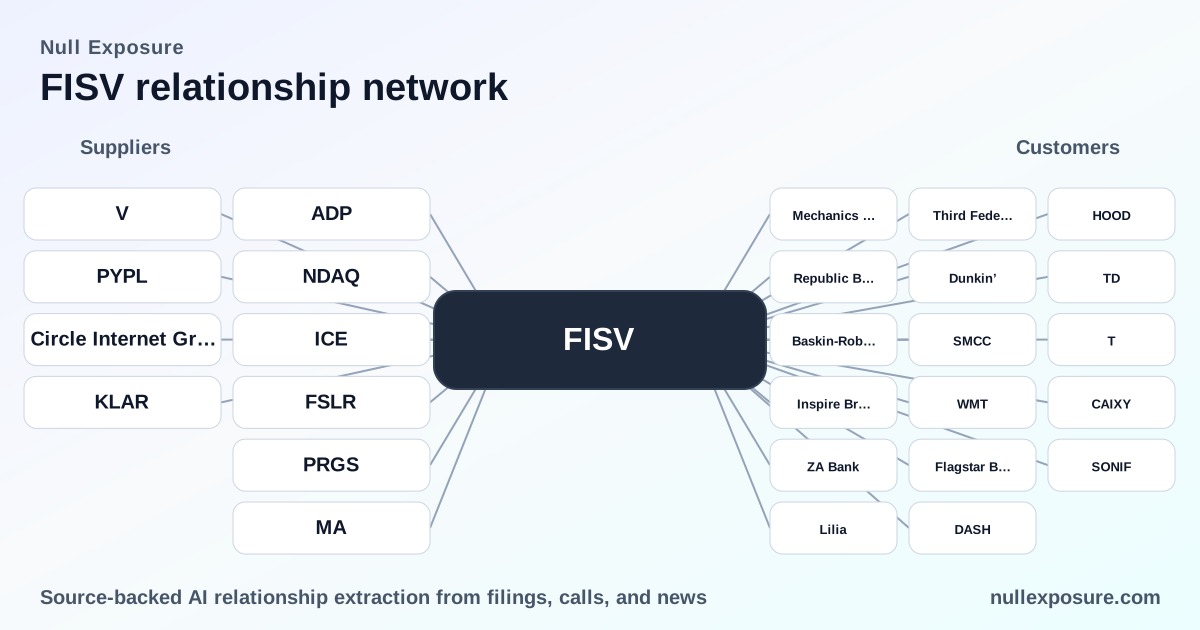
FISV Customer Map: Who Pays for Fiserv’s Payments Engine and Why it Matters
Thesis: Fiserv operates a high-margin, transaction-driven payments and banking technology business that monetizes through multi-year, usage-based contracts across merchant, financial-institution and digital-banking channels; investors should value growth from wallet-share gains (Clover, XD, DNA) and geographic expansion alongside the recurring economics of account- and transaction-based fees.
For a compact view of client momentum and contract types, see more at https://nullexposure.com/.
Overview: Fiserv’s commercial model is straightforward — it sells a mix of software, hardware and payment processing services into banks, retailers and SMBs. Revenue is dominated by processing and services fees that are account- and transaction-linked under long-term contracts, while product sales (POS hardware, card production, software licenses) add episodic upside. The relationships below show the company’s breadth: from global banks to neighborhood restaurants, and from agent-bank agreements to fintech partnerships that embed Fiserv as the payments plumbing.
Key operating constraints and model signals
- Long-term, multi-year contracts and usage-based pricing are central to revenue: processing and services generated 81% of revenue in 2024 and are described in filings as account- and transaction-based fees under multi-year arrangements. That combination creates predictable recurring revenue with upside tied to volume growth.
- Commercial mix is diversified by counterparty type: Fiserv sells to small businesses (Clover/SMB), large enterprises (omnichannel commerce and Commerce Hub) and government/public sector clients for payment processing.
- North America dominance but global reach: the company still derives the majority of revenue from the U.S. and Canada, yet management emphasizes international launches (notably Brazil, Canada and Japan) as growth levers.
- Criticality of services: processing and services are core to operating profit, making Fiserv not just a vendor but a critical infrastructure provider for many clients.
- Reseller and agent-bank relationships are part of distribution: Fiserv supplies technology to banks and third-party resellers that in turn sell to merchants.
- Product mix includes hardware, software and services, meaning revenue drivers are both recurring fees and one-time device/software sales.
If you want a full navigable view of client signals used to build this note, visit https://nullexposure.com/.
Customer relationships — concise investor-oriented summaries
-
Republic Bank & Trust Company — Signed a new core deal to migrate onto Fiserv’s DNA platform, enabling real‑time continuous processing and faster access to deposited funds, per Fiserv’s 2025 Q4 earnings call.
Source: Fiserv 2025Q4 earnings call (Mar 2026). -
Mechanics Bancorp — Expanded its relationship post‑merger with HomeStreet Bank, selecting Fiserv’s core and adding the XD digital platform; the bank now sits above $22 billion in assets, according to the 2025Q4 call.
Source: Fiserv 2025Q4 earnings call (Mar 2026). -
SMCC (Sumitomo Mitsui Card Company / related) — Flagship partnership to bring Clover to SMBs in Japan, introduced in the 2025 Q4 call and covered by market commentary as part of Japan expansion.
Source: Fiserv 2025Q4 earnings call (Mar 2026); Tikr blog (Mar 2026). -
Dunkin’ — Continues as an Inspire Brands merchant client, with Fiserv unifying in-store, in-app and online commerce across concepts, per a 2023 partnership announcement.
Source: PYMNTS partnership article (Sept 2023). -
Inspire Brands — Expanded collaboration to simplify omnichannel commerce across Inspire’s portfolio, per the joint 2023 press release.
Source: PYMNTS partnership article (Sept 2023). -
Baskin‑Robbins — Included among Inspire Brands chains to receive unified commerce services from Fiserv under the expanded 2023 partnership.
Source: PYMNTS partnership article (Sept 2023). -
Yakima Federal Savings & Loan — First institution to deploy Fiserv’s CashFlow Central within the XD environment, targeting SMB AP/AR modernization, according to GlobeNewswire and company releases in April 2026.
Source: GlobeNewswire press release (Apr 30, 2026). -
ZA Bank — Virtual bank leveraging Fiserv technology to improve digital banking experience, noted in investor‑relations coverage ahead of Fiserv investor day (2026).
Source: InvestingNews (Mar–May 2026). -
Third Federal Savings & Loan — Adopted Fiserv’s DNA core platform; Digital Transactions covered the migration as a 2025/2026 initiative.
Source: Digital Transactions (2026). -
Lilia (restaurant) — Cited as the first client for a new restaurant product line, spotlighted by Fiserv management and Digital Transactions in 2025/2026 commentary.
Source: Digital Transactions (2026). -
Flagstar / FLG / Flagstar Bank — Flagstar was impacted by an unauthorized access incident involving a Fiserv file‑transfer application; reporting notes Flagstar’s use of Fiserv for transaction processing and mobile banking.
Source: ITSecurityGuru and PaymentsDive reporting on the incident (2023; covered in 2026 compilations). -
DoorDash (DASH) — Partnered with Fiserv to provide banking services for drivers through the Crimson instant‑pay product, enabling payments after each delivery; discussed in PaymentsDive coverage of FY2024/FY2026 initiatives.
Source: PaymentsDive (FY2024 coverage; cited 2026). -
Walmart (WMT) — Working with Fiserv on pay‑by‑bank transactions at scale, identified by Fiserv executives when discussing major merchant partnerships.
Source: PaymentsDive (FY2024/FY2026 coverage). -
Bridgewater Bancshares (BWBBP / BWB) — Management remarks confirm Bridgewater’s core runs on Fiserv and that Fiserv technology underpinned innovation over several years, per investor‑call transcripts.
Source: Investor transcript coverage (Q4 2025 / FY2026). -
SB Financial Group (SBFG) — Planning a conversion to Fiserv at year‑end; management flagged the conversion as a near‑term operational headwind into 2027.
Source: SBFG earnings call transcript (early 2026). -
Robinhood (HOOD) — Expanded an existing credit‑card relationship to add debit processing services, as announced on Fiserv’s 2025 Q4 earnings call.
Source: Fiserv 2025Q4 earnings call (Mar 2026). -
Western Alliance Bank (WAL) — Entered an agent‑bank partnership to bring Clover commerce and business management tools to Western Alliance clients, per multiple press releases in 2026. High distribution potential for Clover via a bank with commercial reach.
Source: GlobeNewswire / ABFJournal / MonitorDaily (Mar–May 2026). -
Esquire Financial (ESQ) — Operational note: Esquire runs on Fiserv while Signature uses Jack Henry; planned conversion timing discussed in an acquisition notice (optimistic late‑2026, more realistic Q1 2027).
Source: Yahoo Finance summary on Esquire acquisition (May 2026). -
Datavault AI (DVLT) — Announced integrations referencing Fiserv as part of relaunch plans for IDE/NYIAX products; shows Fiserv’s role in broader fintech integrations.
Source: DataVault press release (2026). -
WAFD — Early adopter of CashFlow Central to support SMB payables/receivables without third‑party services, per WAFD remarks in 2025/2026 transcripts.
Source: WAFD earnings call transcripts (FY2025/FY2026). -
QCR Holdings (QCRH) — Commentary referenced migrations between core providers (Fiserv/Jack Henry) as part of core‑service strategy; QCRH remarks captured in earnings transcripts.
Source: Investing.com earnings transcript (2026). -
Sonic (SONIF) — Included alongside Dunkin’ and Baskin‑Robbins in the Inspire Brands/Fiserv commerce collaboration announced in 2023.
Source: PYMNTS (Sept 2023). -
Caixa (CAIXY) — Identified as a market‑leading Brazilian institution partnering with Fiserv in the company’s Brazil launch, with results tracking ahead of plan per the 2025 Q4 call and market write‑ups.
Source: Fiserv 2025Q4 earnings call; Tikr analysis (Mar 2026). -
TD (Toronto‑Dominion Bank) — Management highlighted a strategic relationship in Canada with TD as a growth accelerator for Clover and related offerings.
Source: Fiserv 2025Q4 earnings call; Tikr blog (Mar 2026). -
AT&T (T) — Named among Commerce Hub wins for enterprise customers; cited in Fiserv’s 2025 Q4 commentary on Commerce Hub momentum.
Source: Fiserv 2025Q4 earnings call (Mar 2026). -
Can/Am Technologies — Launched Teller Payments powered by Fiserv, illustrating government payment use‑cases and channel partnerships announced in early 2026.
Source: SimplyWallSt summary (Feb 18, 2026). -
SMFG (Sumitomo Mitsui Financial Group) — Referenced in media as the institutional partner helping bring Clover to Japan, reinforcing Fiserv’s strategic Japan entry.
Source: The Globe and Mail / SMFG press mentions (Mar 2026).
Concluding view Fiserv’s client roster reflects a deliberate strategy: embed at the transactional layer across banks, merchants, and fintechs while up‑selling software (XD, Clover) and hardware (POS devices). The balance of recurring, usage‑linked income and episodic product sales, combined with long contract tenors and high renewal rates, yields a revenue profile that is both resilient and levered to payments volume. Key risks for investors are operational (platform migrations and cyber incidents) and executional (international rollouts), while the visible pipeline of bank migrations and merchant integrations underpins near‑term revenue momentum.
For a deeper interactive map of Fiserv customer signals and to track updates, visit https://nullexposure.com/.