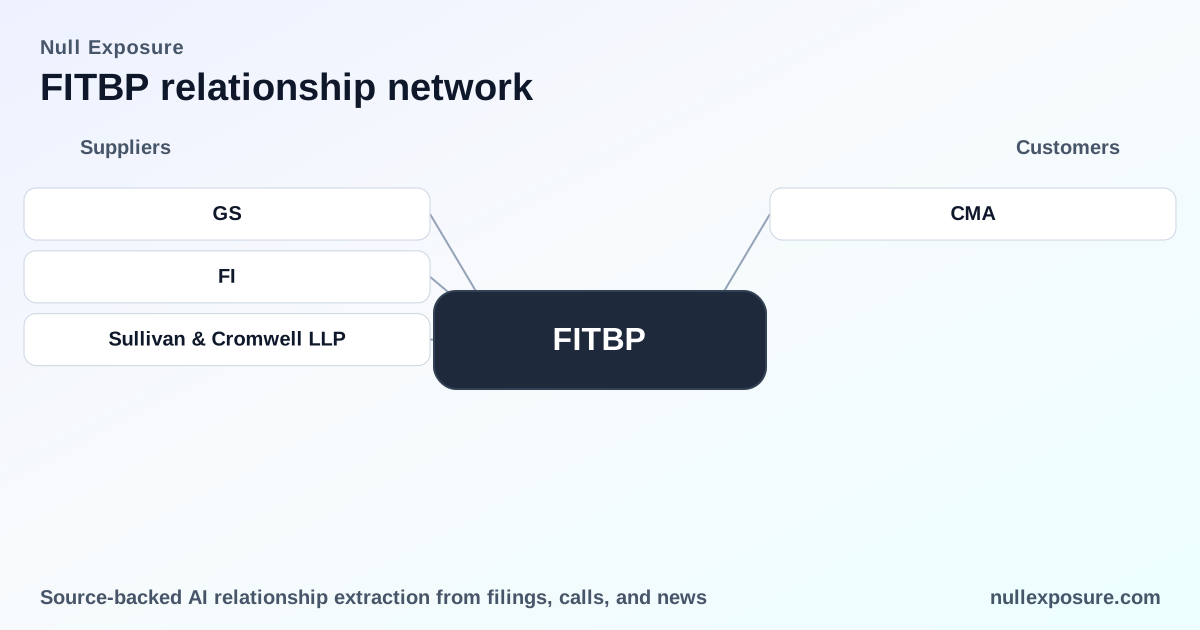
Fifth Third Bancorp (FITBP) — Customer relationships and what they imply for the preferred equity investor
Thesis: Fifth Third Bancorp monetizes a diversified set of client relationships across Commercial Banking, Consumer & Small Business Banking, and Wealth & Asset Management by earning net interest margin on loans and deposits, servicing and mortgage fees, and noninterest income from payments and wealth services. Customer relationships are broad and regional, with servicing scale and treasury/payments revenue the key recurring cash flow drivers for holders of preferred claims. For a deeper client-map read, see https://nullexposure.com/.
Why the customer map matters to investors in FITBP
Fifth Third is a regional bank with a full-service franchise: it generates fee income by servicing loans and providing treasury, foreign-exchange, and wealth management services, while funding and monetizing credit through deposit and lending operations. That mixed revenue model stabilizes cash flow for preferred shareholders because fees (servicing, payments, wealth management) are less cyclical than pure credit spreads.
Key company facts from public filings: the bank reports roughly $213 billion in assets, operates over 1,089 full-service banking centers, and services tens of billions of dollars of residential mortgages for third-party investors — all of which underline the scale of its customer-facing operations and recurring fee pools (company filings, as of December 31, 2024). These operational facts shape counterparty exposure and revenue concentration.
Operational constraints and what they signal about the business model
The customer evidence in filings paints a clear operating posture:
- Broad counterparty mix. Filings identify municipal and government customers, corporations, mid-market firms, small businesses, nonprofits, and retail individuals. This diversity indicates a contracting posture geared toward many client types rather than reliance on a single industry vertical.
- Regional concentration. The footprint is concentrated in the Midwest and Southeast of the U.S., which creates geographic concentration risk even as product diversification mitigates pure sector concentration (company filing disclosures, Dec 31, 2024).
- Service-provider role and recurring fees. Fifth Third both sells loans and retains servicing responsibilities, receiving servicing fees based on outstanding balances; it also provides treasury and FX hedging services to commercial clients. That makes the bank a critical middleman for mortgage investors and commercial clients — a source of steady noninterest income and operational dependency for counterparties.
- Relationship maturity and stage. The firm reports significant active servicing volumes (for example, $94.2 billion of residential mortgage servicing at Dec 31, 2024 versus $100.8 billion the prior year), which signals mature, ongoing client relationships rather than one-off transactions.
- Segment-driven revenue mix. The three operating segments—Commercial Banking, Consumer & Small Business Banking, and Wealth & Asset Management—deliver diversified revenue streams, with commercial payments and wealth fees explicitly called out as growth contributors.
Collectively these constraints point to a diversified, fee-rich regional bank that balances credit risk with recurring servicing and payments revenues; investors in preferred stock should price for stable fee income but also account for regional credit cycles and integration risk from large corporate actions.
For further detail on customer mappings and contract-level signals, visit https://nullexposure.com/.
All identified customer relationships from the source set
The dataset returned two relationship entries; both reference the same corporate counterparty in Fifth Third's 2025 Q4 earnings call. Each entry is summarized below exactly as found in the public remarks.
CMA (ticker: CMA)
Fifth Third stated on its 2025 Q4 earnings call that it has received all material regulatory and shareholder approvals to complete its merger with Comerica; the comment signals an imminent corporate combination that affects large-counterparty composition and strategic positioning (Fifth Third 2025 Q4 earnings call, March 8, 2026).
Comerica (ticker: CMA)
On the same 2025 Q4 earnings call, Fifth Third reiterated that approvals are in place to complete a merger with Comerica, implying an upcoming integration of Comerica as a major counterparty and likely consolidation of customer books (Fifth Third 2025 Q4 earnings call, March 8, 2026).
How these relationships change the risk–return profile for FITBP
The public mention of a merger with Comerica is material for investors assessing customer-related risk and upside:
- Integration will change counterparty concentration and product mix. The addition of Comerica’s customers will redistribute credit and deposit concentrations, and could shift the geographic footprint beyond Fifth Third’s current Midwestern/Southeastern base.
- Fee pools could expand, but integration costs and contract re-pricing are immediate risks. Given Fifth Third’s role as a loan servicer and treasury/payments provider, combining two regional banks could expand cross-sell opportunities for payments and wealth services while creating near-term execution and contract renegotiation risk.
- Operational criticality increases. A larger servicing book and combined treasury operations raise the importance of systems integration and client retention; losses of client relationships or servicing contracts would disproportionately affect noninterest income streams that support preferred dividends.
Practical checklist for investors evaluating preferred exposure
- Confirm how the merger will be executed and whether servicing contracts or investor recourse terms change post-close (earnings call commentary and subsequent filings).
- Monitor servicing balances and mortgage servicing rights valuation trends, since servicing fees are a core noninterest income driver for Fifth Third (company filings, Dec 31, 2024).
- Track commercial payments and treasury management revenue growth as an early indicator of successful client retention and cross-sell.
- Watch for geographic concentration exposures and combined entity branch rationalization that could alter deposit stability.
Bottom line
Fifth Third is a diversified regional bank whose customer relationships create durable fee income, but the announced merger with Comerica is a near-term structural event that will reshape customer concentration and operational risk. Preferred investors should underwrite steady servicing and payments revenue while pricing in integration execution risk and regional credit cycles. For a mapped view of counterparties and relationship signals, visit https://nullexposure.com/.