Five9’s partner-driven route to scale: how channel and usage economics shape revenue quality
Five9 sells cloud contact-center software to enterprises and mid-market buyers, monetizing primarily through monthly subscription fees for its Intelligent CX Platform and usage-based telephony charges. The company combines a SaaS licensing model with consumption billing, a mix of short- and multi-year contracts, and a broad partner ecosystem that amplifies distribution and product integration. For investors, the combination delivers durable recurring revenue backed by over $1.1 billion of remaining multi-year obligations while concentrating revenue in North America and exposing results to telephony usage swings. Learn more at https://nullexposure.com/.
How Five9 actually gets paid and what that implies for revenue stability
Five9 operates as a classic enterprise SaaS vendor for contact centers with an important twist: telephony usage is billed separately on a consumption basis, so headline subscription recurring revenue coexists with variable telephony topline. Company disclosures state that Five9 generates subscription revenue for access to its platform and usage-based telephony revenue, and that it offers monthly, annual and multi-year contracts. As of December 31, 2024, the company reported $1,118.8 million allocated to remaining performance obligations on contracts with original duration greater than one year, which signals significant forward revenue visibility for multi-year deals.
These contract signals imply a mixed contracting posture: high predictability from multi-year SaaS licenses alongside revenue volatility from usage-based telephony. The company’s sales motion spans telesales for smaller accounts and field sales for mid-market and enterprise customers, which supports both scale and upsell into larger buyers. The business runs as a single operating segment—software—so management and investors evaluate performance on consolidated SaaS plus telephony economics rather than multiple discrete product lines.
Where customers are concentrated and why that matters for risk
Company disclosures show a strong North American bias: for the year ended December 31, 2024, billed revenues by customer billing address were United States $927,788 and International $114,150 (amounts in thousands), for total revenue of $1,041,938 (in thousands). Five9 reports more than 3,000 customers with no single customer accounting for more than 10% of revenue in 2024, 2023 or 2022, which makes individual-customer concentration immaterial while leaving geography concentration material to the U.S. market.
Key operating-model takeaways:
- Contracting posture: Mix of monthly, annual and multi-year contracts provides hybrid predictability; long-duration RPO underpins forward visibility.
- Concentration: Customer-level concentration is low, but revenue is materially North America–weighted, exposing the company to U.S. macro and enterprise IT cycles.
- Criticality: Contact-center software is operationally critical to customer service functions, giving Five9 leverage on retention and upsell.
- Maturity: The business is a mature single-segment SaaS operator where growth increasingly depends on partner distribution and product integrations.
Partner relationships that extend distribution and product capability
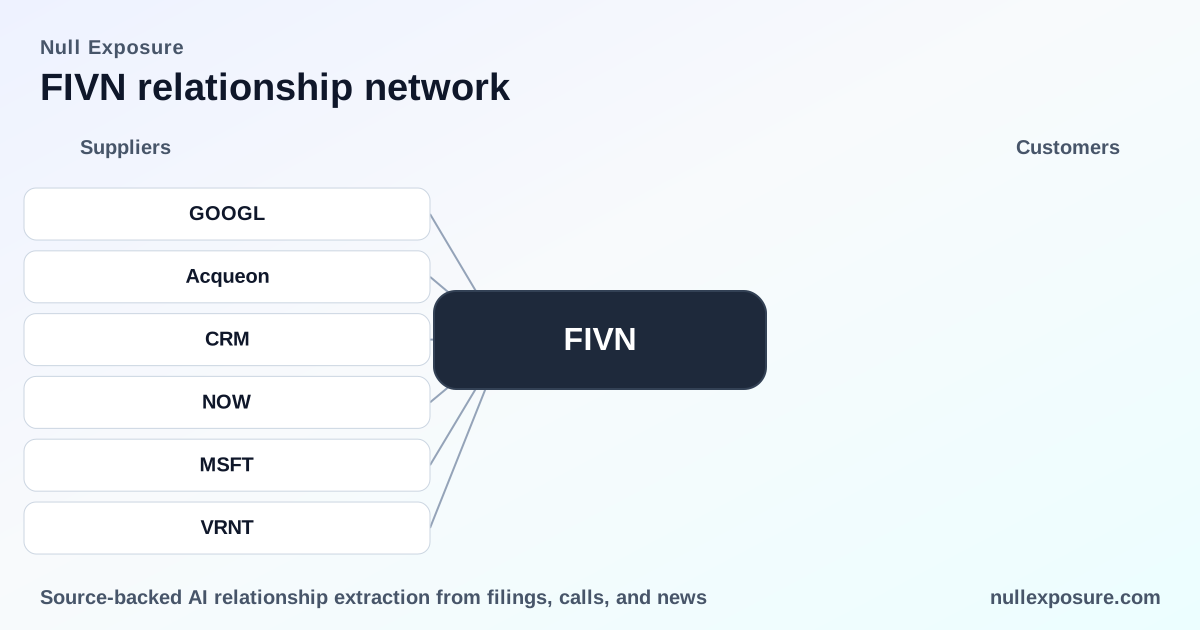
Below I cover every external relationship surfaced in recent coverage and what each partnership contributes to Five9’s strategy and revenue pathway.
-
ServiceNow (NOW): Five9’s alliance with ServiceNow enhances customer experience and digital engagement capabilities, positioning Five9 within broader IT service and workflow ecosystems; TradingView flagged this partnership as a contributor to ServiceNow’s ability to leverage a rich partner base (FY2026). Source: TradingView, May 3, 2026 — https://www.tradingview.com/news/zacks:f43fb6c6f094b:0-servicenow-benefits-from-rich-partner-base-more-upside-ahead/.
-
Salesforce (CRM): Management cites increased bookings with Salesforce as part of broader momentum with strategic partners, which drives distribution into CRM-led customer workflows and supports joint go-to-market motion (FY2026). Source: GuruFocus transcript referencing FY2026 remarks, May 2, 2026 — https://www.gurufocus.com/stock/LTS:0TMV/transcripts/3194756.
-
Google Marketplace (GOOGL): Five9 reports traction through Google Marketplace as an additional commercial channel, expanding cloud-native procurement options for customers and accelerating bookings via marketplace-driven discovery and procurement (FY2026). Source: GuruFocus transcript referencing FY2026 remarks, May 2, 2026 — https://www.gurufocus.com/stock/LTS:0TMV/transcripts/3194756.
Investor takeaway: these three partners—ServiceNow, Salesforce and Google Marketplace—operate as distribution and integration multipliers that reduce direct-sales acquisition cost and open avenues for larger enterprise deals and marketplace-led consumption.
What investors should watch next: growth drivers and downside scenarios
Five9’s revenue mix and partner strategy create a clear list of monitoring points for investors:
- Subscription book vs. usage variability. Subscription revenue gives recurring, predictable cash flow; telephony usage introduces volume sensitivity tied to call volumes and seasonal customer behavior. Watch revenue per customer and telephony minutes trends in quarterly releases.
- RPO as a growth anchor. The more than $1.1 billion of remaining performance obligations for contracts originally longer than one year provides a near-term revenue floor and visibility into multi-year contracts.
- Partner execution. Partnerships with ServiceNow and Salesforce move Five9 deeper into enterprise workflows; performance will hinge on integration depth and joint sales execution rather than logos alone.
- Geography concentration risk. With the bulk of revenue billed to U.S. customers, a domestic slowdown in enterprise IT spend or sector-specific churn would hit Five9 disproportionately.
- Customer diversification. Although no single customer exceeded 10% of revenue, investor focus should remain on customer-level expansion (larger deals) and churn metrics for the largest cohorts.
Key risks to monitor (quick list)
- Telephony usage swings compressing or inflating reported revenue.
- Execution on integrations with ServiceNow and Salesforce translating into sustained bookings.
- International expansion costs and regulatory overhead as the company diversifies geography.
- Competitive pressure from other contact-center providers and bundled offerings from hyperscalers.
Bottom line for investors
Five9 combines a stable SaaS subscription backbone with variable telephony consumption, backed by a meaningful multi-year backlog and amplified through partner channels such as ServiceNow, Salesforce and Google Marketplace. The company’s low customer concentration and high U.S. revenue share paint a picture of resilient core economics with geographic and usage-driven risks that require active monitoring. For investors focused on recurring revenue with embedded upside from partner-led distribution, Five9 represents a business where durable contract economics and strategic alliances are the primary levers for value creation.
For a deeper look at Five9’s customer relationships and partner signals, visit https://nullexposure.com/.