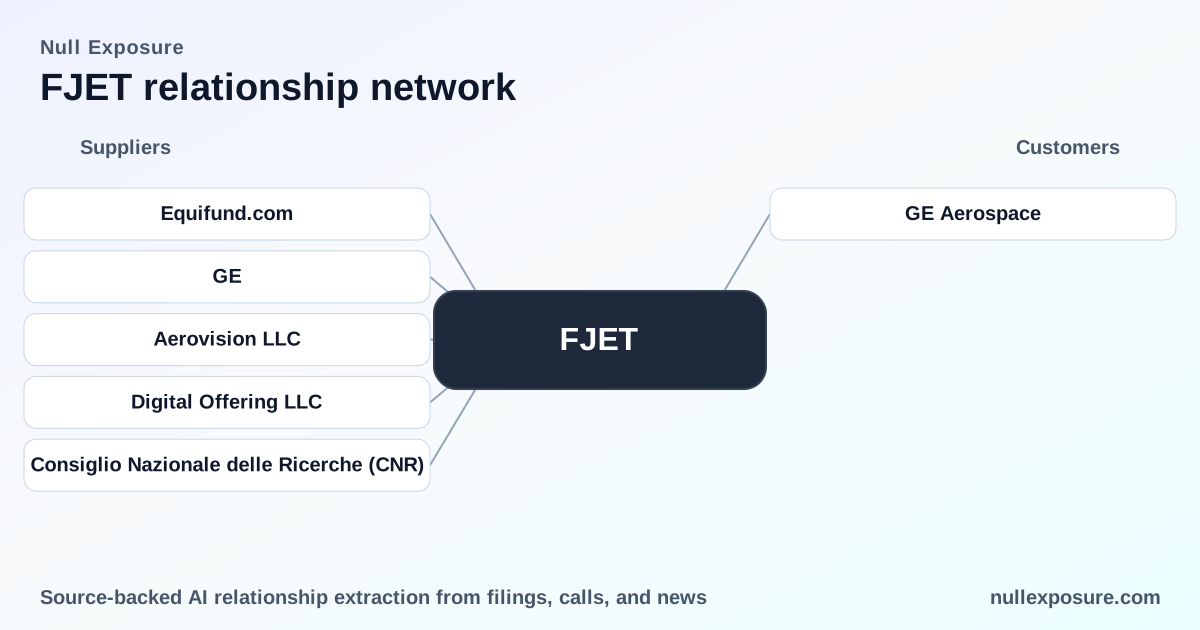
Starfighters Space (FJET): Commercial supersonic test platform with defense and space customers
Starfighters Space operates and monetizes a unique, flight-ready fleet of Lockheed F-104 supersonic aircraft by contracting flight hours and aircraft-based test platforms to defense primes, aerospace suppliers, and space technology developers. The company generates revenue from flight testing, captive-carry and release validation, and hardware interface provisioning—selling access to a supersonic, flight‑validated environment rather than commodity aerospace parts. For a compact relationship map and further analysis visit https://nullexposure.com/.
How Starfighters turns vintage jets into a revenue engine
Starfighters converts a legacy airframe into a commercial test asset: the company outfits F-104s as airborne aerodynamic test platforms and structural carriers for external payloads. Customers buy test campaigns, flight validation cycles, and engineered pylons/assemblies required to secure experimental payloads. Public reporting shows Revenue TTM $0 and EBITDA negative $15.19 million, so current commercialization relies on discrete contracts and program wins rather than recurring product revenues (company data through FY2025–FY2026).
Why investors should care: strategic strengths and structural risks
Starfighters’ business model is asset-backed and service-driven: the F-104 fleet is a differentiated input that is difficult to replicate quickly in private test ranges. That creates a pricing premium and strategic criticality for customers needing supersonic flight validation. Offsetting that advantage are concentration and maturity signals: reported institutional ownership is low (2.94%) while insider ownership is high (32.4%), and trailing financials show no material recurring revenue. Those characteristics position Starfighters as a high-beta, execution-dependent play that scales with program wins from prime contractors and government research labs.
Customer map — every relationship reported (FY2026)
-
Blackstar Orbital / Blackstar Orbital Technologies — Starfighters signed a Technical Interchange Agreement to integrate Blackstar’s lifting-body SpaceDrone with the F-104, providing a BL-75 pylon and related hardware and transferring assemblies and a jettison piston to support captive-carry and release testing at the Shuttle Landing Facility. This partnership moves Blackstar’s program from modelling to flight validation. Source: SpaceWar and GlobeNewswire reporting, March–May 2026.
-
GE Aerospace (GE) — Starfighters completed a supersonic flight test campaign for GE Aerospace under the DoD-funded ATLAS program, carrying and flying an advanced propulsion test vehicle multiple times at supersonic speeds. This represents direct aircraft-access revenue tied to propulsion and hypersonic R&D. Source: BayStreet/Yahoo News and StockstoTrade coverage, March–May 2026.
-
NASA — Starfighters announced a partnership with Mu-G Technologies to pursue microgravity flight missions that include NASA as a target customer for research flights, expanding the company’s addressable market into microgravity services for academic and commercial research. Source: GlobeNewswire, May 2026.
-
Lockheed Martin — Lockheed is listed among Starfighters’ customers; the company positions its platform as a flight-test resource for Lockheed programs where supersonic validation is required. Source: FinancialContent/BayStreet reporting, FY2026.
-
Space Florida — Starfighters lists Space Florida among customers and partners, indicating engagement with state-level launch and aeronautical infrastructure stakeholders that can support test range access and program coordination. Source: BayStreet/Yahoo News, FY2026.
-
Innoveering — Innoveering appears on Starfighters’ customer list, reflecting commercial engagements with engineering and test-services firms that leverage airborne test platforms. Source: BayStreet/Yahoo News, FY2026.
-
Meggitt — Meggitt is named among current customers, implying Starfighters supports instrumentation, sensors, or aerostructure testing for aerospace suppliers. Source: BayStreet/Yahoo News, FY2026.
-
U.S. Air Force Research Laboratory (AFRL) — AFRL is identified as a customer, indicating direct engagement with DoD research programs where supersonic flight validation and data capture are mission-critical. Source: BayStreet/Yahoo News, FY2026.
-
Kratos Defense and Security Solutions (KTOS) — Kratos was awarded a prime contract for which Starfighters operates as a subcontractor, establishing Starfighters’ role as a specialized service provider under larger defense program flows. Source: BayStreet/Yahoo News, FY2026.
-
Mu-G Technologies — Starfighters partnered with Mu-G to provide microgravity flight missions, adding a third mission type (beyond hypersonic research and flight testing) into the company’s commercial portfolio for NASA, universities, and commercial research clients. Source: BayStreet/Yahoo News, FY2026.
Operational signals and business constraints as an investor reads them
-
Contracting posture: Starfighters sells discrete program work (flight campaigns, test payload integration) rather than high-volume recurring products. The relationship with Kratos (Starfighters as a subcontractor) and flight tests for GE indicate a program-based revenue model tied to prime contractor schedules (company disclosures and FY2026 press coverage).
-
Concentration and criticality: Customer list skews to large defense and aerospace organizations (GE Aerospace, Lockheed Martin, AFRL). That creates high customer concentration but also high counterparty credit quality, insofar as primes and government labs carry budgetary capacity for test programs.
-
Capability maturity: The company delivers operationally meaningful outputs—hardware interfaces (BL‑75 pylon), captive-carry, jettison testing and supersonic flights—transitioning some programs from lab modeling to flight validation. Those are mission-critical milestones for space and hypersonic developers and reflect a specialized, validated operating capability (multiple press releases, March–May 2026).
-
Financial posture: Public financials show no trailing revenue recorded and negative EBITDA, indicating the company is still dependent on discrete contracts to generate cash and scale. Ownership and liquidity signals (high insider ownership, low institutional) reinforce a small-cap, execution-dependent profile.
Risks, upside and the investor take
- Upside: Unique asset moat—flight-ready supersonic aircraft plus proven integration hardware create a service that primes and space startups need to de-risk high-cost programs; successful repeat business with GE, Lockheed and AFRL would re-rate revenue visibility.
- Risk: Revenue immaturity and concentration—zero reported trailing revenue and dependence on program wins make cash flow volatile; a few contract delays would materially affect near-term results.
- Execution watch items: contract conversion cadence, margins on test campaigns, and progress from one-off press engagements to sustained backlog.
For a relationship-level tracker and alerts on new program wins, see our coverage at https://nullexposure.com/ — the platform maps customer interactions and public filings that drive near-term valuation catalysts.
Bottom line
Starfighters has carved a defensible niche selling supersonic flight validation and hardware interfaces to defense primes and space innovators. The company’s value proposition is clear and specialized, but the financials require conversion of press‑announced engagements into repeatable revenue. Investors should treat FJET as a high‑beta, contract‑driven aerospace services play: follow program awards, subcontract roles, and conversion of these partnerships into booked revenue as primary triggers for reassessing valuation.