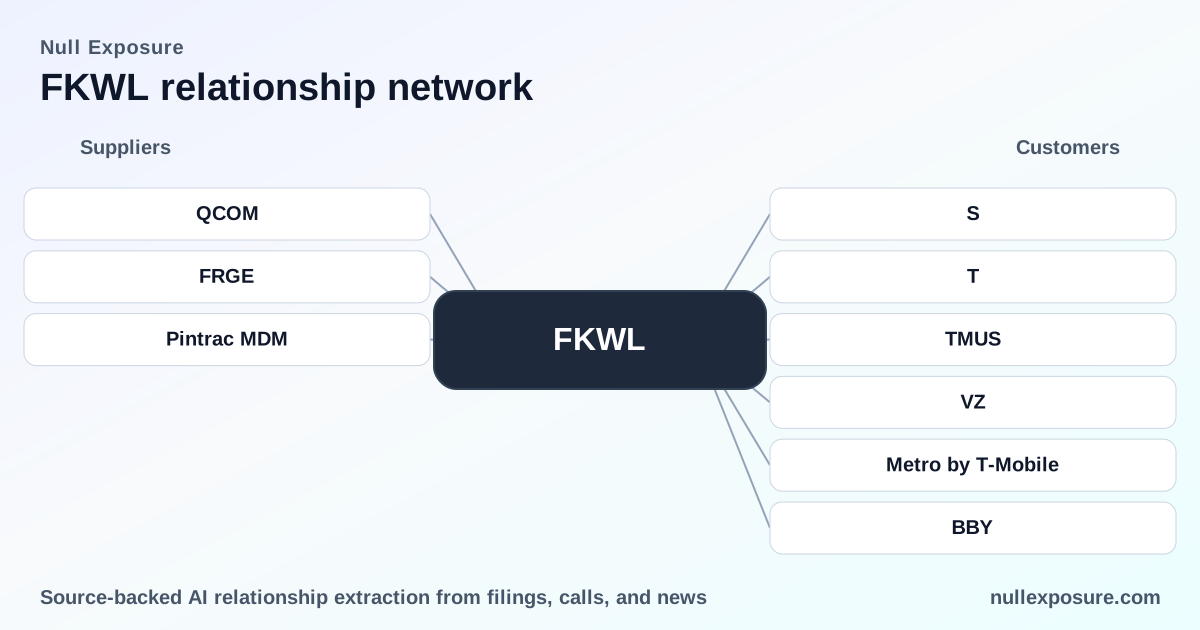
Franklin Wireless (FKWL): Customer Footprint, Concentration Risk, and Channel Dynamics
Franklin Wireless designs and sells wireless access hardware—principally mobile hotspot routers and related broadband devices—and monetizes by selling finished hardware directly to carriers and indirectly through distributors and retail partners. Revenue is point-in-time product sales, heavily concentrated in a handful of operator relationships, making carrier certification and distribution agreements the primary drivers of near-term top-line performance. For direct access to our coverage and signals, visit https://nullexposure.com/.
Quick investor thesis: predictable hardware sales, concentrated customer risk
Franklin operates a lean, single-segment hardware business: most revenue comes from hotspot router sales sold at a point in time to wireless operators, distributors, and retailers. That model generates high revenue volatility tied to product cycles, carrier certifications, and a few large customers who account for the majority of sales. Investors should value Franklin as a specialty OEM with attractive product-led upside (5G/RedCap certifications) offset by significant customer concentration and the operational risks of hardware manufacturing and import/distribution.
How Franklin’s operating model shapes leverage and risk
- Contracting posture: spot sales. Franklin recognizes revenue at a point in time for product shipments, indicating short contract duration and transactional order flows rather than long-term recurring contracts.
- Revenue concentration: very high. For FY2025 two customers represented roughly 61% and 33% of net sales, a concentration that makes Franklin’s fortunes hinge on continued purchase behavior from those partners.
- Role and channel mix: carrier-led plus distributors/retail. The company sells directly to wireless operators and through strategic partners and distributors; this dual route increases reach but concentrates bargaining power in large carriers and national retailers.
- Product maturity and criticality: core hardware. The company’s core product is hotspot hardware, now evolving into 5G and 5G RedCap-certified devices—technologically incremental but commercially critical for carrier device portfolios.
- Geographic footprint: North America and Asia. Primary markets are North America and Asia, which affects supply-chain exposure and channel execution.
These constraints are company-level signals drawn from the firm’s disclosures and explain why customer relationships are both strategic and fragile for Franklin.
Documented customer relationships and press evidence
Below I summarize every relationship recorded in the source set; each item is a 1–2 sentence plain-English snapshot with a concise source reference.
T-Mobile / Metro by T-Mobile (markets.financialcontent.com; Dec 2022)
Franklin announced the JEXtream RG2100 sub-6 5G mobile hotspot would launch at Metro by T-Mobile stores on Dec. 8 with broader T‑Mobile availability to follow, signaling a direct OEM-to-MVNO/carrier channel relationship. Source: FinancialContent press release (Dec 6, 2022) — https://markets.financialcontent.com/wss/article/newswire-2022-12-6-franklin-brings-the-first-5g-mobile-hotspot-to-metro-by-t-mobile
S / Sprint (slashgear.com; article dated in context of FY2019)
The Sprint U300 3G/4G USB modem was manufactured by Franklin Wireless, demonstrating legacy OEM relationships to major US carriers and the company’s historical role as a device supplier. Source: SlashGear product announcement (published online; referenced FY2019) — https://www.slashgear.com/sprint-u300-dual-wimax-evdo-reva-usb-modem-announced-1726687/
AT&T (Newswire announcement; FY2023)
Franklin launched the A50 5G mobile hotspot with AT&T, reflecting a certified product partnership and route-to-market through a national operator. Source: Newswire press release (FY2023) — https://www.newswire.com/news/franklin-wireless-introduces-new-5g-hotspot-with-at-t-21950465
AT&T (repeat entry for A50 launch; FY2023)
A duplicate press mention reconfirms the A50 launch with AT&T and reinforces the company’s active certification pipeline on major US networks. Source: Newswire press release (FY2023) — https://www.newswire.com/news/franklin-wireless-introduces-new-5g-hotspot-with-at-t-21950465
AT&T (A10 LTE launch; FY2022)
Franklin announced the A10 LTE Mobile Hotspot nationwide with AT&T, showing an ongoing multi-product relationship with the carrier dating back at least to FY2022. Source: Newswire press release (FY2022) — https://www.newswire.com/news/franklin-wireless-launches-its-first-at-t-mobile-hotspot-21880005
AT&T (duplicate A10 mention; FY2022)
A second listing repeats the A10 nationwide launch and substantiates AT&T as a recurring buyer and certification partner. Source: Newswire press release (FY2022) — https://www.newswire.com/news/franklin-wireless-launches-its-first-at-t-mobile-hotspot-21880005
AT&T (RG350 RedCap certification; FY2025)
Franklin’s RG350 was certified on AT&T’s nationwide 5G RedCap network, positioning the company as early-to-market on RedCap hardware and enhancing its product differentiation. Source: Quiver Quant news summary and GlobeNewswire (Jul 2025) — https://www.quiverquant.com/news/Franklin+Access+Launches+RG350%3A+First+5G+RedCap+Mobile+Hotspot+Certified+on+AT%26T+Network
AT&T (duplicate RG350 cert; FY2025)
A mirrored entry confirms the RG350 certification on AT&T’s RedCap network, underlining the commercial importance of this milestone. Source: Quiver Quant / GlobeNewswire (FY2025) — https://www.quiverquant.com/news/Franklin+Access+Launches+RG350%3A+First+5G+RedCap+Mobile+Hotspot+Certified+on+AT%26T+Network
Metro by T‑Mobile (markets.financialcontent.com; FY2022)
Franklin specifically highlighted Metro by T‑Mobile as the first retail outlet for its RG2100, emphasizing an MVNO retail channel alongside primary carrier shelves. Source: FinancialContent press release (Dec 6, 2022) — https://markets.financialcontent.com/wss/article/newswire-2022-12-6-franklin-brings-the-first-5g-mobile-hotspot-to-metro-by-t-mobile
Verizon (CNBC recall report; FY2021)
Verizon recalled 2.5 million hotspot devices that were imported by Franklin Wireless due to lithium-ion battery hazards, a material product-liability event that affected the Ellipsis Jetpack line and required recall management. Source: CNBC report (Apr 8, 2021) — https://www.cnbc.com/2021/04/08/verizon-recalls-2point5-million-hotspot-devices-due-to-fire-hazard.html
AT&T (GlobeNewswire RG350 launch; FY2025)
GlobeNewswire reported the RG350 as AT&T-certified, reinforcing the company’s strategic push into RedCap-certified hardware in 2025. Source: GlobeNewswire (Jul 30, 2025) — https://www.globenewswire.com/news-release/2025/07/30/3124128/0/en/franklin-access-launches-rg350-the-first-at-t-certified-5g-redcap-hotspot.html
Metro by T‑Mobile (Newswire quote; FY2022)
Franklin’s CEO publicly framed the Metro by T‑Mobile launch as an honor, underscoring the PR and commercial value of MVNO and carrier rollouts. Source: Newswire release (FY2022) — https://www.newswire.com/news/franklin-brings-the-first-5g-mobile-hotspot-to-metro-by-t-mobile-21880045
T‑Mobile (Newswire duplicate; FY2022)
A repeated T‑Mobile/METRO mention confirms the RG2100 product placement across the T‑Mobile family of brands. Source: Newswire (FY2022) — https://www.newswire.com/news/franklin-brings-the-first-5g-mobile-hotspot-to-metro-by-t-mobile-21880045
Best Buy / BBY (SlashGear; FY2019)
The Sprint U300 device was also distributed into select Best Buy stores, illustrating Franklin’s historical retail channel relationships and the use of major electronics retailers for product reach. Source: SlashGear (FY2019) — https://www.slashgear.com/sprint-u300-dual-wimax-evdo-reva-usb-modem-announced-1726687/
Best Buy (duplicate BBY entry; FY2019)
A second listing reiterates Best Buy retail availability for the Sprint U300, confirming the retail path-to-consumer in that product cycle. Source: SlashGear (FY2019) — https://www.slashgear.com/sprint-u300-dual-wimax-evdo-reva-usb-modem-announced-1726687/
Yahoo Finance / AT&T (RG350 cert; FY2025)
Yahoo Finance coverage of the RG350 reiterates AT&T certification and amplifies the product-launch impact across financial media. Source: Yahoo Finance summary (FY2025) — https://finance.yahoo.com/news/franklin-access-launches-rg350-first-130000961.html
C Spire Network (Newswire; FY2022)
Franklin announced the RG2100N availability on the C Spire Network, indicating sales and certification beyond the national incumbents into regional carriers. Source: Newswire partnership release (FY2022) — https://www.newswire.com/news/franklin-wireless-partnership-to-bring-koreas-first-5g-sd-wan-21879149
Key takeaways for investors
- Concentration is the dominant firm-level risk: two customers accounted for roughly 94% of FY2025 net sales between them (60.9% and 33.5%), making customer retention and renewals the single largest value lever.
- Carrier certifications drive product value: AT&T RedCap certification for the RG350 and multiple AT&T product launches demonstrate Franklin’s pathway to commercial differentiation.
- Operational profile is transactional and hardware-centric: the business recognizes nearly all revenue at shipment (point-in-time), which produces lumpy quarter-to-quarter top-line outcomes.
- Legacy exposures matter: the Verizon recall is an example of how manufacturing/import risks translate into headline operational and reputational challenges.
For continuous monitoring of Franklin’s customer signals and carrier milestones, see our coverage at https://nullexposure.com/.
Investor actions: track carrier procurement cycles, certification announcements, and accounts-receivable concentration disclosures in quarterly filings—those metrics will directly presage near-term revenue swings and valuation re-rating.