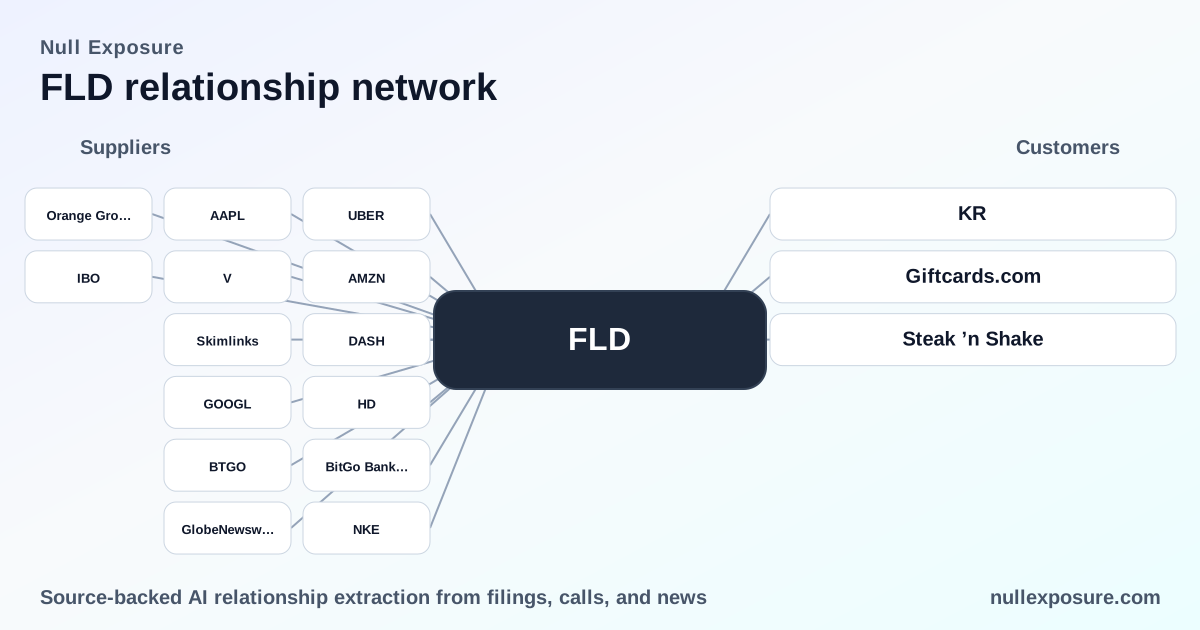
FLD Customer Map: Who’s Buying Bitcoin Exposure From Fold and Why It Matters
Fold Holdings (FLD) operates a consumer-focused bitcoin rewards and payments platform that monetizes through merchant partnerships, branded gift card distribution, and employer-facing payroll reward programs. The company generates revenue from retail distribution and transaction flows tied to its Fold Bitcoin Gift Card and business products (such as the Bitcoin Bonus Program), while retaining strategic optionality in expanding distribution into large retail networks and employer payroll channels. Investors should view FLD as a services-led financial platform with concentrated product routes to market, high insider ownership, and early-stage unit economics that depend materially on partner distribution and consumer take-up. For more background research, see NullExposure for complementary relationship intelligence: https://nullexposure.com/
How Fold’s economics and go-to-market work in practice
Fold’s core product set converts merchant and retail distribution into recurring transaction volume: gift cards sold through grocery and giftcard channels and employer payroll programs that embed bitcoin rewards in compensation and consumer offers. Revenue today flows from sales and platform fees rather than traditional interest-bearing assets; Fold’s recent financials show modest top-line scale (approximately $31.8M revenue TTM) and negative gross profit, underlining that commercial traction, not legacy finance spreads, will drive near-term valuation expansion.
- Distribution-led model: physical and digital gift cards placed at retailers such as Kroger and Giftcards.com, supplemented by app-driven purchases.
- B2B services: employer payroll reward programs and merchant co-promotions (e.g., Steak ’n Shake) that drive customer acquisition and on-platform spend.
- Concentration & control: high insider ownership (≈71% insiders) signals founder-aligned execution but raises governance and liquidity considerations for institutional holders.
Company-level constraints and operating posture
Fold’s customer footprint is U.S.-centric, oriented toward individual consumers in their prime earning years and expanding into employer payroll programs. Key operating signals:
- Customer type: the company reports a predominantly individual consumer base concentrated in the 25–54 age bracket and skewed toward prime-credit, higher-income users — a demographic that supports transaction-based monetization.
- Geography: Fold’s product availability is focused in the United States, making U.S. regulatory and retail distribution dynamics the primary operational environment.
- Relationship role: Fold acts as a seller of financial services and bitcoin rewards — the firm packages bitcoin into reward products and distributes them through retail and B2B channels.
- Segment: Fold sits in consumer financial services, delivering bitcoin-native rewards rather than traditional banking products.
From an operational perspective, contracting posture is commercial and programmatic with enterprise partners (co-branded promotions and payroll programs), concentration risk is meaningful because a handful of retail and enterprise channels drive distribution, criticality to partners is moderate (rewards are a marketing differentiator rather than mission-critical infrastructure), and maturity is early — the company is scaling distribution but has negative gross profit today. For deeper relationship analytics, visit https://nullexposure.com/.
Catalog of customer relationships disclosed in news (FY2025–FY2026)
Below I list every relationship entry captured in public press and news mentions, with a concise plain-English takeaway and the source citation for each item.
Simple Mining — The Globe and Mail press release (FY2026)
Simple Mining is using Fold’s Bitcoin Bonus Program to reward salaried staff with recurring bitcoin allocations tied to tenure, signalling early adoption among crypto-native enterprise operators. Source: Globe and Mail press release, May 2026 — https://www.theglobeandmail.com/investing/markets/stocks/FLD-Q/pressreleases/1475429/fold-announces-bitcoin-bonus-program-for-employers-first-offering-from-fold-business/
Steak ’n Shake — The Globe and Mail press release (FY2026)
Steak ’n Shake is Fold’s flagship Bitcoin Bonus Program partner, enabling over 10,000 employees to earn bitcoin as part of compensation through the program. Source: Globe and Mail press release, May 2026 — https://www.theglobeandmail.com/investing/markets/stocks/FLD-Q/pressreleases/1475429/fold-announces-bitcoin-bonus-program-for-employers-first-offering-from-fold-business/
Steak ‘n Shake — Manila Times / GlobeNewswire (FY2026)
Fold’s FY2025/FY2026 financial release notes an inaugural program with Steak ‘n Shake allowing all employees to receive Bitcoin bonuses, indicating a nationwide roll-out executed in early 2026. Source: Manila Times reporting on GlobeNewswire, March 2026 — https://www.manilatimes.net/2026/03/18/tmt-newswire/globenewswire/fold-holdings-inc-nasdaq-fld-announces-fourth-quarter-and-full-year-2025-results/2302242/amp
Simple Mining — Manila Times / GlobeNewswire (FY2026)
The same GlobeNewswire release repeated Simple Mining’s adoption of the payroll-linked bitcoin bonus for salaried staff, confirming multiple press outlets ran the announcement. Source: Manila Times republishing the press release, April 2026 — https://www.manilatimes.net/2026/04/23/tmt-newswire/globenewswire/fold-announces-bitcoin-bonus-program-for-employers-first-offering-from-fold-business/2327127/amp
Kroger — InvestingNews (FY2025)
Fold’s Bitcoin Gift Card is available online and through select retailers including Kroger, expanding physical retail distribution into a major grocery network. Source: InvestingNews feature on gift card distribution, March 2026 — https://investingnews.com/fold-launches-affiliate-program-as-bitcoin-gift-card-gains-momentum-on-holiday-gift-guides/
Simple Mining — Bitcoin.com news (FY2026)
Bitcoin.com coverage confirms Simple Mining’s use of recurring bitcoin allocations for salaried staff based on tenure, illustrating adoption by crypto-industry employers. Source: Bitcoin.com news report, May 2026 — https://news.bitcoin.com/bitcoin-bonuses-expand-as-fold-brings-payroll-linked-rewards-to-employers/
Steak ’n Shake — Bitcoin.com news (FY2026)
Bitcoin.com also covered Steak ’n Shake’s employee bitcoin bonus rollout, reinforcing the program’s public visibility and marketing value. Source: Bitcoin.com news report, May 2026 — https://news.bitcoin.com/bitcoin-bonuses-expand-as-fold-brings-payroll-linked-rewards-to-employers/
Steak 'n Shake — The Block (FY2025)
The Block reported a limited-time customer promotion where Steak 'n Shake customers could earn BTC on orders, showcasing Fold’s consumer-facing merchant offers as a customer acquisition channel. Source: The Block article, October 2025 — https://www.theblock.co/post/377071/fold-bitcoin-burger-rewards
KR (Kroger) — InvestingNews (FY2025)
InvestingNews notes the gift card availability specifically calls out Kroger and Giftcards.com as retail partners for the Fold Bitcoin Gift Card. Source: InvestingNews, March 2026 — https://investingnews.com/fold-launches-affiliate-program-as-bitcoin-gift-card-gains-momentum-on-holiday-gift-guides/
Giftcards.com — InvestingNews (FY2025)
Giftcards.com is called out as a distribution partner, indicating Fold’s strategy to route product through existing gift-card channels for scale. Source: InvestingNews, March 2026 — https://investingnews.com/fold-launches-affiliate-program-as-bitcoin-gift-card-gains-momentum-on-holiday-gift-guides/
Steak ’n Shake — Bitget news (FY2026)
Bitget’s reporting reiterates that the inaugural Steak ’n Shake program allows employees to receive Bitcoin bonuses powered by Fold’s platform. Source: Bitget news summary, May 2026 — https://www.bitget.com/amp/news/detail/12560605273433
Kroger — Quiver Quant (FY2025)
Fold’s corporate update cited Kroger availability for physical cards, underscoring retail penetration in roughly 2,000 Kroger brand locations. Source: Quiver Quant summary of Fold results, Q3 2025 — https://www.quiverquant.com/news/Fold+Holdings%2C+Inc.+Reports+41%25+Year-Over-Year+Revenue+Growth+in+Q3+2025
Steak ‘n Shake — Quiver Quant (FY2025)
Quiver’s coverage references the nationwide Steak ’n Shake promotion that rewards customers with a $5 Bitcoin Gift Card on select meals, demonstrating a dual B2B/B2C promotional strategy. Source: Quiver Quant, Q3 2025 — https://www.quiverquant.com/news/Fold+Holdings%2C+Inc.+Reports+41%25+Year-Over-Year+Revenue+Growth+in+Q3+2025
Steak ’n Shake — Quiver Quant partnership notice (FY2025)
A separate Quiver article reiterates the partnership’s mechanics, confirming the promotional structure used to drive consumer adoption. Source: Quiver Quant press note on partnership, March 2026 — https://www.quiverquant.com/news/Fold+Holdings%2C+Inc.+Partners+with+Steak+%E2%80%99n+Shake+to+Offer+Bitcoin+Rewards+on+Select+Meals
giftcards.com — Bitget news (FY2026)
Bitget and other coverage list giftcards.com as an online channel where Fold’s product is accessible, consolidating digital gift-card distribution as a consistent channel. Source: Bitget news, May 2026 — https://www.bitget.com/amp/news/detail/12560605273433
giftcards.com — Manila Times / GlobeNewswire (FY2026)
The GlobeNewswire release also notes online availability via giftcards.com, confirming cross-publication consistency on distribution partners. Source: Manila Times republishing the press release, March 2026 — https://www.manilatimes.net/2026/03/18/tmt-newswire/globenewswire/fold-holdings-inc-nasdaq-fld-announces-fourth-quarter-and-full-year-2025-results/2302242/amp
What investors should extract from these partner disclosures
- Distribution is the growth lever: Kroger and Giftcards.com put Fold into mainstream retail channels, creating a path to scale consumer acquisition and transaction volume.
- B2B programs accelerate retention: Employer payroll programs with Steak ’n Shake and Simple Mining convert corporate payroll budgets into recurring on-platform bitcoin demand, which can lift lifetime value if programs stick.
- Concentration & execution risk: A small set of partners accounts for most publicized distribution wins; Fold’s valuation upside is tied to converting these headline partnerships into sustained revenue and improving gross margins.
Bottom line and action items
Fold’s customer relationships validate a dual distribution strategy (retail gift-card channels + employer payroll programs) that can drive volume growth if execution and unit economics improve. Key near-term questions for investors: retention from these partners, margin recovery from negative gross profit, and the company’s ability to broaden retail footprint beyond the named partners.
For deeper, relationship-level briefings and to track how these partnerships evolve in filings and press releases, consult NullExposure’s research hub: https://nullexposure.com/