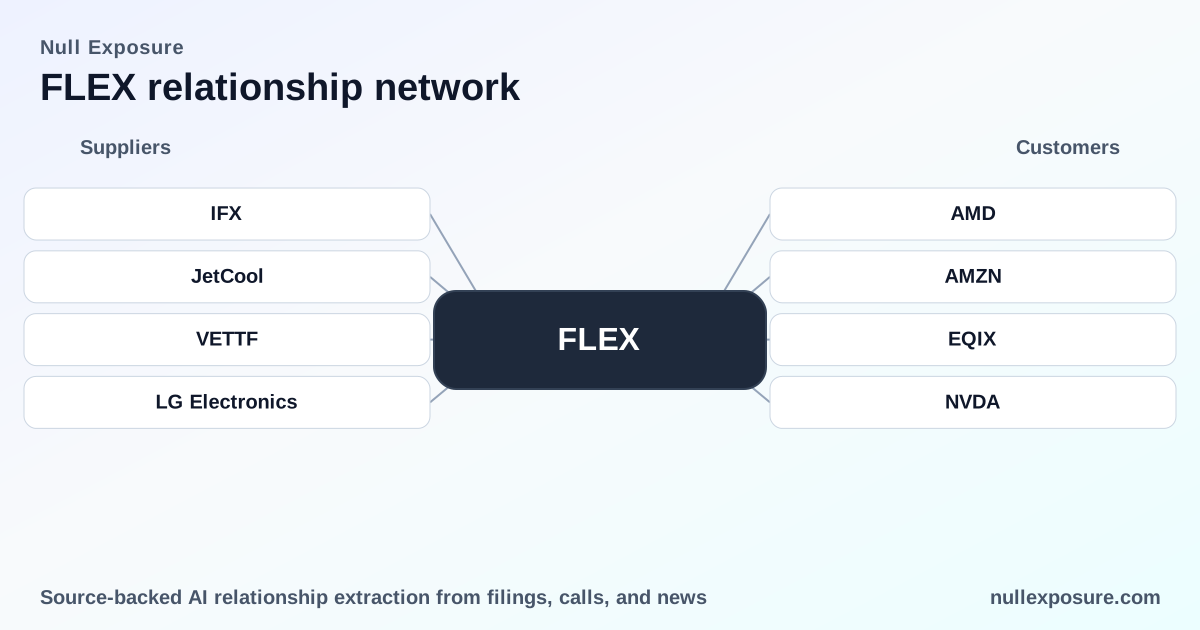
FLEX customer map: what material relationships tell investors about Flex Ltd.
Flex is an end‑to‑end outsourced manufacturing and supply‑chain partner that monetizes engineering, assembly and recurring manufacturing services for large OEMs across data center, industrial, healthcare, automotive and consumer end markets. Revenue comes from design‑to‑delivery contracts, recurring production runs, aftermarket services and selective proprietary products; Flex captures margin through scale, global footprint and integrated supply chain capabilities. For further company intelligence, see https://nullexposure.com/.
The investment thesis in one line
Flex converts capital‑intensive manufacturing capacity into predictable service revenue by signing modular production and engineering agreements with large enterprises; the equity case rests on continued client wins in high‑growth verticals (AI infrastructure, data centers, and healthcare equipment), disciplined margin expansion, and geographic diversification of manufacturing capacity.
Why the customer roster matters to valuation
Flex’s customer relationships are both the revenue engine and the primary operational risk vector. A concentrated set of large enterprise customers drives nearly half of sales among the top ten, which gives Flex leverage on volume but creates exposure to order timing and product lifecycle swings. Flex’s global manufacturing footprint allows it to shift production across North America, EMEA and APAC — a structural advantage when customers need on‑shore or regionally compliant supply.
Key company‑level operating signals drawn from corporate disclosures:
- Contracting posture is mixed: management emphasizes long‑term partnerships while disclosure also confirms customers frequently give short‑term purchase commitments, so Flex runs a hybrid model of long strategic relationships and transactional order flows.
- Counterparty profile is large enterprise: customers are predominantly multinational OEMs and data‑center operators, increasing revenue visibility at scale but also tying Flex to the capital cycles of its large clients.
- Geographic diversification is deliberate and material: North America, EMEA and APAC are all central to revenue, enabling Flex to meet regionally sensitive programs (e.g., Build America / Buy America).
- Role and segment: Flex operates as manufacturer and service provider across manufacturing and services segments, with active engagements across its facility network.
- Concentration and materiality: top ten customers account for a meaningful share (~44% in FY2025), but no single customer dominated >10%, which balances customer risk against dependency.
For a fuller view of Flex’s client relationships and how they map to risk, visit https://nullexposure.com/.
Relationship roll call — who Flex is working with (plain‑English summaries)
Nextracker (NXT)
Flex’s affiliate sale supported Nextracker’s IPO footprint: Nextracker used offering proceeds to buy 30,590,000 LLC Common Units from a subsidiary of Flex, evidencing a capital/ownership relationship alongside commercial ties. This transaction was disclosed in Nextracker’s IPO announcement in 2023.
Source: Nextracker press release announcing full exercise of underwriters’ option (FY2023).
Teradyne Robotics (TER)
Flex manufactures core robotics components for Teradyne Robotics, positioning Flex as a scalable production partner that enables Teradyne’s global automation deployments. This commercial manufacturing arrangement was described in a PR Newswire release announcing an expanded partnership (May 2026).
Source: PR Newswire, “Flex and Teradyne Robotics expand partnership,” May 4, 2026 (FY2026).
Advanced Micro Devices (AMD)
Flex expanded U.S. manufacturing of AMD Instinct GPU platforms at its Austin, Texas facility, a strategic collaboration that strengthens AMD’s domestic production capacity for AI and high‑performance compute. Multiple press reports in March 2026 covered the initiation and ramp of AMD Instinct MI355X production at Flex’s U.S. site.
Source: Yahoo Finance / other press coverage, “Flex announces U.S. manufacturing collaboration with AMD,” March 9, 2026 (FY2026).
TDC
TDC’s public filing explicitly identifies Flex as a key single‑source contract manufacturer for on‑premises hardware systems, indicating a material supplier dependency for that customer’s product line. This reliance was disclosed in TDC’s 10‑K filing (FY2024).
Source: TDC 10‑K (filed for year ended December 31, 2024).
Ciena (CIEN)
Ciena’s commentary links Flex manufacturing in the U.S. with compliance advantages for federal programs, suggesting Flex enables customers to meet “Build America, Buy America” requirements and access large public‑sector opportunities. This rationale was cited in a March 2026 market article about Ciena’s positioning in the BEAD program.
Source: FinancialContent markets article, March 9, 2026 (FY2026).
Amazon / AWS (AMZN)
Management commentary in Flex’s Q3 FY2026 disclosure indicates material and growing engagement with AWS, with leadership noting strong growth in that vertical during the quarter — a signal that cloud infrastructure OEM work is a live revenue stream for Flex. The remark appeared in an earnings call transcript covering Q3 FY2026.
Source: Q3 FY2026 earnings call transcript published via InsiderMonkey (FY2026).
Equinix (EQIX)
Flex deployed its JetCool liquid‑cooling solution at an Equinix Co‑Innovation Facility in Virginia, demonstrating Flex’s role in delivering energy‑ and water‑efficient cooling systems for high‑density AI data centers. This deployment was discussed in a sector analysis piece in early 2026.
Source: SahmCapital analysis, January 12, 2026 (FY2026).
NVIDIA (NVDA)
Flex announced a collaboration with NVIDIA to develop modular, high‑performance, energy‑efficient AI data centers, including advanced power‑rack hardware and prefabricated designs targeting large AI deployments — a strategic product partnership that addresses escalating power and integration needs for hyperscale customers. Coverage appeared across industry press in March–May 2026.
Source: TradingView / SimplyWall.St press reporting on Flex‑NVIDIA collaborations (FY2026).
How these relationships influence risk and upside
These customers illustrate Flex’s tenant base of high‑growth infrastructure players (AMD, NVIDIA, Equinix, AWS) and diversified OEMs (Ciena, Teradyne, Nextracker, TDC). That mix creates asymmetric upside: winning larger, repeatable programs in AI infrastructure lifts utilization and margin, while order volatility and short customer purchase commitments create quarter‑to‑quarter revenue swing risk.
Operational consequences for investors:
- Concentration benefits and risks: top customers drive scale and margin but can compress revenue when product lifecycles shorten or orders are pushed.
- Criticality of configuration and compliance: U.S. manufacturing for AMD and Build America alignment for customers like Ciena increase the stickiness and differentiability of Flex’s on‑shore capabilities.
- Maturity and contract tenor: documentation shows Flex pursues long‑term partnerships but executes a mix of short‑term production orders, requiring agile inventory and working‑capital management.
Bottom line — what to watch next
- Monitor production ramps at the Austin facility for AMD Instinct and the cadence of NVIDIA modular data‑center programs; these determine near‑term revenue mix and margin expansion.
- Watch quarterly commentary on AWS and Equinix engagements as leading indicators for recurring infrastructure business.
- Keep an eye on order cadence and customer concentration metrics in Flex’s next fiscal filings to assess whether large enterprise wins are converting into durable, long‑cycle programs.
Bold takeaway: Flex sits at the confluence of hyperscale AI infrastructure demand and traditional OEM outsourcing — that positioning drives both outsized upside and tangible order‑timing risk.
For ongoing coverage and deeper relationship mapping, visit https://nullexposure.com/.