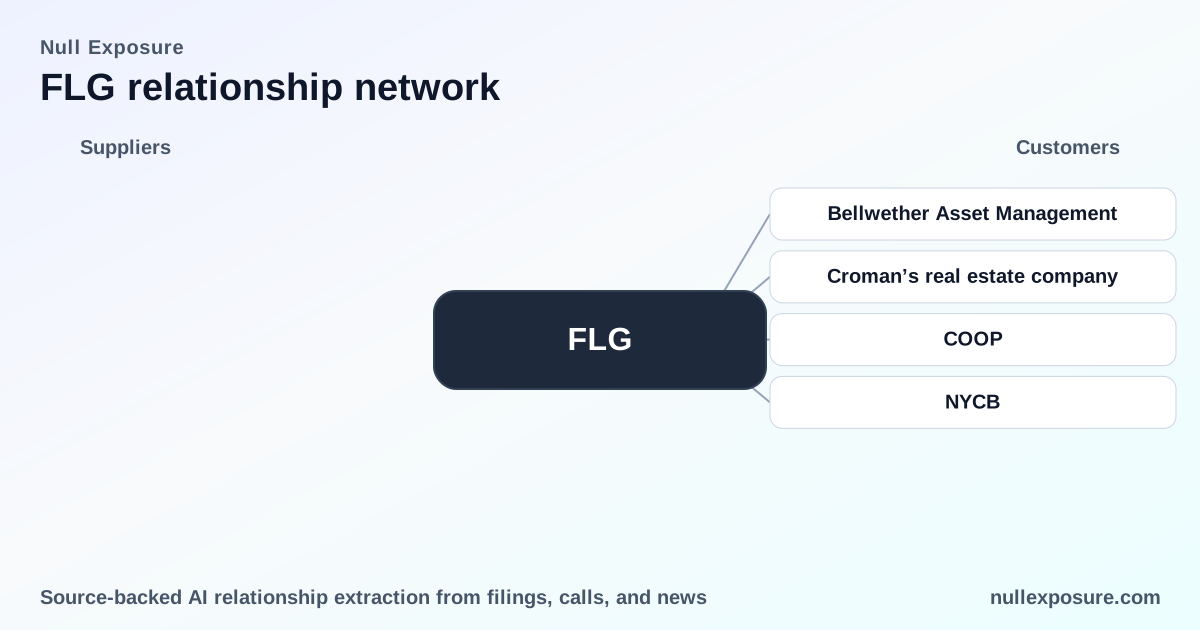
Flagstar Financial (FLG): Customer Relationships, Concentrations, and Strategic Constraints
Flagstar Financial operates as a regional bank holding company that monetizes through traditional banking streams—net interest income from lending and deposits, fee income from servicing and transactional services, and occasional portfolio sales. Over the past two years management has actively reshaped the balance sheet through large portfolio dispositions and targeted reductions in city-specific CRE exposure, converting illiquid loan risk into liquidity and fee income where possible. For investors, the story is one of active de-risking, concentrated geographic exposure, and material counterparty transactions that directly influence capital allocation and earnings volatility. Learn more about relationship-driven risk intelligence at https://nullexposure.com/.
How Flagstar’s customer footprint shapes its operating model
Flagstar presents as a banking franchise that runs a consolidated services-oriented operation: lending, deposit gathering, and private banking are the principal commercial engines. Several company-level signals from filings and press reports define operating constraints and decision rules that drive relationships:
- Contracting posture and role mix: Filings describe Flagstar both as a lender and a service provider, with the bank structuring contracts for deposit products and borrowing facilities while also subject to consumer protection laws in its retail services. This dual role increases both regulatory oversight and counterparty contract complexity.
- Customer concentration and geography: The company explicitly identifies the New York City metropolitan region as a core exposure and operates 400+ locations across ten states, indicating regional concentration risk that elevates portfolio sensitivity to local economic cycles.
- Counterparty spectrum and criticality: Flagstar serves a range of counterparties—individuals (notably HNW through ~80 private banking teams), mid-market businesses, small businesses, and larger institutional counterparties—implying diversified revenue sources but also material single-counterparty limits (board-level approvals for exposures >$350m).
- Maturity and spend bands: Internal rules require escalated approvals for large commercial credits (>$75m to CCO; >$350m to the Board), signaling a governance posture that treats high-dollar relationships as strategic and tightly controlled.
- Segment focus: Management reports a single operating segment centered on banking services, and the company is actively realigning operations to improve consolidated profitability rather than product-line level optimization.
These constraints make Flagstar a bank that actively manages relationship size and credit concentration through portfolio sales and structured credit governance rather than passive hold-to-maturity strategies.
Relationship map and recent transactions investors should track
Below I enumerate each counterparty mentioned in public coverage and what that interaction means for FLG’s risk and earnings profile.
Mr. Cooper (COOP)
Flagstar sold its residential mortgage servicing business to Mr. Cooper in a sizable transaction reported at roughly $1.3–$1.4 billion, a move that materially reduces servicing-related operating risk and shifts fee income and headcount off Flagstar’s P&L. According to Banking Dive and the Detroit Free Press coverage from 2025–2026, the sale was a central element of Flagstar’s portfolio reshaping and led to employee transitions tied to the divestiture (Banking Dive, May 2026; Detroit Free Press, Feb 2025).
JPMorgan Chase (JPM)
Flagstar transferred liquidity risk by selling roughly $5 billion of mortgage warehouse loans to JPMorgan Chase, improving funding flexibility and lowering wholesale funding dependence. That sale was reported in Banking Dive as part of a broader de-risking strategy completed last year (Banking Dive, May 2026).
Bellwether Asset Management
Flagstar sold a $247 million note position tied to New York apartment exposure into a vehicle managed by Bellwether Asset Management, a targeted disposal intended to reduce headline CRE concentration in NYC. Bisnow reported the transaction as part of Flagstar’s active trimming of localized loan risk (Bisnow, Mar 2026).
New York Community Bancorp. (NYCB)
Flagstar’s current corporate identity follows a 2022 acquisition by New York Community Bancorp., with the consolidated franchise now operating under the Flagstar Financial name—a structural change that alters capital and management dynamics and informs current strategic priorities (Detroit Free Press, Mar 2026).
Pinnacle Group
A single large credit tied to Pinnacle Group—a $564 million loan on rent-stabilized units—has been a reported drag on Flagstar’s portfolio, contributing materially to prior earnings pressure. Coverage in May 2026 identified this exposure as a notable legacy loan that affected profitability until recently (Bisnow, May 2026).
Croman’s real estate company
Flagstar is among lenders pursuing foreclosure actions against Croman’s real estate company, seeking approximately $51.4 million across several suits, reflecting receivable remediation activity at the small-to-mid corporate borrower level. Bisnow and The Real Deal reported on these foreclosure pursuits, illustrating the bank’s active workout posture for distressed CRE credits (Bisnow, Mar 2026; The Real Deal referenced in Bisnow).
What these relationships reveal about Flagstar’s strategy
- Active portfolio management: Sales to Mr. Cooper and JPMorgan demonstrate a preference for converting credit and servicing assets into liquid capital or strategic counterparty relationships, reinforcing management’s prioritization of balance-sheet flexibility.
- Concentration remediation: Disposals to Bellwether and tightened enforcement on Croman/Croman-related foreclosures show targeted efforts to reduce NYC multifamily and CRE risk pockets.
- Governance and approval thresholds: Board- and CCO-level approval rules for large credits underscore conservative governance around sizeable counterparty exposures—this institutional posture reduces episodic governance risk but concentrates decision-making for transformational moves.
Investment implications and key risks
- Earnings sensitivity to large credits: The Pinnacle $564M exposure exemplifies how a few large credits can swing earnings; Flagstar’s path to durable profitability depends on continued resolution or remediation of similar legacy loans.
- Execution risk on disposition strategy: Converting large portfolios into cash or third-party servicing relieves risk but transfers revenue streams; investors should track how transaction proceeds are redeployed and the net effect on recurring revenue.
- Geographic concentration: With heightened exposure to the NYC metro multifamily market, macro shocks to that region will disproportionately affect Flagstar’s asset quality.
For a deeper, relationship-centric view of counterparties and concentrations available across public records, visit https://nullexposure.com/ to see how these linkages map to credit and operational risk.
Flagstar’s recent actions are consistent with a bank that trades near-term revenue streams to stabilize capital and reduce concentrated CRE risk—an approach that supports a clearer runway for normalized earnings once legacy credits resolve and redeployment targets are achieved.