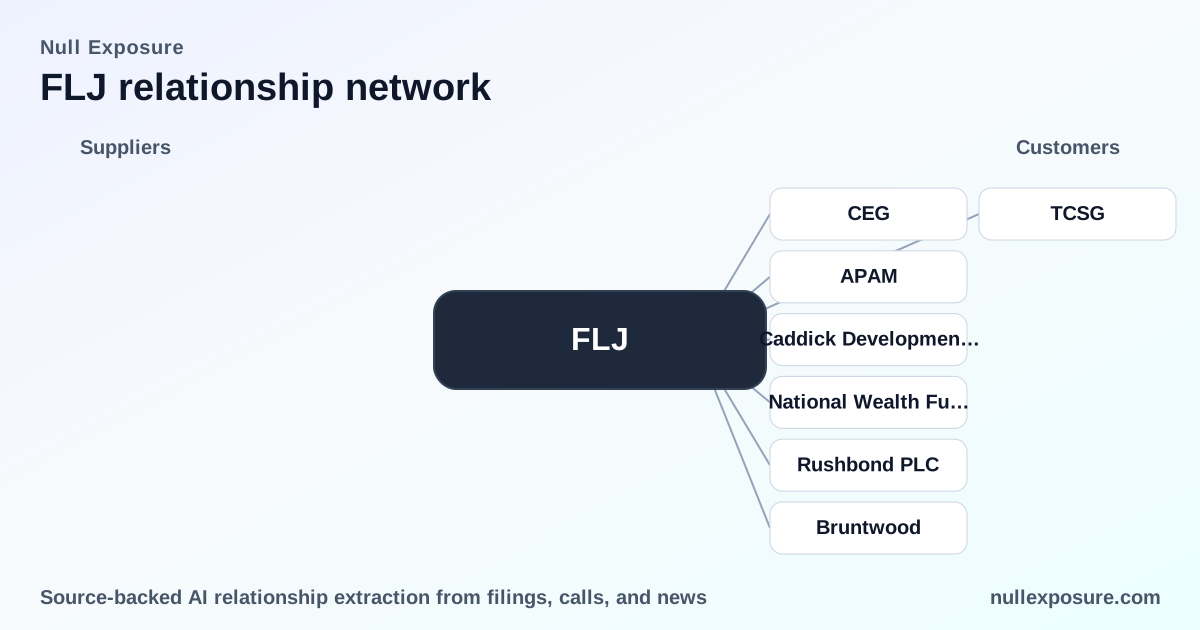
FLJ — Client Footprint and Commercial Implications for Investors
Fox Lloyd Jones (FLJ) operates as a regional office agency and property services firm that generates revenue through agency fees, tenant and landlord representation, full-turnkey lettings and project-led commercial advisory for institutional and developer clients. The firm monetizes through deal commissions and managed lettings on mid- to large-scale office schemes, leveraging local market knowledge and repeat business from high-profile real estate owners and occupiers. For a concise supplier and client map, visit https://nullexposure.com/.
Investor thesis: how the client list drives value
FLJ’s client roster is concentrated among established developers, funds and corporate occupiers, positioning the business as a specialist intermediary for urban office transactions in Northern England. Revenue growth is driven by winning premium mandates on large schemes (turnkey lettings, landmark office deals) and by cross-selling agency services across repeated developer and fund relationships. The presence of institutional tenants elevates deal size and margin potential, while a regional focus contains operating costs and strengthens local placement capability.
What the client names tell you about operating posture and risk
- Contracting posture: FLJ operates principally on a project and mandate basis, indicating a transactional but repeatable contracting model tied to development cycles and leasing rounds.
- Concentration: Client concentration skews toward a small group of repeat institutional developers and occupiers, increasing revenue volatility tied to a finite pool of large mandates.
- Criticality of relationships: Relationships with developers and funds are high-impact: winning a single full-turnkey letting or flagship office mandate can materially affect annual revenues.
- Maturity and scale: The client mix—ranging from local developers to national fund bodies—signals a mature regional player that competes for selective, high-value assignments rather than volume retail leasing.
These characteristics frame FLJ as a project-driven, relationship-dependent intermediary with both elevated deal-level margins and pronounced sensitivity to the commercial property cycle.
Clients and relationships cited in recent coverage
According to a Yorkshire Post article published March 9, 2026, FLJ “boast a range of high profile clients” and acts on several prestigious schemes; the article is the source for the relationships summarized below.
APAM
FLJ lists APAM among its named clients, indicating active engagement with asset managers on regional office projects and placements. (Yorkshire Post, March 9, 2026.)
CEG
CEG appears as a developer client on FLJ’s roster, signaling the firm’s involvement with mixed-use and commercial development mandates in established regional schemes. (Yorkshire Post, March 9, 2026.)
Caddick Developments
Caddick Developments is referenced as a named client, highlighting FLJ’s ties to a prominent regional developer and its capacity to secure developer-led leasing instructions. (Yorkshire Post, March 9, 2026.)
Rushbond PLC
Rushbond PLC’s inclusion demonstrates FLJ’s engagement with specialist regional property investors on office and city-center schemes. (Yorkshire Post, March 9, 2026.)
National Wealth Fund (formerly UKIB)
FLJ is credited with a full-turnkey letting to the National Wealth Fund at 2 Whitehall Quay, an institutional tenant win that underlines the firm’s capability to handle large, high-profile lettings. (Yorkshire Post, March 9, 2026.)
Bruntwood
Bruntwood’s presence on the client list confirms FLJ’s relationships with major regional landlords and operators of office stock, bolstering recurring opportunity for asset management and re-letting activity. (Yorkshire Post, March 9, 2026.)
TCS / TCSG
TCS (listed with TCSG as an inferred symbol) is named among occupier clients, indicating FLJ’s role representing corporate tenants or facilitating large corporate lettings in the region. (Yorkshire Post, March 9, 2026.)
Why these relationships matter for valuation and outlook
- Deal size and margin uplift: Institutional tenants and large developers generate larger mandates and higher fees per transaction, lifting average revenue per deal relative to high-volume retail leasing.
- Visibility into near-term pipeline: A client list featuring several repeat developers suggests a near-term pipeline of redevelopment and letting opportunities; individual flagship transactions (for example, the turnkey letting to the National Wealth Fund) materially influence yearly results.
- Cyclicality and concentration risk: Dependence on a limited cohort of large clients increases exposure to development slowdowns or tenant hiring freezes; investors should model lumpy revenue recognition tied to project timetables.
- Competitive positioning: FLJ’s focus on Northern-office markets and ability to secure institutional mandates differentiates it from national volume brokers and supports premium pricing on bespoke lettings.
Key takeaways for investors
- FLJ is a mandate-driven, relationship-centric agency that extracts value from large, high-profile office lettings and developer mandates.
- Client composition skews toward developers, funds and institutional occupiers, which enhances deal economics but increases headline sensitivity to a small set of contracts.
- Operational risk is concentrated around project timing and regional market cycles; a small number of lost mandates could materially affect short-term revenue, while winning marquee lettings accelerates growth and credibility.
For an integrated view of counterparties, mandates and relationship tracking, explore the coverage and tools available at https://nullexposure.com/. Investors evaluating FLJ should weigh the firm’s premium mandate capabilities against the structural concentration and cyclicality inherent in project-led commercial agency.