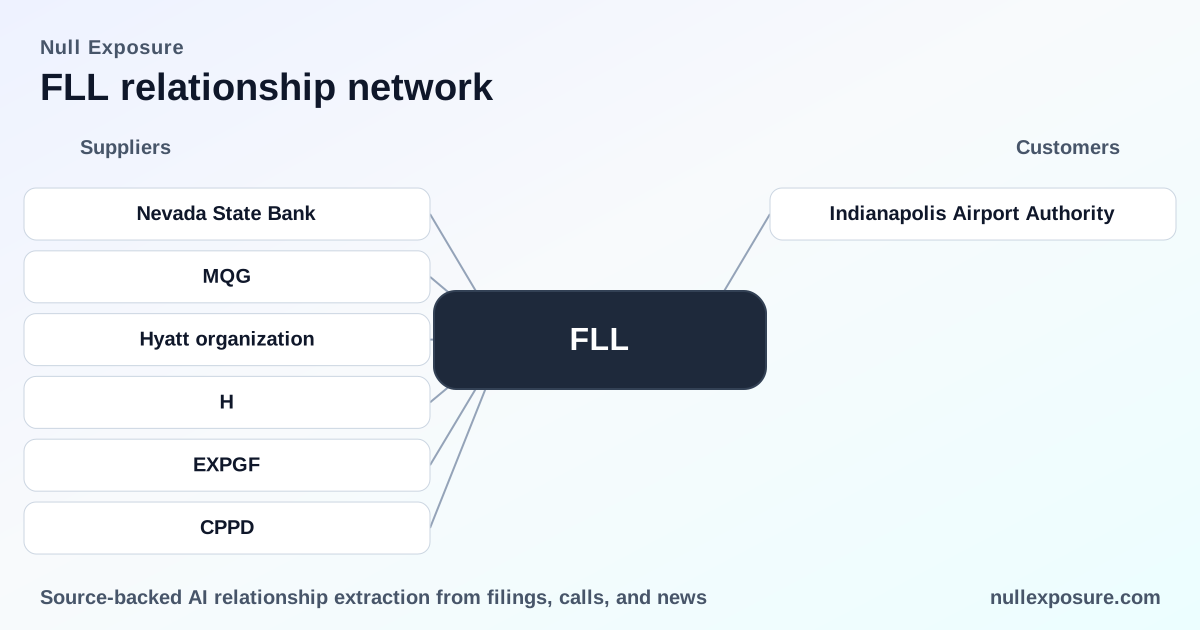
Full House Resorts (FLL): Customer Relationships and Contracted Sports-Wagering Exposure
Full House Resorts operates, develops and manages regional casinos and hospitality properties and monetizes through on-site gaming, hospitality services, leases and contracted sports-wagering arrangements that generate both revenue shares and up-front market access fees. The company combines brick-and-mortar casino economics (gaming floors, F&B, rooms) with a services-oriented sports-wagering arm where it acts as both seller of gaming experiences to individual patrons and licensor of wagering skins to partners — producing a mix of recurring gaming revenue and time‑amortized contractual cash flows. For a concise dossier on institutional counterparty signals visit https://nullexposure.com/.
How Full House actually gets paid — the operating model in plain English
Full House’s cash flows split into two clear buckets: property-level gaming and hospitality, where revenue is earned directly from individuals (local repeat visitors and drive-in tourists), and contracted sports wagering, where the company licenses market access and operates wagering skins in multiple states and recognizes one-time market access fees over the life of agreements.
- Licensing and long-term contracting are core features. The company’s filings disclose one-time “market access” fees that are recorded as long-term liabilities and recognized as revenue ratably over initial contract terms, including an example $5.0 million fee amortized over an eight‑year sports agreement (contractual term began August 2023) and a $1.0 million fee amortized over a 10‑year initial term. According to the company’s FY2024 filing, these structures create predictable amortization revenue streams tied to contract tenure.
- Customer counterparty is primarily individuals. Full House’s customer base is concentrated in nearby residents and drive‑in tourists; this is a retail, high-repeat patron model rather than institutional wholesale sales.
- Geographic and segment footprint is regional and service-based. The company derives revenues from properties in Mississippi, Colorado, Indiana, Nevada and Illinois and houses its Contracted Sports Wagering segment in Colorado, Indiana and Illinois (company FY2024 filing).
Key takeaway: the business mixes traditional casino economics with licensing-style, long-dated sports-wagering agreements that produce deferred revenue and minimum-payment protections.
What the contracts look like and why that matters to investors
Full House’s commercial posture is licensor + seller, not a pure technology platform. That has four investor-relevant implications:
- Long-term, predictable cash flows: Market access fees and minimum revenue guarantees (for example, a $5.0 million annual minimum under an Illinois sports agreement) create downside protection and predictable near-term receipts, with amortization schedules smoothing recognition over 8–10 year contract horizons (company FY2024 filing).
- Moderate materiality and concentration: One of Full House’s casinos generated 37.5% of revenue and 60.5% of Adjusted EBITDA for the year ended December 31, 2024, signaling material revenue concentration at the property level that amplifies regional or regulatory shocks.
- Contract maturity and active-stage exposure: The company reported three active skins at year-end 2024 (down from four a year earlier), indicating those licensed relationships are currently active but subject to churn and state-level dynamics.
- Retail customer base drives demand risk: Dependence on local and drive‑in patrons emphasizes macro and local economic sensitivity — a property-level revenue swing is likely to transmit quickly to consolidated results.
Investor implication: contracts provide cash-flow smoothing and downside floors, but geographic concentration and retail demand cycles remain the dominant risk drivers.
Relationship inventory — every customer counterparty flagged
Indianapolis Airport Authority
Full House submitted a proposal in 2015/2016 to develop a $650 million casino-anchored mixed-use project in response to a request for proposals from the Indianapolis Airport Authority; the item was reported publicly in May 2016. (IndyStar, May 13, 2016: https://www.indystar.com/story/money/2016/05/13/casino-operator-still-interested-indy-airport-project/84338264/)
This is the only external counterparty flagged in the search results; the news item documents Full House’s past development interest tied to airport-area real estate rather than an ongoing contractual revenue relationship in the current filings.
Additional company-level signals and contractual constraints
Use these items as context for counterparty analysis and financial modeling — they are drawn from the company’s filings and form the structural constraints of the business:
- Licensing posture: The company records market access fees as long-term liabilities and recognizes them ratably as revenue over the initial contract term; treatment also allows for acceleration on early termination (company FY2024 filing). This structures near- to medium-term revenue visibility.
- Spend/guarantee banding: Under the Illinois sports agreement Full House receives a percentage-of-revenue subject to a minimum of $5.0 million per year; this floor sits in the $1m–$10m spend band and provides a contractual cushion to variable wagering income.
- Role definitions: Filings describe Full House as both licensor (collecting market access fees) and seller (operating properties and customer-facing services), which means counterparty risk splits between counterparties to licensing deals and retail patrons.
- Geographic concentration: Revenue is sourced from a concentrated set of states (MS, CO, IN, NV, IL); sports-wagering skins are present in Colorado, Indiana and Illinois — regulatory changes in any of these states have outsized implications.
- Maturity and stage: As of Dec 31, 2024, there were three active skins, underscoring that contracted sports-wagering relationships are in an operating stage rather than early negotiation.
Citing the company’s FY2024 filing for these specifics provides the most direct basis for modeling contractual revenue recognition and downside scenarios.
Key risks to model and monitor
- Single-property concentration risk: One Illinois casino accounted for a large share of revenue and adjusted EBITDA in FY2024; a localized downturn, regulatory change or competitive displacement there would materially impact consolidated margins.
- Contract churn and renegotiation risk: Active skins declined from four to three over 2023–2024, signaling partner churn risk; market access fees are amortized but revenue recognition can accelerate if contracts terminate early.
- Regulatory and state-level exposure: Sports-wagering operations require continuous state licensing and compliance; policy shifts in Colorado, Indiana or Illinois will directly affect income streams.
- Retail demand cyclicality: Dependence on local residents and drive-in tourism concentrates sensitivity to consumer discretionary cycles and regional economic conditions.
Investors should model downside scenarios where minimum guarantees persist but variable revenue compresses, and stress-test EBITDA against the Illinois concentration.
Bottom line and recommended investor actions
Full House combines recurring property revenues with contractually structured, long-dated sports-wagering cash flows that improve near-term revenue visibility—but the business remains regionally concentrated and retail-demand driven. Monitor three levers closely: Illinois casino performance (the material contributor), the status of active skins and market-access fee recognition, and regulatory developments in Indiana and Colorado.
For an investor-grade dossier and regular counterparty signal updates, see https://nullexposure.com/.