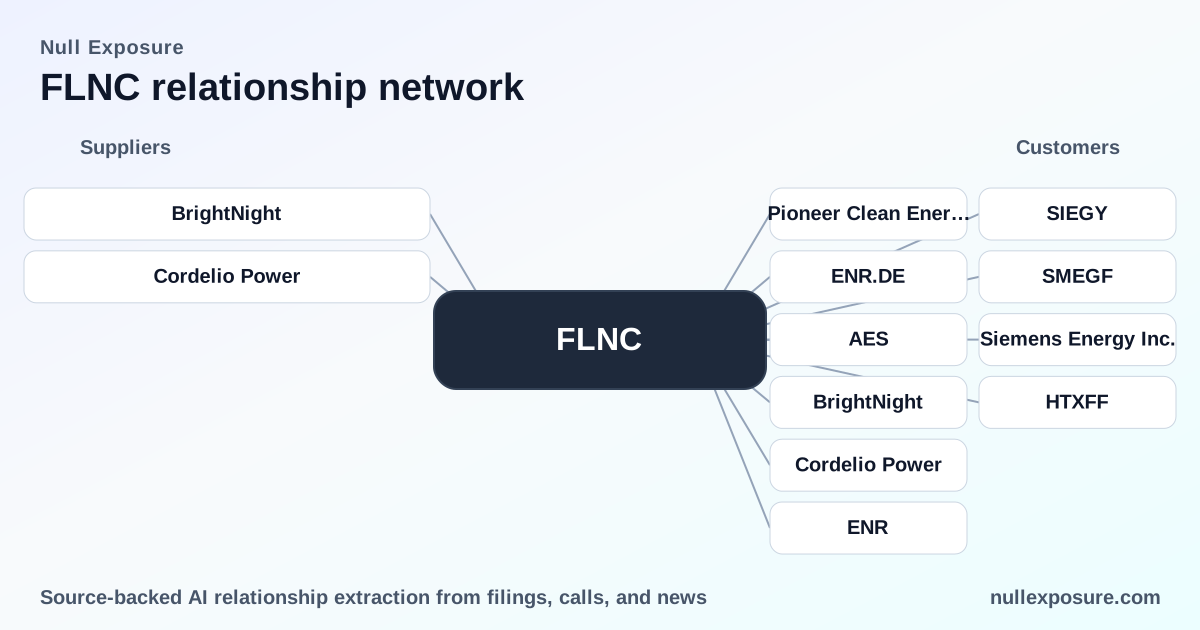
Fluence Energy (FLNC) — Customer Map and Commercial Implications
Fluence Energy builds, sells and operates utility-scale battery storage solutions and complementary cloud software, monetizing through large equipment contracts, long-term service agreements and subscription-style digital offerings. Revenue is driven by system sales (Gridstack product lines), recurring O&M/service contracts and growing SaaS revenues, with material concentration in a small number of strategic customers that also function as founders and channel partners. For a concise institutional briefing and original source links, visit https://nullexposure.com/.
How Fluence makes money and where the risk lives
Fluence’s business model is a three-legged stool: hardware project sales (battery systems), long-term service contracts (O&M and extended warranties), and cloud-based software subscriptions that optimize assets. The company reports a global footprint — deployed assets, contracted backlog and pipeline across North America, EMEA and APAC — and recognizes that its top two customers generated roughly 41% of revenue in FY2025, a structural concentration that shapes strategy and risk.
- Contracting posture: Fluence executes long-term project and service contracts and delivers recurring revenue through multi-year O&M and warranty streams.
- Commercial roles: The company is both seller of energy storage systems and an ongoing service provider for operational assets; digital offerings give it a subscription-like revenue line.
- Geography and pipeline: Fluence operates globally with meaningful exposure to North America, EMEA and APAC, and maintains a multi-GW pipeline.
- Spend and materiality: Related-party or founder-linked transactions have shown six-figure to $100m+ revenue scales, reinforcing the commercial importance of certain partners.
These structural attributes — concentration, long-duration contracts and mixed hardware/software economics — define both the company’s upside (recurring revenue + large projects) and key downside vectors (partner disputes, contract execution).
Who Fluence is doing business with — relationship snapshots
Below are the customer and partner relationships identified in public reporting and press coverage. Each entry is a plain-English summary with a concise citation.
-
Pioneer Clean Energy Center — Fluence was selected to supply its Gridstack Pro solution to the Pioneer Clean Energy Center in Yuma County, AZ, a 300 MWac solar plus 300 MW / 1,200 MWh battery project under a long-term tolling agreement. (Sahm Capital, Jan 21, 2026: sahmcapital.com)
-
BrightNight — BrightNight is a developer on the Pioneer Clean Energy Center project; Fluence’s Gridstack Pro installation is specified to support grid reliability under a long-term tolling structure. (Sahm Capital, Jan 28, 2026: sahmcapital.com)
-
Cordelio Power — Cordelio Power is a co-developer on the Yuma County Pioneer project alongside BrightNight and will contract Fluence’s Gridstack Pro equipment for the tolling arrangement. (Sahm Capital, Jan 28, 2026: sahmcapital.com)
-
Torch Clean Energy — Fluence partnered with Torch Clean Energy to develop the Winchester solar-plus-storage project in Cochise County, AZ; the deal specifies two 80 MW solar arrays paired with Fluence Gridstack Pro 5000 systems delivering 160 MW / 640 MWh in total, with delivery expected in early 2027. (Investing.com, May 2026: ca.investing.com)
-
LEAG (HTXFF) — Fluence announced a landmark 4 GWh project with LEAG that the company characterized as the largest battery project in European history, signaling meaningful enterprise-scale deployment in EMEA. (Fluence Q4 FY2025 earnings call, Mar 2026)
-
Siemens AG (SIEGY / SIEGY ticker references) — Siemens AG is a founder and historically one of Fluence’s largest revenue sources; public filings and investor-advocacy notices highlighted the strategic founder relationship and the potential for revenue impacts tied to litigation and public scrutiny. (GlobeNewswire / Bragar filings, Aug–Oct 2025)
-
Siemens Energy / Siemens Energy Inc. (ENR.DE / ENR / SMEGF / ENR.DE ticker references) — Public reports and a high-profile dispute alleged a lawsuit filed by Siemens Energy (an affiliate of Fluence’s founders) alleging engineering, design and contractual issues; the litigation disclosure has been cited repeatedly in investor alerts and class-action notices. (Prnewswire and GlobeNewswire releases, 2025; Newsfile press releases, 2026)
-
The AES Corporation (AES) — AES is a founder and long-standing customer that has been described in filings and class-action related notices as one of Fluence’s largest revenue sources and preferred BESS technology partner, underscoring revenue concentration and strategic alignment. (Newsfile / GlobeNewswire investor notices, 2025–2026)
-
Phrasing variants documented in public materials (SIEGY, AES, SMEGF, ENR, ENR.DE) — Regulatory filings, investor alerts and press releases cite the same Siemens/AES relationships under multiple tickers and entity names; the recurrent references across documents reinforce that Siemens and AES together account for a significant share of historical revenue and attention in litigation-related disclosure. (Multiple GlobeNewswire and Newsfile releases, 2025–2026)
Note: the list above covers every distinct relationship name returned in the search results; duplicate ticker or name variants are summarized and cited to the public notices that raised those issues.
What the relationship map implies for investors
- Concentration risk is real and measurable. Fluence disclosed that its top two customers accounted for approximately 41% of revenue in FY2025, which magnifies the financial impact of any dispute or order flow change with those customers. (Company FY2025 disclosures)
- Long-term contracts and O&M create durable cash flow potential, but they also impose execution and service obligations that are critical to profitability and reputation; Fluence reports significant assets under management for service contracts and recognizes service revenue over time. (Company FY2025 disclosures)
- Legal friction with founder-linked parties elevates event risk. Public reporting from 2024–2026 documents litigation and short-seller attention tied to projects and engineering disputes involving Siemens Energy and affiliates; that dynamic increases volatility in investor sentiment and could affect future procurement. (Blue Orca / press and subsequent investor notices, 2024–2026)
- Global pipeline and scale projects validate growth — multi-GWh European awards and multiple U.S. solar-plus-storage wins show Fluence executing on large, high-ticket projects that underpin backlog and future service revenue. (Earnings call and project press releases, FY2025–FY2026)
Constraints and company-level commercial signals
The public record provides several company-level signals that frame how Fluence operates:
- Contracting posture: Predominantly long-term project contracts and recurring service agreements, with a recognized SaaS component for digital applications.
- Revenue concentration: Top-two customers ~41% of FY2025 revenue, a material concentration that drives both negotiating leverage and single-counterparty risk.
- Geographic reach: Verified operations and pipeline in North America, EMEA and APAC, with significant projects in the U.S., Germany, Australia and other markets.
- Role mix: Fluence functions as seller of core battery systems, ongoing service provider for deployed assets, and software vendor via cloud-based offerings.
- Spend scale: Related-party and founder-linked revenues have shown six-figure to $100m+ magnitudes, indicating large-ticket commercial flows.
These constraints define Fluence’s commercial architecture: high-ticket, long-duration equipment sales married to recurring service and software economics, concentrated by counterparty and diversified by geography.
Bottom line for investors
Fluence’s commercial footprint combines large enterprise project wins and recurring service/SaaS revenue, creating a compelling structural revenue mix if execution and partner relations remain stable. Key investment risks are concentrated counterparty exposure and ongoing litigation/disputes tied to founder-linked partners, which materially affect near-term revenue visibility and sentiment. For a structured investor briefing and source links, visit https://nullexposure.com/.
Bold takeaways: Fluence has real growth opportunities via multi-GWh projects and digital contracts, but its top-customer concentration and public disputes with founder-affiliated entities are principal risk drivers that must be monitored closely.