Flowers Foods (FLO): Retail Relationships Drive Volume, Not Margin — What Investors Need to Know
Flowers Foods operates and monetizes by producing and wholesaling packaged bakery products—breads, rolls, snack items and related branded goods—into major U.S. retail and foodservice channels; revenue is recognized at a point in time and the company captures margin through scale, national brand placement, and targeted brand acquisitions such as Simple Mills. The business model is volume-driven and channel-dependent: large retail partners determine shelf access, pricing dynamics, and much of Flowers’ working-capital profile. For more context on Flowers’ customer exposures and relationship signals, visit the Null Exposure homepage: https://nullexposure.com/.
How Flowers makes money and how customers shape risk
Flowers Foods is the second-largest packaged bakery producer in the U.S., selling through supermarkets, mass merchandisers, club stores, discount and convenience channels, and foodservice. Revenues are primarily point-in-time wholesale sales, but the company also provides optional distributor financing and supports complex arrangements such as scan-based trading (SBT). Those mechanics create a hybrid contracting posture: largely spot transactions with pockets of longer-term financing exposure to distributors.
- Concentration is material. Top-10 customers accounted for 56.7% of net sales in Fiscal 2024, signaling heavy reliance on a relatively small set of retail giants.
- Channel control is asymmetric. Large retailers and club stores exercise price and assortment control, while Flowers retains product and margin responsibility until consumer purchase in certain SBT arrangements.
- Geography is domestic. The revenue footprint is U.S.-centric, so macro U.S. consumer trends and retail inventory cycles drive demand with limited geographic diversification.
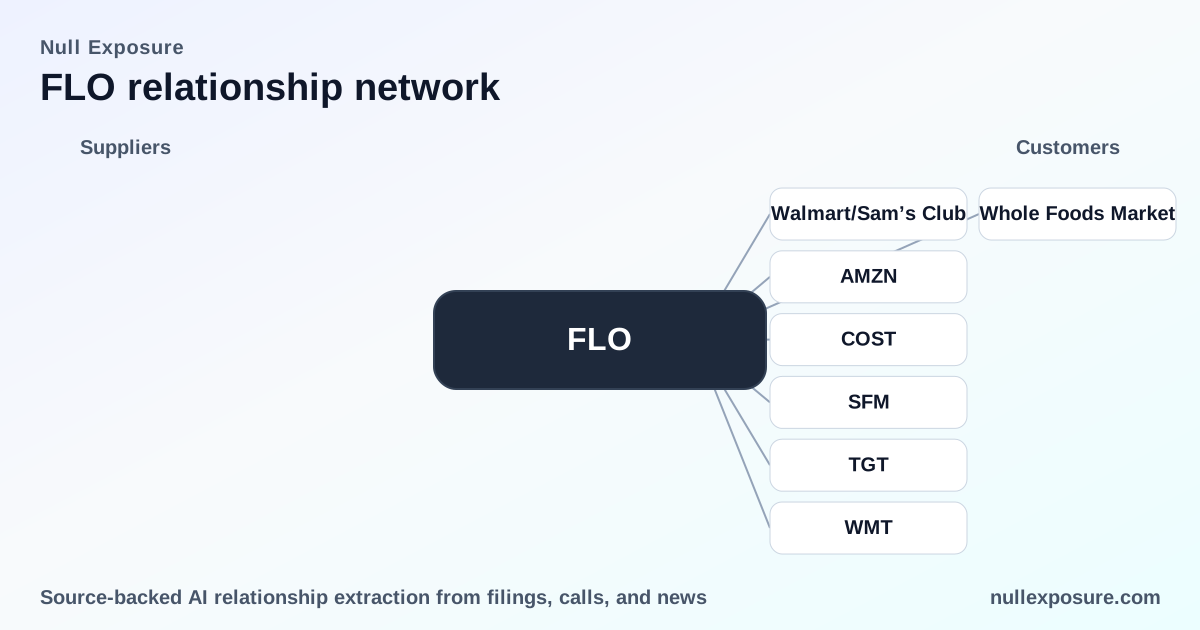
Relationship roll call — every customer mention from the available results
Walmart / Sam’s Club (FY2024 10‑K)
Walmart and Sam’s Club collectively represented 22.4% of Flowers Foods’ sales in Fiscal 2024, making them the company’s single largest customer by a wide margin. This exposure is documented in the company’s 2024 Form 10‑K filing. (Source: FY2024 10‑K, filing referenced in company materials.)
Walmart (news mentions, FY2026)
Flowers’ acquired brands and legacy SKUs are carried in Walmart’s assortment and are repeatedly cited as a national retail partner supporting distribution scale. A March 2026 press cycle noted Walmart as a core retail channel for Simple Mills and other Flowers brands. (Source: MillingMEA / Baking Business / Prepared Foods coverage, March–May 2026.)
Amazon / Whole Foods (FY2026 news coverage)
Flowers and its Simple Mills brand maintain a strong e-commerce presence on Amazon and placement at Whole Foods, enabling both broad reach and premium-channel exposure; multiple industry articles in 2026 referenced Amazon and Whole Foods as key digital and natural-grocery endpoints. (Source: MillingMEA and Baking Business reporting on Simple Mills, March 2026; Prepared Foods, May 2026.)
Costco / Costco Wholesale (FY2026 news coverage)
Simple Mills and other Flowers brands are carried by Costco Wholesale, providing high-volume, limited-SKU exposure and favorable velocity economics for specific items—press reports in 2026 list Costco among the major retail partners. (Source: Baking Business and Prepared Foods articles, March–May 2026.)
Target (FY2026 news coverage)
Target is listed across multiple 2026 outlets as a national retail partner carrying Flowers’ branded bakery items, contributing to multi-channel shelf presence and national promotional programs. (Source: MillingMEA, Baking Business, Prepared Foods — March–May 2026.)
Sprouts / Sprouts Farmers Market (SFM) (FY2026 news coverage)
Sprouts is a distribution channel for Flowers’ natural and better-for-you brands such as Simple Mills, supporting the company’s penetration of the natural grocery segment. Industry press referenced Sprouts among the chain partners carrying Simple Mills in 2026. (Source: Baking Business and Prepared Foods coverage, March–May 2026.)
Whole Foods Market (FY2026 news coverage)
Whole Foods Market is specifically cited as a placement venue for Simple Mills, reinforcing Flowers’ footprint in the natural and specialty retail channel and bolstering brand equity among premium shoppers. (Source: Baking Business and Prepared Foods reporting, March–May 2026.)
(Note: multiple source mentions across the news cycle reference the same retail partners—those repeats are captured in the citations above.)
What the constraints reveal about operating posture and risk
Flowers’ relationship signals combine to form a consistent operating profile:
-
Contracting posture — mixed spot / selective long-term: The company recognizes most revenue at a point in time, consistent with spot wholesale sales, but it also documents optional long-term distributor financing (notes receivable up to ten years) when territory transfers involve seller financing. This produces episodic credit exposure tied to distributor transactions rather than blanket long-term contracts. (Source: company excerpts on revenue recognition and distributor financing.)
-
Concentration and materiality are high: Top-10 customers made up 56.7% of sales in Fiscal 2024, creating single-counterparty and channel concentration risk centered on major mass merchandisers and club stores. (Source: FY2024 customer concentration disclosure.)
-
Counterparty profile is large-enterprise dominated: Customers include mass merchandisers, supermarkets, club stores and national chains—large enterprise buyers that command pricing and shelf placement. This amplifies negotiation asymmetry but also provides stable, high-volume demand. (Source: company descriptions of customer mix.)
-
Criticality and roles: Flowers operates as the principal seller across core channels, but reseller and SBT relationships shift inventory/recognition timing and retail ownership dynamics; these arrangements mean Flowers occasionally retains fulfillment and inventory risk while retailers control final pricing. (Source: company disclosures on SBT, IDP/reseller roles.)
-
Maturity: The business is mature—scale, national distribution and established brand franchises (including Simple Mills) position Flowers as a stable industry incumbent rather than a growth-stage operator.
Investor implications and near-term watch items
- Concentration risk is the primary operational lever. Walmart/Sam’s Club accounting for 22.4% of sales requires active monitoring of assortment decisions, promotional cadence, and private‑label competition. (Source: FY2024 10‑K.)
- SBT and distributor financing add working-capital complexity. Scan-based trading can shift recognition and returns dynamics; occasional long-term notes to distributors create credit exposure that warrants disclosure monitoring. (Source: company excerpts on SBT and 10‑year notes.)
- Brand acquisitions are the growth engine. Simple Mills’ distribution into Whole Foods, Sprouts, Target, Costco and Amazon supports margin diversification through premium SKUs; investor returns depend on execution of cross-channel distribution and margin management. (Source: industry press on Simple Mills, March–May 2026.)
For a consolidated view of Flowers’ counterparties and how they map to revenue concentration and credit exposure, see Null Exposure’s customer analytics hub: https://nullexposure.com/.
Bottom line
Flowers Foods is a volume-centric, retail-dependent consumer staples operator with pronounced concentration in a small set of large U.S. retailers. Investor attention should focus on assortment outcomes at Walmart and club channels, the margin and working-capital effects of SBT and distributor financing, and the execution of branded growth initiatives like Simple Mills across both brick-and-mortar and e-commerce channels.