FLXN customer relationships: licensing, an exit, and what they tell investors
Flexion Therapeutics historically monetized proprietary pain treatments through product sales and territorial licensing, then executed an exit through acquisition by Pacira. The company generated revenue via licensing deals with regional partners (notably in Greater China) and ultimately transferred core assets into Pacira’s non‑opioid pain portfolio through a cash-and-CVR acquisition structure. For a concise view of Flexion’s customer and partner footprint, visit https://nullexposure.com/ for the primary reference hub.
How the commercial playbook worked — licensing upfronts plus commercialization leverage
Flexion’s model combined direct commercialization in established markets with territorial license agreements that produced upfront cash and shifted commercialization risk to local partners. The FY2021 agreements that underpin the Greater China strategy included an upfront payment structure, which reflects a contracting posture focused on monetizing IP near term while outsourcing country‑level execution. This approach reduced capital intensity for international rollouts and created discrete, high‑visibility revenue events tied to licensing milestones rather than ongoing, unpredictable product sales.
Key takeaways:
- Licensing generated convertible, near-term cash through upfronts.
- Geographic partnering confined commercial exposure while enabling local market access.
- The subsequent acquisition by Pacira transferred remaining commercial upside and consolidated product ownership under a single buyer.
The deal map: partners and the acquisition that closed the loop
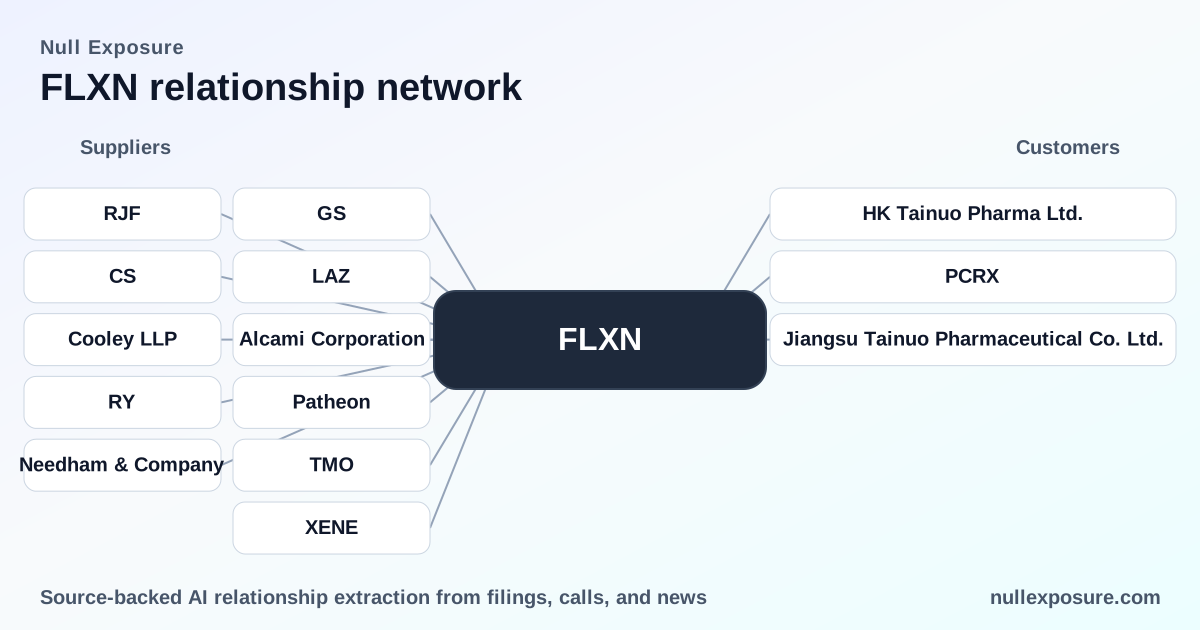
Below I cover every named relationship from public reporting and filings tied to Flexion’s customer/partner footprint.
HK Tainuo Pharma Ltd.
Flexion executed an agreement in FY2021 under which HK Tainuo committed an upfront payment of $10 million as part of a licensing arrangement. According to Flexion’s FY2021 SEC filing, the $10 million upfront formed part of the Greater China licensing package (https://www.sec.gov/Archives/edgar/data/1419600/000156459020014651/flxn-ex991_6.htm).
Jiangsu Tainuo Pharmaceutical Co. Ltd.
Flexion entered an exclusive license covering mainland China, Hong Kong, Macau and Taiwan with Jiangsu Tainuo (a subsidiary of China Shijiazhuang Pharmaceutical) for the development and commercialization of ZILRETTA in Greater China, per the company’s FY2021 SEC filing (https://www.sec.gov/Archives/edgar/data/1419600/000156459020014651/flxn-ex991_6.htm).
Pacira BioSciences, Inc. (PCRX)
Pacira acquired Flexion in a transaction that paid $8.50 per share in cash plus one non‑tradeable contingent value right (CVR) worth up to $8.00 per share, transferring Flexion’s products into Pacira’s portfolio and delivering an exit to Flexion shareholders, as reported in transaction filings and press coverage in FY2021 (Newsfile press release, March 2026 coverage: https://www.newsfilecorp.com/release/99224/; Citeline deal reporting: https://insights.citeline.com/SC145214/Pacira-Aims-For-Non-Opioid-Pipeline-Growth-With-Flexion-Buy/). Citeline also characterized the transaction value at roughly $427.5 million.
A separate industry article notes that Pacira integrated Flexion’s Iovera device and Zilretta into its broader non‑opioid pain portfolio, indicating strategic fit beyond a simple asset purchase (FiercePharma, FY2022 commentary: https://www.fiercepharma.com/marketing/pacira-survey-finds-knee-pain-hurts-physically-socially-and-mentally).
What these relationships reveal about Flexion’s operating constraints and posture
With limited public constraints extracted as discrete clauses, we read company‑level operational signals from the transaction map:
-
Contracting posture: Flexion favored non‑dilutive licensing that produced upfront cash and delegated on‑the‑ground commercialization to established regional partners. That posture mitigated execution risk and converted IP value into liquidity ahead of an exit.
-
Customer concentration: The prominence of a single strategic buyer (Pacira) in the ultimate corporate outcome signals concentration of strategic value — a small number of acquirers or large partners controlled the primary monetization pathways for Flexion’s portfolio.
-
Criticality and commercial maturity: The mix of exclusive regional licenses and a full corporate acquisition demonstrates commercial maturity of Flexion’s lead assets: they were sufficiently de‑risked to attract a strategic buyer and to support single‑territory exclusive licensing. Institutional counterparties and buyers treated the assets as commercially actionable rather than preclinical bets.
-
Revenue profile and timing: The licensing approach created lumpy, milestone/upfront‑weighted revenue recognition rather than a steady, product‑sales revenue stream. That profile is attractive for liquidity near term but increases reliance on discrete commercial events for future cash flows.
Investment implications: upside, risks, and what to watch next
Flexion’s public partner and buyer relationships crystallize both opportunity and risk for investors evaluating the asset trajectory.
-
Upside: The Pacira acquisition consolidated Flexion’s products under a company with established commercialization capacity in non‑opioid pain, unlocking distribution scale and potential product synergies. The Greater China license provided immediate cash and local commercialization reach without capital deployment.
-
Risk profile: Reliance on territorial licensing and a single strategic acquirer implies concentration risk for value realization. Investors should track how Pacira executes integration and whether the Asia partner routes convert into durable sales for ZILRETTA and related products.
-
Signals to monitor: Watch milestone payments and CVR realizations from the Pacira deal, reported product rollouts in Greater China via Jiangsu/HK Tainuo, and revenue disclosures tied to licensed territories in company filings and Pacira reporting channels.
For deeper, structured intelligence on transaction-level relationships and downstream implications, visit https://nullexposure.com/ — the site aggregates the primary filings and press sources that underlie this analysis.
Bottom line for operators and research investors
Flexion monetized established pain assets through a deliberate mix of regional licensing and strategic sale, generating upfront liquidity and consolidating long‑term commercialization under Pacira. That path demonstrates a repeatable route for small specialty biotechs: de‑risk core assets via selective licensing, then realize residual value through a strategic acquisition. For investors assessing similar franchises, the Flexion case underlines the importance of partner selection, milestone structuring, and the tradeoff between near‑term cash and retained upside.
Sources cited in this note include Flexion’s FY2021 SEC filing (https://www.sec.gov/Archives/edgar/data/1419600/000156459020014651/flxn-ex991_6.htm), press reporting on the acquisition and deal value (Newsfile; Citeline), and industry coverage of product integration into Pacira’s portfolio (FiercePharma).