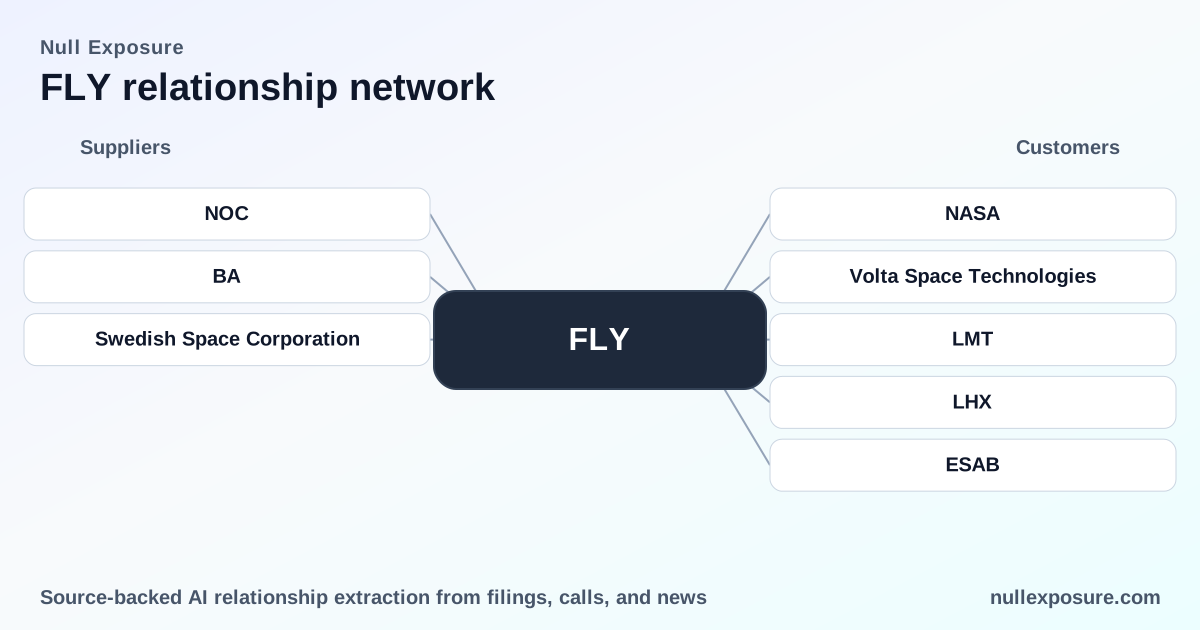
Firefly Aerospace (FLY): Customer map and what it means for investors
Firefly Aerospace operates and monetizes through a mix of commercial launch services, spacecraft systems (landers and orbital vehicles), and nascent lunar data services sold under government and commercial contracts. Revenue comes from multi-launch agreements and milestone-based government contracts—most notably NASA's CLPS program—and from payload customers who pay for dedicated mission slots or data products; the company is scaling cadence while carrying negative EBITDA and a still-developing margin profile. For investors tracking customer concentration, contract criticality, and near-term revenue visibility, Firefly’s customer set is dominated by government prime contractors and a handful of strategic commercial partners. Learn more about our coverage at https://nullexposure.com/.
How Firefly gets paid and why customers sign contracts
Firefly sells mission outcomes: reliable delivery to orbit or lunar surface, and an evolving product set that includes lunar imagery and sustained orbital services (Elytra). Contracts are milestone-heavy, payment-linked, and skew toward government and defense customers, which buys revenue visibility but concentrates counterparty and program risk. The company’s public financials show TTM revenue of $159.9 million and negative EBITDA (-$199.0 million), signaling a growth-stage operator converting backlog and program wins into scale.
Key operating-model characteristics investors should factor into valuation:
- Contracting posture: predominantly fixed-price or milestone-based government contracts and multi-launch commercial purchase agreements that trade lower margin predictability for higher revenue visibility.
- Concentration: customer roster is concentrated in government agencies and primes, increasing revenue lumpy-ness if a mission slips or a contract is delayed.
- Criticality: deliveries (launch and lunar landings) are mission-critical for customers; execution reliability directly affects reorder probability and follow-on awards.
- Maturity: product and service mix are early-commercial — the company is moving from demonstrator to cadence-based revenue while working toward positive operating leverage.
The full customer roster investors must track
Below I cover each relationship cited in public reporting and trade press. Each entry is a concise, investor-grade summary with a source reference.
NASA
Firefly is a prime contractor under NASA’s CLPS framework, winning a $176.7 million Blue Ghost Mission 4 award for south-pole lunar payload delivery and securing a separate $10 million contract addendum for lunar imagery and data, positioning lunar data as a revenue line. (Sources: FinancialContent deep dive; 247wallst report; ASDNews and TS2/Reuters coverage, FY2025–FY2026.)
Lockheed Martin (LMT)
Lockheed Martin contracted Firefly to carry a demonstrator payload on Alpha Flight 7, and Firefly frames successful payload delivery as validation of Alpha's return-to-flight reliability—activity that underpins follow-on mission opportunities and defense exercises. (Sources: Firefly press release Mar 11, 2026; ExpressNews and investingnews reporting, FY2026.)
Northrop Grumman Corp. (NOC)
Firefly is listed among government and commercial partners that include Northrop Grumman, signaling relationship breadth with major defense primes and potential collaborative tasking in responsive space or national-security payload delivery. (Source: ExpressNews coverage, FY2026.)
U.S. Space Force
Firefly supported Space Force exercises and has been engaged by primes in responsive-space operations, reflecting a role in defense-focused mission execution and operational-readiness exercises. (Source: ExpressNews and investingnews articles, FY2026.)
L3Harris Technologies (LHX)
Firefly holds multi-launch agreements with L3Harris that provide forward revenue visibility—public reporting cites deals for up to three dedicated Alpha launches and references up to 20 Alpha missions in multi-launch language, making L3Harris a meaningful source of scheduled launch revenue. (Sources: IBTimes coverage; StockTwits/press reporting, FY2026.)
Volta Space Technologies
Firefly announced a commercial payload agreement to fly Volta’s wireless power receiver (“LightPort”) on Blue Ghost Mission 2, demonstrating commercial payload revenue and the use of lunar missions as technology testbeds for emerging lunar utility concepts. (Source: TS2 tech summary of Firefly announcements, Dec 2025 / FY2025.)
ESA (European Space Agency) and ESAB (as cited)
Public reports list ESA’s Lunar Pathfinder as a Mission 2 payload customer, and an intermediate data extraction lists “ESAB” in connection with those payload manifests—indicating Firefly is carrying European payloads and supporting international science/communications missions in addition to U.S. government work. (Source: TS2 tech coverage summarizing Mission 2 payloads, FY2025.)
What these relationships imply for revenue quality and risk
The customer map points to high-revenue visibility when missions execute but elevated program and concentration risk if schedules slip.
- Government prime and agency contracts provide milestone-linked inflows and the potential for sizable awards (the NASA $176.7M win and $10M addendum are tangible examples).
- Dependence on a small set of large customers and primes concentrates downside if an Alpha flight fails, a payload is lost, or regulatory clearances are delayed—each is directly correlated to cash flow timing.
- Multi-launch agreements (L3Harris, Lockheed) are positive signals for utilization and unit economics, but they require consistent reliability to turn booked launches into sustainable margin improvement.
Operational constraints and investor checklist
Company-level signals from the public record and quarterly results shape where investors should focus their diligence:
- Execution risk is the dominant variable: technical failures or contamination issues have previously triggered FAA investigations and influenced customer confidence; successful recent flights reduce that risk but do not eliminate it.
- Revenue mix is shifting: NASA CLPS awards and commercial payloads are expanding the mix toward higher-ticket, less-frequent contracts; lunar data addenda open recurring-data commercial potential.
- Capital and margin runway: negative EBITDA and a high EV/Revenue multiple indicate the market is pricing growth; investors must watch cash consumption and realized margin expansion from scaled cadence.
- Concentration versus diversification: the customer base is top-heavy with government and prime contractors, which accelerates scale when awards come but amplifies single-mission shocks.
Bottom line — what investors should watch next
Firefly’s customer relationships are both its valuation driver and its key risk vector: large, milestone-rich government contracts (notably with NASA) underpin near-term revenue, while multi-launch agreements with primes and commercial payload partnerships chart a path to higher utilization. Investors should monitor: (1) execution on scheduled Alpha launches, (2) timing and cash flow from NASA CLPS milestones, (3) conversion of multi-launch agreements into realized missions, and (4) margin progression as cadence rises.
For a consolidated view of these relationships and continued signal coverage, see our platform at https://nullexposure.com/. Follow mission outcomes and contract notices closely—Firefly’s public-era valuation is tethered to execution on every listed customer relationship.