Flywire (FLYW): Customer Wins That Drive Payments Revenue Growth
Flywire is a global payments enablement and vertical software company that monetizes through a mix of transaction fees, platform/subscription charges, and usage-based revenue tied to payment volume and software adoption. Recent customer announcements show Flywire is executing a two‑pronged commercial strategy: sign large institutional clients (universities, health systems, enterprise SaaS) to capture recurring platform fees and scale transaction revenue through its global payments network. For investors, that combination supports visible recurring revenue with high incremental margin on transaction volume.
Find ongoing coverage and analysis at the Null Exposure homepage: https://nullexposure.com/
Recent customer wins — concrete commercial momentum
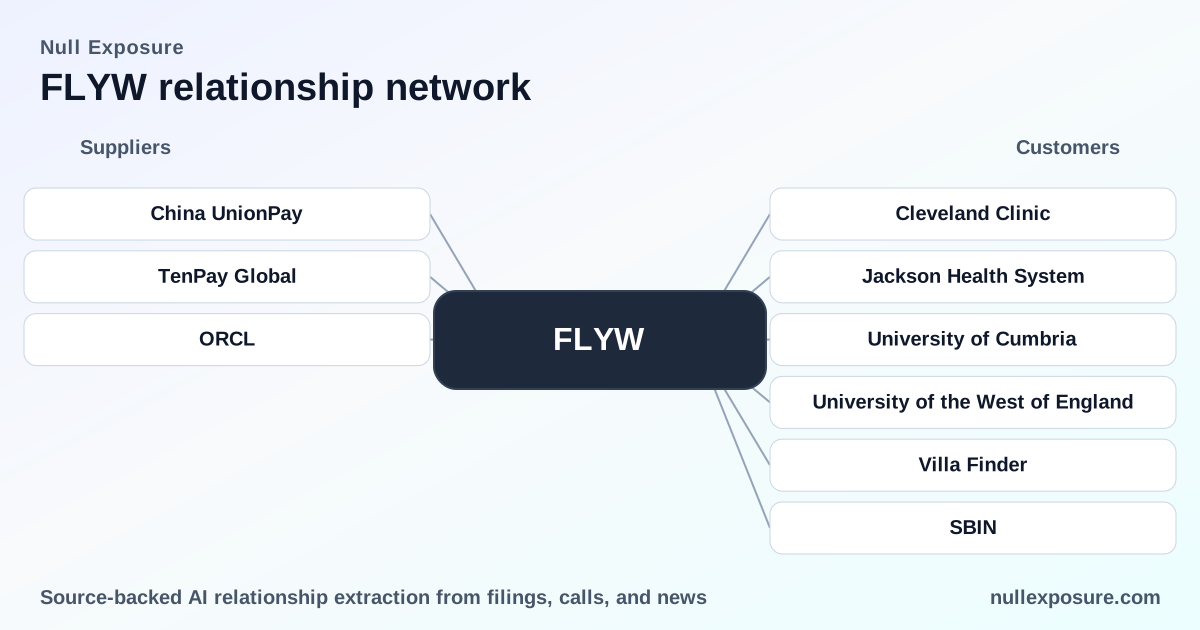
The following list covers every customer relationship disclosed in the source material and summarizes what each win means for Flywire’s business.
KnowBe4 — strategic B2B AR partnership (Apr 22, 2026)
KnowBe4 selected Flywire as its preferred partner for global accounts receivable and international payments, positioning Flywire to automate invoice‑to‑cash across KnowBe4’s multinational customer base. This deal strengthens Flywire’s B2B invoicing footprint and supports higher usage fees tied to cross‑border payments. (GlobeNewswire press release, Apr 22, 2026: https://www.globenewswire.com/news-release/2026/04/22/3279031/)
The Pennsylvania State University — enterprise education deployment (Apr 29, 2026)
Penn State selected Flywire to manage all tuition payments for more than 100,000 students, representing a material education vertical deployment that should drive both subscription/platform fees and recurring transaction volume. (GlobeNewswire press release, Apr 29, 2026: https://www.globenewswire.com/news-release/2026/04/29/3283799/)
Cleveland Clinic — phased healthcare rollout progressing (Q4 2025 commentary)
Flywire reported initial payment processing components are live at Cleveland Clinic with additional phases — including the full patient financial experience — scheduled for subsequent quarters, indicating multi‑phase enterprise implementations that expand platform penetration over time. (Q4 2025 earnings call transcript, Mar 9, 2026: https://www.insidermonkey.com/blog/flywire-corporation-nasdaqflyw-q4-2025-earnings-call-transcript-1703949/)
Jackson Health System — health system win (Q4 2025 commentary)
Flywire confirmed signing Jackson Health System during the quarter, a win that reinforces the company’s position across integrated regional health networks and should contribute recurring software and transaction revenue as deployment scales. (Q4 2025 earnings call transcript, Mar 9, 2026: https://www.insidermonkey.com/blog/flywire-corporation-nasdaqflyw-q4-2025-earnings-call-transcript-1703949/)
University of Cumbria — higher‑education full‑suite adoption (Q4 2025 commentary)
Flywire noted progress on “full platform penetration” with a full suite win at University of Cumbria, reflecting the company’s pull‑through strategy of selling the end‑to‑end payments and reconciliation product set to campus clients. (Q4 2025 earnings call transcript, Mar 9, 2026: https://www.insidermonkey.com/blog/flywire-corporation-nasdaqflyw-q4-2025-earnings-call-transcript-1703949/)
University of the West of England — expanded education footprint (Q4 2025 commentary)
Another full‑suite education win, the University of the West of England further validates Flywire’s ability to convert pilot relationships into comprehensive platform contracts that increase lifetime revenue per client. (Q4 2025 earnings call transcript, Mar 9, 2026: https://www.insidermonkey.com/blog/flywire-corporation-nasdaqflyw-q4-2025-earnings-call-transcript-1703949/)
Villa Finder — travel / marketplace integration (Q4 2025 commentary)
Villa Finder, a Asia‑focused villa rental platform serving an international customer base, selected Flywire to modernize global payment infrastructure and integrate payments into booking workflows, demonstrating Flywire’s applicability to travel and marketplace businesses that need multi‑currency settlement. (Q4 2025 earnings call transcript, Mar 9, 2026: https://www.insidermonkey.com/blog/flywire-corporation-nasdaqflyw-q4-2025-earnings-call-transcript-1703949/)
State Bank of India (SBI) — local acquiring and education payments in India (Mar 2026)
Flywire partnered with State Bank of India to enable Indian payers to pay international education fees in rupees, expanding Flywire’s local collection footprint in a high‑growth education remittance market and strengthening its APAC payment rails. (Financial IT, Mar 2026: https://financialit.net/news/payments/flywire-partners-state-bank-india-sbi-digitize-education-payments-india)
What these relationships collectively signal to investors
These customer announcements confirm Flywire’s dual revenue engine: enterprise platform sales that produce subscription and implementation revenue, and a payments network that scales transaction fees as clients move more volume through Flywire’s rails. Key observations:
- Large institution penetration: wins like Penn State and Cleveland Clinic demonstrate success in signing major, multi‑year customers that generate both recurring platform fees and consistent transaction flow.
- Sector diversification: education, healthcare, travel/marketplaces, and B2B SaaS (KnowBe4) broaden Flywire’s vertical exposure and reduce single‑vertical risk.
- Global payments expansion: the SBI partnership and emphasis on APAC/EMEA flow point to continued growth in cross‑border volumes, where Flywire captures higher fee margins.
Explore how these customer dynamics fit into broader portfolio analysis at Null Exposure: https://nullexposure.com/
Operating model constraints and why they matter for revenue quality
Flywire’s public disclosures and the aggregated evidence reveal several company‑level operational characteristics that underpin revenue predictability and risk profile:
- Contracting posture: Flywire typically signs multi‑year contracts with an initial three‑year term that are not terminable for convenience and auto‑renew for one‑year terms, which creates high revenue visibility and switching friction for large clients.
- Revenue mix: the company combines subscription and usage‑based fees, so revenue growth depends on both new client acquisition and increased payment volume from existing clients.
- Counterparty diversity: Flywire serves individual payers (students, patients) and large enterprises/health systems, which smooths revenue but requires different go‑to‑market and credit approaches.
- Global concentration: the business processes significant volume from APAC and EMEA while maintaining a global footprint across 240+ countries and 140+ currencies, meaning currency, regulatory, and local partnering strategies materially affect margins.
- Scale economics: Flywire processed nearly $30 billion in payments in 2024, indicating meaningful transaction scale that supports incremental margin as volume grows.
These attributes combine into a high‑visibility, recurring revenue model with exposure to macro cross‑border flows and client implementation risk. Use the above signals to model revenue stickiness, concentration, and sensitivity to international payments volumes.
Risk areas investors should watch
- Implementation and ramp risk: multi‑phase deployments at big customers (e.g., Cleveland Clinic) can temporarily depress margin while revenue recognition lags.
- Geographic regulatory exposure: heavy APAC/EMEA volume creates regulatory and FX risk that can compress net fees.
- Client concentration: large university or health system rollouts move meaningful volume; losing a single multi‑campus client would be financially consequential.
Bottom line for investors
Flywire’s recent customer disclosures demonstrate repeatable enterprise sales and payment‑volume monetization. The company’s contract structure and subscription/usage hybrid model deliver visibility and scalable margins as transaction volumes expand, but investors should model implementation timelines and regional regulatory exposures into near‑term growth assumptions. For a concise investor brief and tracking of ongoing Flywire customer developments, visit Null Exposure: https://nullexposure.com/